
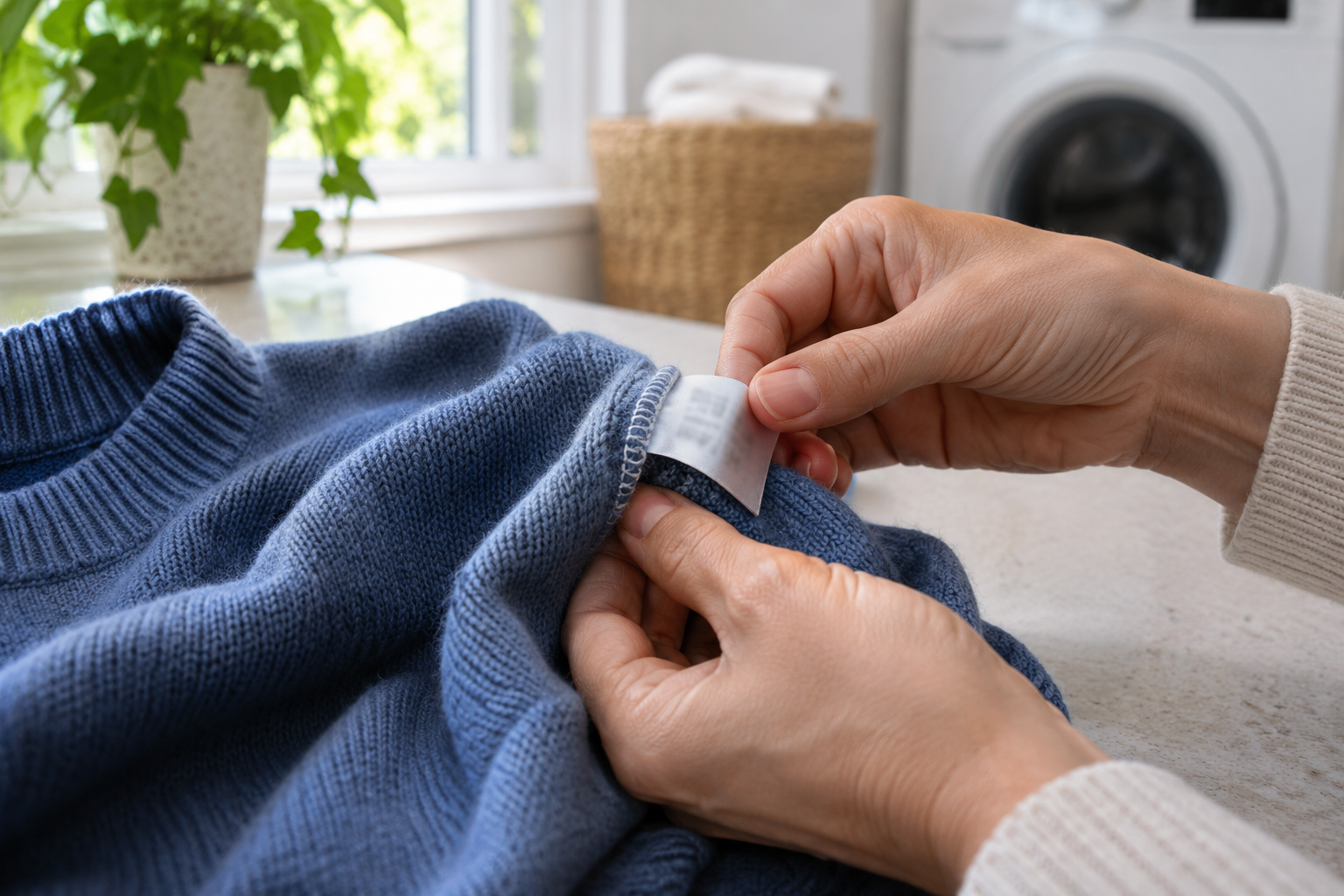
You notice a temperature on a jumper’s label, select the matching number on the washing machine, and feel ready to begin. The label may also limit the washing action, rule out tumble drying, or specify how the item should be finished.
Reading the full label first turns laundry into a sequence you can complete. The aim is to understand the garment’s instructions before the fabric is wet and the only available drying space is already occupied.
Look for instructions, not just fibre content
Find the care label and read any wording alongside the symbols. A separate label may describe the fibre composition, but “cotton” or “wool” does not provide the whole care instruction for a finished garment.
GINETEX groups its care symbols into washing, bleaching, drying, ironing, and professional textile care. Your label may use this system, words, or another regional format. Identify the actual instructions rather than forcing an unfamiliar mark into a meaning you remember approximately.
Lay the item in good light and turn the label fully out. A photograph can help enlarge small print for your own reference. Keep the original label attached so the instructions remain with the garment.
Read the washing process as well as the number
In the GINETEX system, a number inside the wash tub gives a maximum washing temperature. Bars beneath the tub indicate a milder process with reduced mechanical action. Matching the temperature alone may therefore miss an important limit.
Consult your machine’s manual to understand its programmes. A programme’s friendly name is not enough to establish that it matches every instruction on the garment. Check the relevant temperature and treatment settings before starting.
If the label says not to wash, do not assume a quick handwash is an acceptable substitute. Likewise, a handwash instruction needs to be understood on its own terms. Guessing that every gentler-looking action must be harmless can produce a result the label did not authorise.
Decide how the garment will dry before washing it
Drying instructions are a separate decision. Permission to machine wash does not automatically mean permission to tumble dry. Natural-drying instructions may also specify a method, such as drying flat, rather than merely avoiding the dryer.
Check the space and equipment you will need. If an item must lie flat, make a suitable clean space available before the wash begins. If the drying arrangement cannot be provided, postpone that item rather than improvising after it is wet.
This small planning step is especially useful in a shared home. Other people may assume the next stage is obvious and transfer a load into the dryer. Separate an item with different instructions and explain its drying plan clearly.
Do not treat finishing as an automatic final step
Read the ironing or professional-care instructions before attempting to remove creases or stains. A crossed-out treatment in the care-symbol system means it must not be used. Professional wet cleaning is also distinct from washing something at home.
When an instruction is unclear, ask the manufacturer or a suitable professional cleaner. Describe the garment and share the complete label, including any wording. A fragment showing only one symbol can remove the context needed for a useful answer.
Be particularly cautious about choosing a finishing method from the appearance of the fabric alone. The useful question is what the item’s label permits, not what usually works on another piece of clothing.
Turn the label into a short practical plan
For an unfamiliar garment, summarise the permitted process in your own words. An illustrative note might say: “Check the specified mild wash programme; keep out of the tumble dryer; prepare a flat drying space.” This is an example of a note, not an instruction for every jumper.
Include any step that another person might otherwise miss. Keep the note with your laundry arrangements and refer back to the original label whenever there is uncertainty.
Do not copy the plan from a similar-looking garment. Two blue jumpers can carry different instructions. Compare labels directly before treating them as suitable for the same load.
Pause when the information is missing
If a secondhand item has lost its care label or the marks have become unreadable, recognise that you have less information. Check the maker’s guidance where possible or obtain informed advice before using a treatment that would be difficult to reverse.
A complete laundry decision includes what happens after the wash. Taking a moment to read those later instructions can prevent the drying or finishing stage from undoing the care taken at the beginning.