
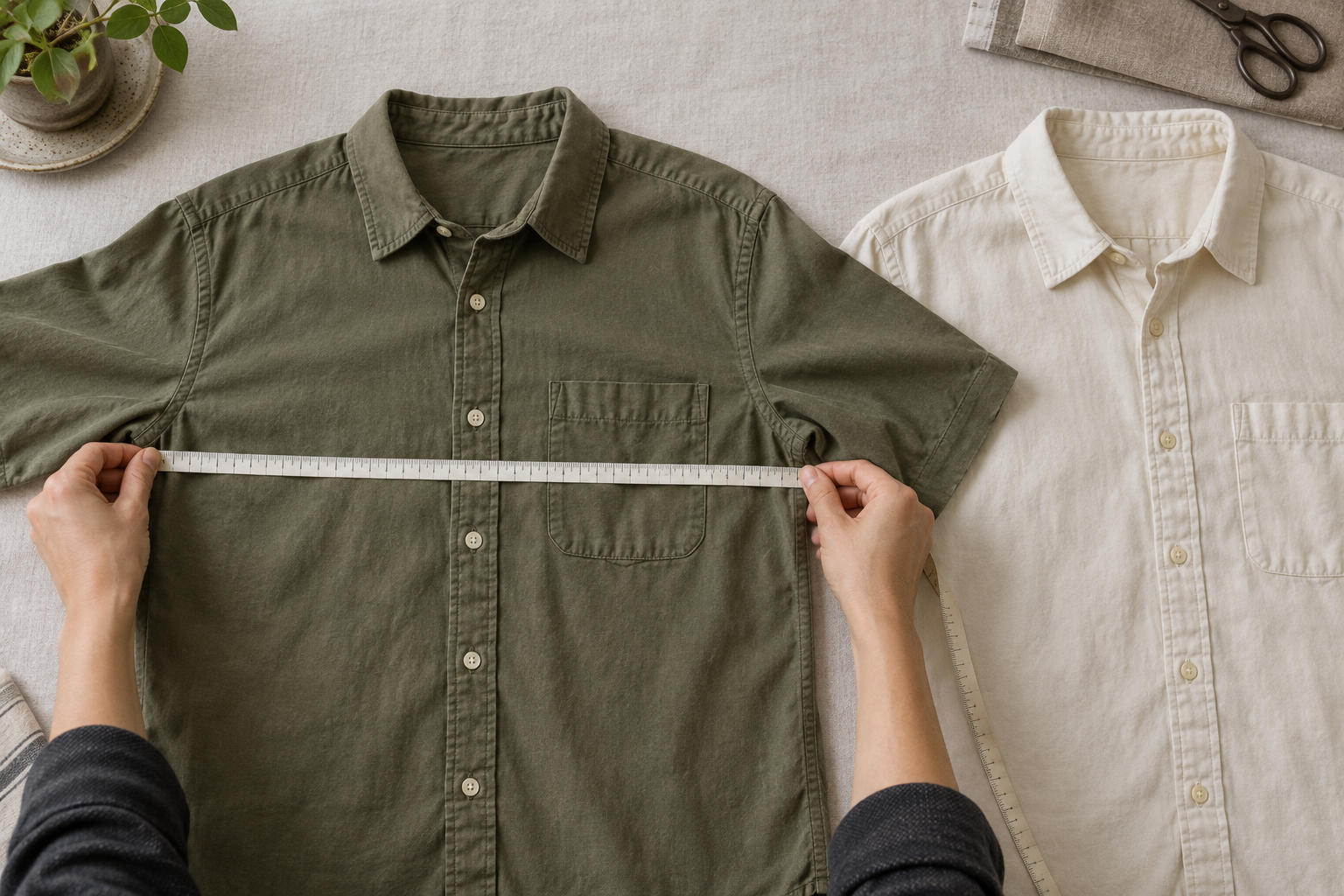
A secondhand listing says the shirt measures 52 centimeters across the chest. That number becomes useful when you know the same measurement on a shirt you enjoy wearing. A familiar garment gives you a practical reference for the space, length, and shape you want.
The reference needs to be chosen carefully. Comparing a stretchy T-shirt with a stiff woven shirt can produce reassuring numbers and an uncomfortable purchase. Start with similar clothing, then use measurements to identify questions rather than treating them as a guarantee.
Choose a reference for the same job
Pick an item that fits the way you want the proposed purchase to fit. For a jacket worn over a sweater, use a jacket that already accommodates that layer. For trousers you want to sit in all day, choose a pair that remains comfortable while seated.
Consider fabric and construction alongside the label size. A fitted knit, a loose woven top, and a structured blazer allow movement differently. Look for similar stretch, thickness, and silhouette. If the reference is only an approximate match, make a note of the difference before comparing numbers.
Measure the reference in its normal, clean condition, laid flat and smoothed gently. Fasten buttons or zips as they would be worn. Do not stretch the fabric or press a curved seam into an unnatural straight line just to make measuring easier.
Match the endpoints, not just the label
A measurement called “length” can start at the shoulder, the back neck seam, or the top of a waistband. Sleeve length may run from the shoulder seam or from the center of the back. Two honest measurements can differ because they describe different distances.
Read the listing’s method before measuring your own item. If the method is missing, ask where the tape starts and ends. A photograph with the tape in place is especially helpful for an unfamiliar cut. Make sure both measurements use the same units.
- For a woven shirt, compare underarm width, shoulder width, body length, and sleeve length where the construction allows a like-for-like comparison.
- For trousers, compare the relaxed flat waistband, front rise, inseam, and any thigh or hip measurement using matching positions.
- For a coat, include the room needed for layers and check whether the sleeve construction matches your reference.
For an inseam, follow the inside leg seam from the crotch join to the hem. A straight line taken beside a curved seam is a different measurement. Use the seller’s approach consistently, and ask for clarification when the photo and description disagree.
Keep flat widths separate from body measurements
A 40-centimeter flat waistband is not a 40-centimeter waist circumference. Doubling a simple flat width can offer a rough circumference comparison, but shaped waistbands, overlapping closures, elastic, and curved construction can complicate that shortcut.
The most useful first comparison is therefore garment to garment. Suppose your comfortable woven shirt measures 54 centimeters across the underarms, while the listing measures 52. The candidate is two centimeters narrower when flat. That difference deserves attention, especially if your reference already feels close through the chest.
Do not subtract your body measurement from a flat garment width. They describe different things. The extra room built into clothing is often called ease; the amount needed depends on the design, fabric, intended movement, and your preferred fit. There is no single allowance that solves every garment.
Ask about the fabric and its history
Measurements cannot show whether elastic has weakened, a knit has stretched at the elbows, or a lining restricts movement. Ask about fiber content, stretch, alterations, and visible wear where those details affect your decision.
A shortened hem may be acceptable, but letting it down later depends on the remaining allowance and the condition of the old fold. Do not assume an alteration can be reversed. If the seller mentions shrinkage, compare the garment’s present measurements rather than the size chart for a new version.
Keep requests concise. For example: “Could you confirm the width between the underarm seams with the shirt buttoned and unstretched, and show where the sleeve measurement begins?” That gives the seller a specific task instead of asking whether the item will fit a stranger.
Decide which uncertainties matter
Some differences are welcome. You may want a longer hem or a wider leg. Others affect a part of the garment you cannot easily change, such as a tight armhole or short rise. Decide which measurements are essential before the photograph or brand persuades you to ignore them.
Check the listing’s return terms and the platform’s applicable protections before committing. If an important measurement remains unclear and the purchase would be difficult to reverse, passing on the item is a reasonable outcome. Keep your reference measurements for the next listing; the comparison work is still useful.