
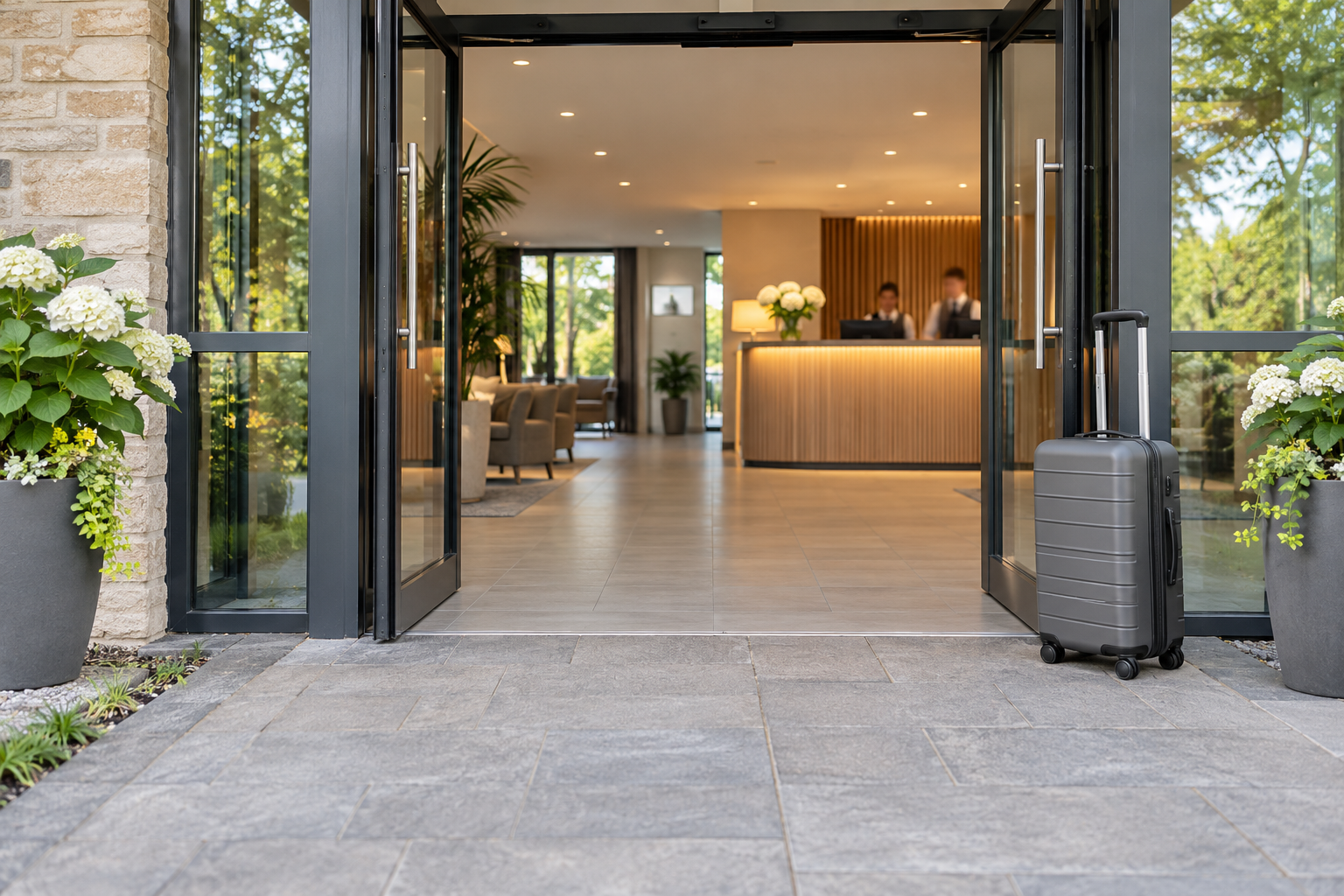
A hotel listing says there is a lift. That answers one useful question, but it does not establish whether you can get from the pavement to reception, enter the lift comfortably, or use the room reached at the other end.
For a stay that depends on step-free access, review the whole route before booking. The most useful information describes what the property has, leaving you to decide whether those features meet your own requirements.
Start where you will actually arrive
Identify your likely arrival point: a parking space, taxi drop-off, station approach, or pavement outside the building. Ask how that point connects to the usable entrance. A description beginning at reception may omit the difficult part.
Find out about surfaces, slopes, thresholds, and any alternative entrance. If the entrance shown in the booking photographs has steps, ask for photographs or a clear description of the other route. Establish whether it is available whenever you expect to arrive.
Where access depends on staff assistance or a portable ramp, ask how the arrangement works. You need to know whom to contact and what happens outside the usual reception hours. Avoid treating “someone can help” as a complete explanation.
Follow the route beyond reception
Ask whether the room can be reached without steps throughout the journey. Include corridors, changes of level, and doors between reception and the room. A lift may serve one wing while a connecting route still contains a staircase.
If lift size affects your decision, request the relevant measurements and compare them with what you need. Make sure units and measurement points are clear. A photograph can provide context but cannot reliably establish usable dimensions on its own.
Consider what happens if a facility is temporarily unavailable. Ask the property about its practical arrangements rather than assuming another route exists. The answer may affect the room or floor you are willing to reserve.
Ask about the room, not only its label
“Accessible room” can conceal details that matter to different guests. Describe the features you need: for example, space beside a bed, an appropriate bed height, or a bathroom arrangement you can use. You do not have to rely on a broad category to communicate those requirements.
Request information about the particular room type being offered. A photograph of one adapted room does not show that every room in the category has the same layout. If furniture position matters, ask whether the pictured arrangement is the one you should expect.
VisitEngland encourages detailed accessibility information, including measurements and photographs. Use that information to make your own assessment, and ask focused follow-up questions where the guide leaves uncertainty.
Include the facilities you expect to use
A room may work while the breakfast area, restaurant, or other essential facility is reached by a different route. Identify what you intend to use during the stay and check those connections too.
For a bathroom, ask about the relevant physical features rather than assuming a shower is step-free because it appears in the room description. If a particular aid or piece of equipment is essential, establish whether it is actually available and how it is reserved.
Keep the conversation specific and manageable. A short list of essential requirements is easier to answer accurately than a general request for assurance that everything will be fine.
Confirm what the reservation includes
Once the property has answered, check that the booking records the agreed room type and essential arrangements. Ask for written confirmation through the property’s normal booking channel and retain it with your travel details.
A statement that a feature exists somewhere in the hotel is different from confirmation that it will be available for your stay. Clarify that distinction before accepting a reservation you cannot easily change.
Read the applicable cancellation and change terms as well. If a necessary feature remains uncertain, resolve that question before committing. A suitable alternative property may be more practical than a booking dependent on several unconfirmed assumptions.
Reconfirm important arrangements before travelling
Contact the hotel if your arrival time changes or if you need to verify a previously agreed arrangement. Save the entrance instructions and a usable contact method where you can find them during the journey.
Ask how the property handles emergency evacuation for guests who need assistance, and discuss any relevant arrangements on arrival. Everyday step-free access does not, by itself, explain the emergency plan.
The useful outcome is a clear journey from arrival to the facilities you need. Checking that journey in advance makes the room description more meaningful than the presence of a lift alone.