
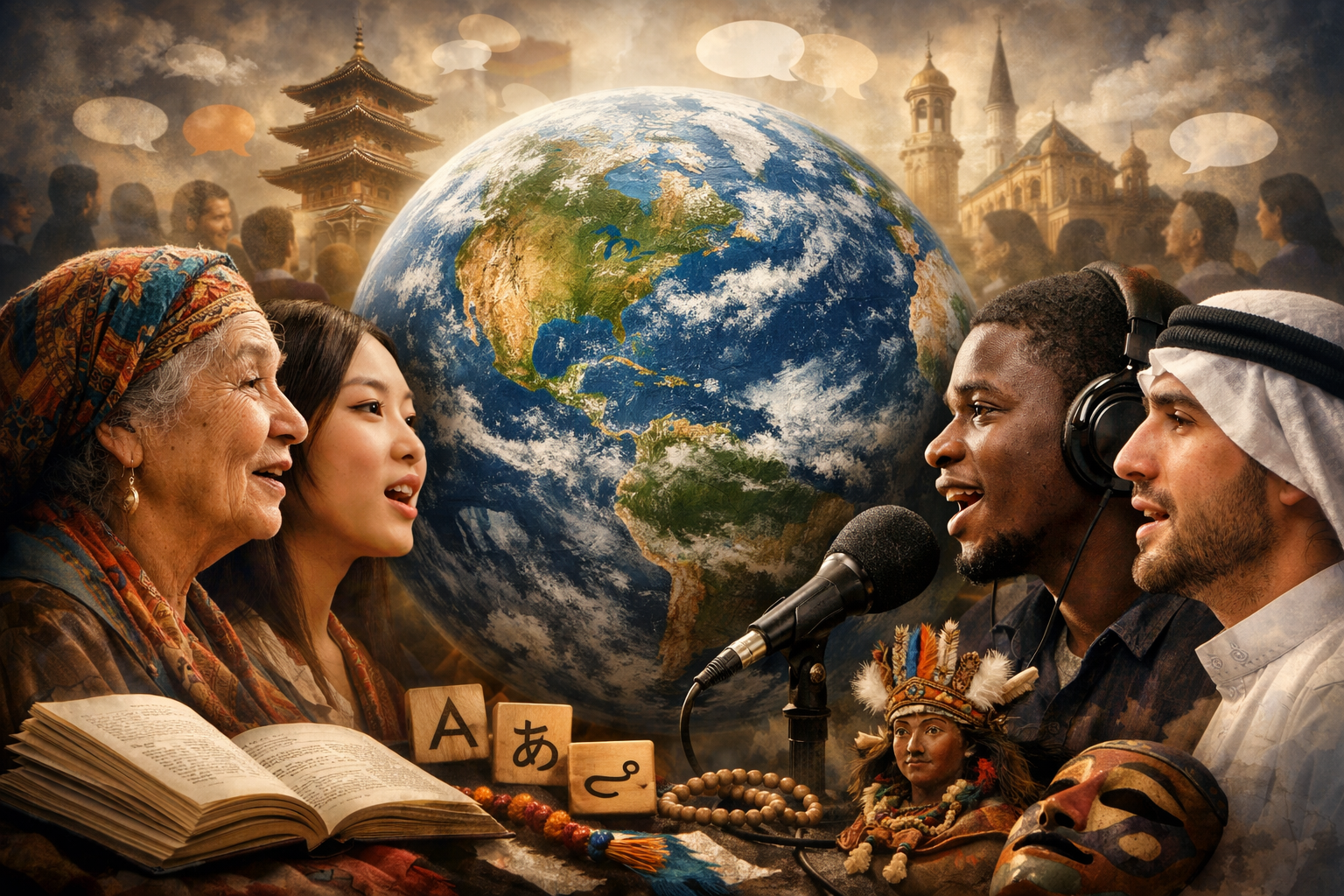
Introduction: More Than Words
Language is often described as a system of communication, but in social life it does far more than carry information. It signals where people come from, what communities they belong to, what histories they inherit, and how they see themselves in the world. From family expressions passed down across generations to national debates over official languages, language sits at the center of identity.
In every society, language operates on both a personal and collective level. It can create intimacy, preserve memory, express resistance, and establish social boundaries. At the same time, it can be shaped by migration, colonization, technology, education, and political power. To understand culture and society, it is essential to understand the deep relationship between language and identity.
Language as a Marker of Belonging
One of the most immediate ways language shapes identity is through belonging. The language or dialect a person speaks often connects them to a family, region, ethnic group, or nation. Accent, vocabulary, pronunciation, and even rhythm can reveal social background and cultural roots.
For many people, hearing their home language creates an instant sense of recognition and comfort. It carries emotional associations with childhood, rituals, food, songs, and community life. This is why language loss can feel deeply personal. When a language fades, speakers may feel that an essential part of their identity is disappearing with it.
Belonging through language is not limited to national or ethnic identity. Professional groups, religious communities, youth cultures, and online communities all develop their own linguistic styles. Shared slang, phrases, and references help members recognize one another and reinforce group identity.
The Emotional Power of Mother Tongues
A mother tongue often holds emotional meanings that are difficult to replicate in another language. People may be fluent in multiple languages, but they frequently describe one language as the truest medium for grief, affection, humor, or prayer. This emotional attachment shows that language is not only practical but also deeply tied to inner life.
Language, Power, and Social Status
Language is never neutral in society. Some languages and dialects are treated as prestigious, educated, or correct, while others are unfairly labeled broken, informal, or inferior. These judgments are rarely about linguistic quality alone; they reflect social power.
Standard languages are usually linked to institutions such as government, schools, courts, and media. As a result, people who speak the dominant language or accent may gain social advantages, while others may face exclusion or discrimination. A person’s accent can shape assumptions about intelligence, class, trustworthiness, or competence, even when those assumptions have no factual basis.
This creates a powerful connection between language and social identity. Many people learn to shift the way they speak depending on context, using one style at home and another at work or school. This practice, often called code-switching, can be a strategy for survival, acceptance, or mobility within unequal social systems.
- Language can open access to education and employment.
- Accent and dialect often influence first impressions.
- Official language policies can include or exclude communities.
- Code-switching helps many people navigate different social spaces.
Cultural Memory and Intergenerational Identity
Language is one of the primary ways culture is preserved and transmitted. Stories, proverbs, songs, ceremonies, and oral histories carry values that define a community across time. Through language, generations pass on not just information but ways of thinking, remembering, and interpreting the world.
In many Indigenous, minority, and diasporic communities, language preservation is closely tied to cultural survival. When younger generations stop learning an ancestral language, the loss can extend beyond vocabulary. Traditional ecological knowledge, spiritual concepts, kinship systems, and local histories may become harder to access.
Revitalization efforts therefore have social and symbolic importance. Community schools, language nests, digital archives, and cultural festivals help restore not only speech but also dignity and continuity. Reclaiming language can be a form of healing after generations of suppression or forced assimilation.
Migration and Hybrid Identities
Migration often transforms linguistic identity. Families moving across borders may speak one language at home and another in public life. Children of migrants may grow up translating for parents, blending vocabularies, or feeling caught between linguistic worlds. These experiences can create hybrid identities that are complex rather than divided.
Rather than seeing bilingualism or mixed speech as confusion, many scholars and communities view it as creativity and adaptation. New forms of expression emerge when languages meet, reflecting changing realities and layered identities in multicultural societies.
Language and the Politics of Recognition
Public recognition of language is a major social issue. Decisions about which languages are taught in schools, used in government, or represented in media send strong messages about whose identities matter. Language policies can affirm diversity, but they can also erase it.
When minority languages are excluded from public life, speakers may feel pressure to abandon them in order to succeed. Over time, this can produce shame, silence, or fractured identity. By contrast, when institutions recognize multiple languages, they acknowledge the legitimacy of different cultural experiences.
This is why language rights are increasingly discussed as human rights. Access to justice, healthcare, education, and civic participation often depends on being able to understand and be understood. Recognition is not only symbolic; it affects everyday life.
Digital Culture and New Language Identities
In the digital age, language and identity are evolving in new ways. Social media allows people to maintain heritage languages across distance, form communities around shared speech, and revive local expressions in global spaces. At the same time, digital platforms accelerate the spread of dominant languages and standardized styles.
Online communication also encourages experimentation. Emojis, memes, abbreviations, and multilingual posts create new forms of identity performance. Young people in particular use language online to signal humor, politics, belonging, and generational perspective. Digital speech may seem casual, but it reveals how culture continues to reshape language in real time.
Conclusion: Identity Spoken Aloud
Language is one of the clearest ways human beings make identity visible. It reflects ancestry, emotion, memory, aspiration, and power. It can unite communities, preserve traditions, and give voice to experiences that might otherwise be ignored. It can also expose inequality, especially when certain ways of speaking are privileged over others.
Understanding the relationship between language and identity helps us see culture and society more clearly. It reminds us that every language variety carries meaning, history, and human dignity. In listening carefully to how people speak, we learn not only about words, but about the worlds those words sustain.