
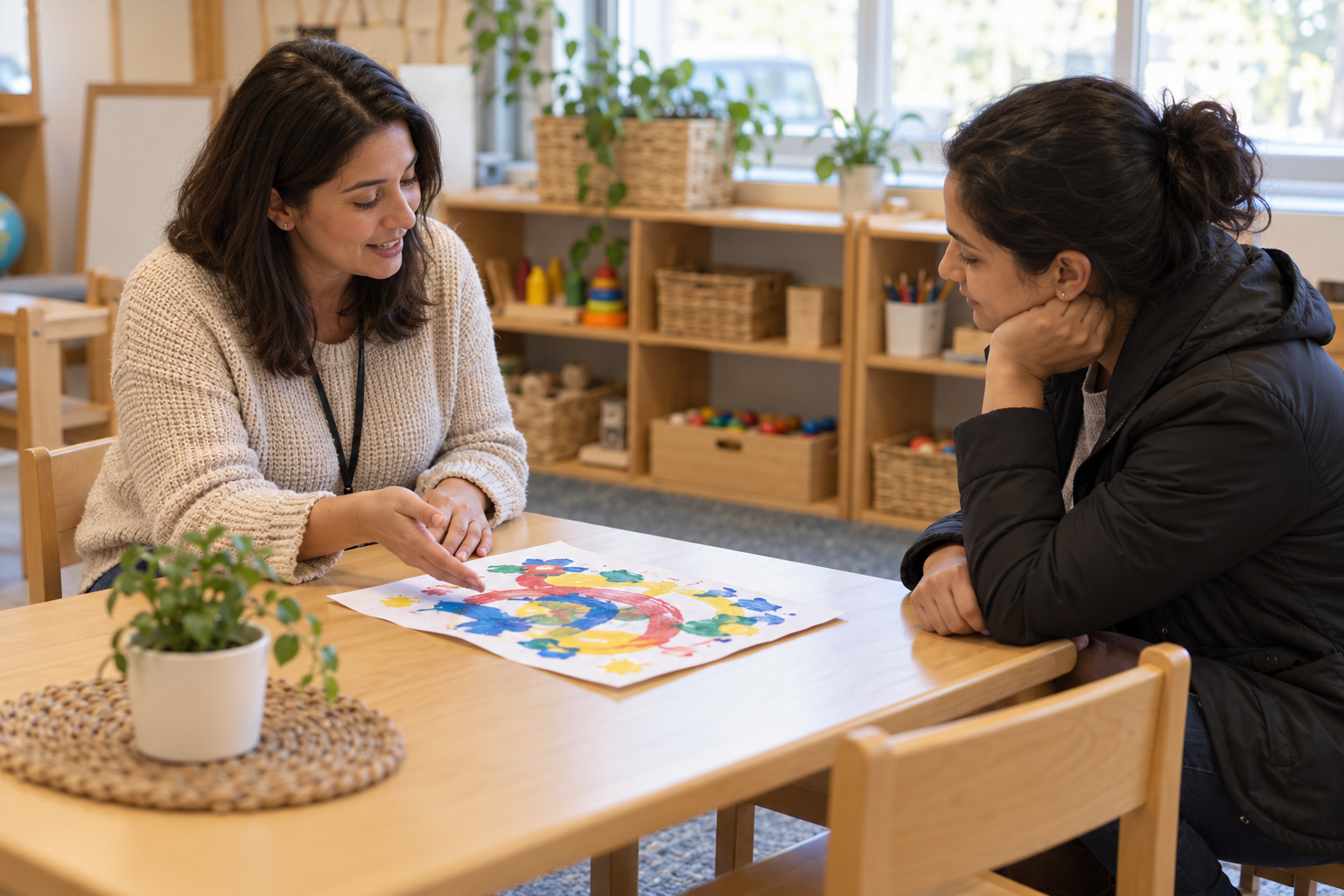
A parent-teacher meeting can leave you with plenty of information and very little idea what to do on Monday. You hear about effort, confidence, progress, and homework, then the next family arrives. The conversation feels important, but the next step stays vague.
A useful goal is to leave with one practical action that both adults understand. That does not mean ignoring everything else about your child. It means choosing a starting point small enough to try, observe, and discuss again.
Bring one example rather than a verdict
Before the meeting, identify the issue you most want help understanding. Describe something you have seen rather than attaching a label. “Starting homework takes a long time, even when the task is short” invites a different conversation from “My child has no motivation.”
Bring a relevant piece of work or a brief description of a recent evening. Include what happened before and afterwards. Was the instruction unclear? Did your child begin once you read it together? Did the difficulty appear only with one subject? You are offering information, not trying to establish a diagnosis.
Also note a strength or something your child enjoys. It can suggest an entry point for the plan. A child who likes explaining things aloud, for instance, might respond differently to preparation than one who prefers quiet reading.
Ask what the teacher sees
School and home are different settings. A task that goes smoothly in class may become difficult after a tiring journey home. A child who talks confidently with family may hesitate in a busy classroom. Treat those differences as clues worth exploring.
Ask the teacher for a specific example: “What does this look like during independent work?” or “Which part of the task usually needs help?” If a report mentions improvement, ask what changed. If it mentions concern, ask how often it appears and in which situations.
Listen for information you could not have observed yourself. The teacher may notice that your child understands a topic but misses the first instruction, or that group work changes how they participate. Make room for the teacher’s priorities too; your starting concern may not be the most useful place to begin.
Choose an action that fits ordinary life
Suppose, in a hypothetical meeting, both adults notice that a child loses track of multi-part homework instructions. “Work harder” gives nobody a clear task. A more practical trial might be to have the child explain the first step before starting, using the teacher’s usual instruction format.
The parent could provide a brief check at home, while the teacher checks whether the same difficulty occurs in class. Agree what support is reasonable. A plan requiring lengthy individual coaching every evening may fail simply because the family cannot sustain it.
Keep the action tied to the actual concern. Extra worksheets will not necessarily clarify instructions. Buying a planner will not necessarily help a child who does not understand how to use one. Ask why the proposed step should help before adding more work.
Make responsibilities visible
Write down who will do what. “We will support organisation” sounds collaborative, but it can conceal two completely different expectations. “The teacher will demonstrate the checklist; we will ask our child to use it when packing” is easier to carry out.
Check that your child has an appropriate role. Depending on their age, they might choose where the checklist goes or say which instruction is confusing. Present the plan as support, avoiding the feeling that adults have met privately to produce a list of faults.
If language, timing, or access makes the meeting difficult, ask the school about available arrangements. Clear communication depends on everyone being able to take part, including understanding the agreed action afterwards.
Decide what a follow-up will examine
Set a realistic review point with the teacher. The right interval depends on the issue and school arrangements; a routine trial and a serious concern need different responses. Agree the communication channel as well, rather than assuming a teacher can answer messages immediately.
Choose an observable question for that review. Did starting the task become easier? Was the checklist used without repeated reminders? Did the teacher see the same obstacle? These observations can guide the next conversation even when a grade has not changed.
Keep any message concise and private. Share relevant details through the school’s agreed channel rather than a parent group chat. If the plan proves impractical, say which part failed and ask to adjust it.
A meeting does not have to resolve every question to be useful. One understood action and a clear opportunity to review it give the conversation somewhere to go.