
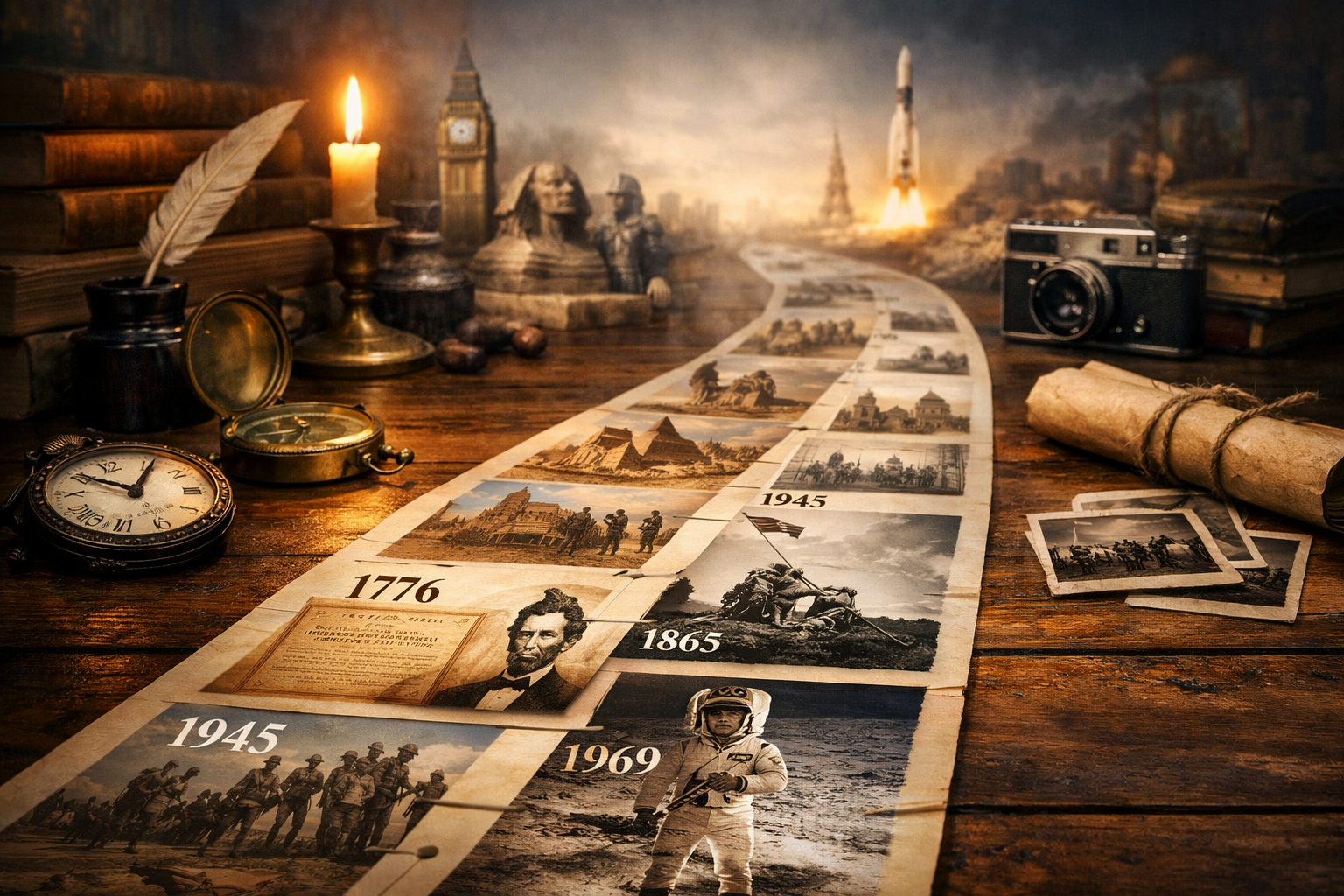
The Power of Timelines in History and Archives
History is not only a collection of past events; it is a way of understanding how people, places, institutions, and ideas changed over time. Archives preserve the evidence of that change in the form of letters, photographs, maps, registers, newspapers, government files, oral histories, and digital records. Yet archives, by themselves, can feel overwhelming. Thousands of records may exist for one subject, spread across decades or even centuries. Timelines help transform that mass of information into a readable structure.
A timeline is one of the simplest and most effective tools for organizing historical knowledge. It places events, documents, and developments in chronological order, allowing researchers and readers to see sequence, duration, cause, and consequence. In the context of history and archives, timelines do more than list dates. They create pathways through collections, reveal relationships between records, and make the past easier to interpret.
Why Chronology Matters
Chronology is fundamental to historical thinking. Knowing that one event happened before another can change how we interpret both. A policy document created before a war, for example, carries a different meaning than a similar document produced after the conflict. A personal diary written during a famine offers a more immediate perspective than a memoir written decades later. Timelines support this kind of interpretation by preserving order and context.
For archives, chronology is equally important. Archivists often arrange records according to provenance and original order, but users still need ways to understand when materials were created and how they relate to broader events. A timeline can connect a box of local council minutes to a national reform movement, or place a family photo album within the years of migration, industrial growth, or social upheaval. This chronological framework helps users move from isolated records to meaningful stories.
How Archives Feed Historical Timelines
Every archival collection contains potential timeline material. Official documents may mark legislation, elections, court rulings, or administrative changes. Personal papers may reveal births, deaths, moves, relationships, and moments of crisis. Institutional archives can trace the founding of organizations, expansions of facilities, leadership transitions, and public responses. When combined, these records make timelines richer and more reliable.
Importantly, archives also show that history rarely unfolds in a neat, linear way. Gaps in records, conflicting dates, and multiple perspectives remind us that timelines are interpretations built from evidence, not perfect replicas of the past. A well-designed historical timeline should therefore point back to sources whenever possible. This strengthens trust and invites deeper research.
Common Sources Used to Build Timelines
-
Government records such as censuses, legislation, tax rolls, and administrative files
-
Newspapers and periodicals that provide dates, reactions, and public context
-
Letters, diaries, and memoirs that add personal voices and lived experience
-
Photographs, maps, and architectural plans that document visual change over time
-
Church, school, and hospital records that track communities and institutions
-
Digital archives, websites, and born-digital files that document recent history
Types of Timelines in Historical Research
Not all timelines serve the same purpose. Some are broad overviews designed for public education, while others are highly specialized research tools. A museum might create a concise timeline of a city’s development for visitors. An academic historian might build a detailed chronology from court records to study labor unrest in a single decade. A family historian may use a timeline to track ancestors across addresses, occupations, and migration routes.
There are also comparative timelines, which place two or more developments side by side. For example, a timeline of civil rights legislation can be compared with a timeline of grassroots protest movements. This reveals how formal policy and social action influenced each other. In archives, comparative timelines are especially useful because they connect records from different collections, helping users see how local and global histories intersect.
Digital Timelines and Public Access
The digital age has expanded what timelines can do. Interactive timelines now allow users to click on dates, view scans of original documents, listen to oral history clips, or explore maps layered with chronology. This makes archival collections more accessible to students, researchers, and the general public. Instead of reading a long catalog description, users can move through time and discover records in a more intuitive way.
Digital timelines are particularly valuable for institutions seeking to widen access. They can highlight underrepresented histories, connect dispersed collections, and bring attention to records that might otherwise remain hidden in finding aids. A timeline about immigration, for instance, can combine ship manifests, policy changes, neighborhood photographs, and personal testimony in a format that is both educational and engaging.
Challenges in Creating Accurate Timelines
Although timelines appear straightforward, creating them requires careful judgment. Dates may be uncertain, especially for older records. Different sources may disagree. Some events develop gradually rather than happening at one clear moment. Archivists and historians must decide whether to mark the beginning of a process, its most visible turning point, or its official conclusion.
There is also a risk of oversimplification. If a timeline includes only major political milestones, it may erase everyday life, minority experiences, or long-term social change. Good historical timelines balance major events with cultural, local, and personal developments. They also acknowledge uncertainty where evidence is incomplete. In this way, a timeline becomes not just a summary, but a transparent research tool.
Best Practices for History and Archive Timelines
-
Use reliable primary and secondary sources
-
Include source references or links to archival materials
-
Represent multiple perspectives where possible
-
Distinguish clearly between exact dates and approximate periods
-
Balance landmark events with social and cultural context
-
Design for clarity, readability, and public accessibility
Why Timelines Still Matter
In an age of information overload, timelines remain essential because they help people make sense of complexity. They show continuity and disruption, progress and setback, memory and evidence. For historians, they are analytical tools. For archivists, they are interpretive bridges between records and users. For the public, they offer a clear and compelling way to engage with the past.
Most importantly, timelines remind us that archives are not static warehouses of old papers. They are living resources that document movement through time. When archival evidence is arranged into timelines, the past becomes easier to follow and more meaningful to explore. Dates become stories, documents become voices, and history becomes a connected human experience rather than a disconnected list of facts.