
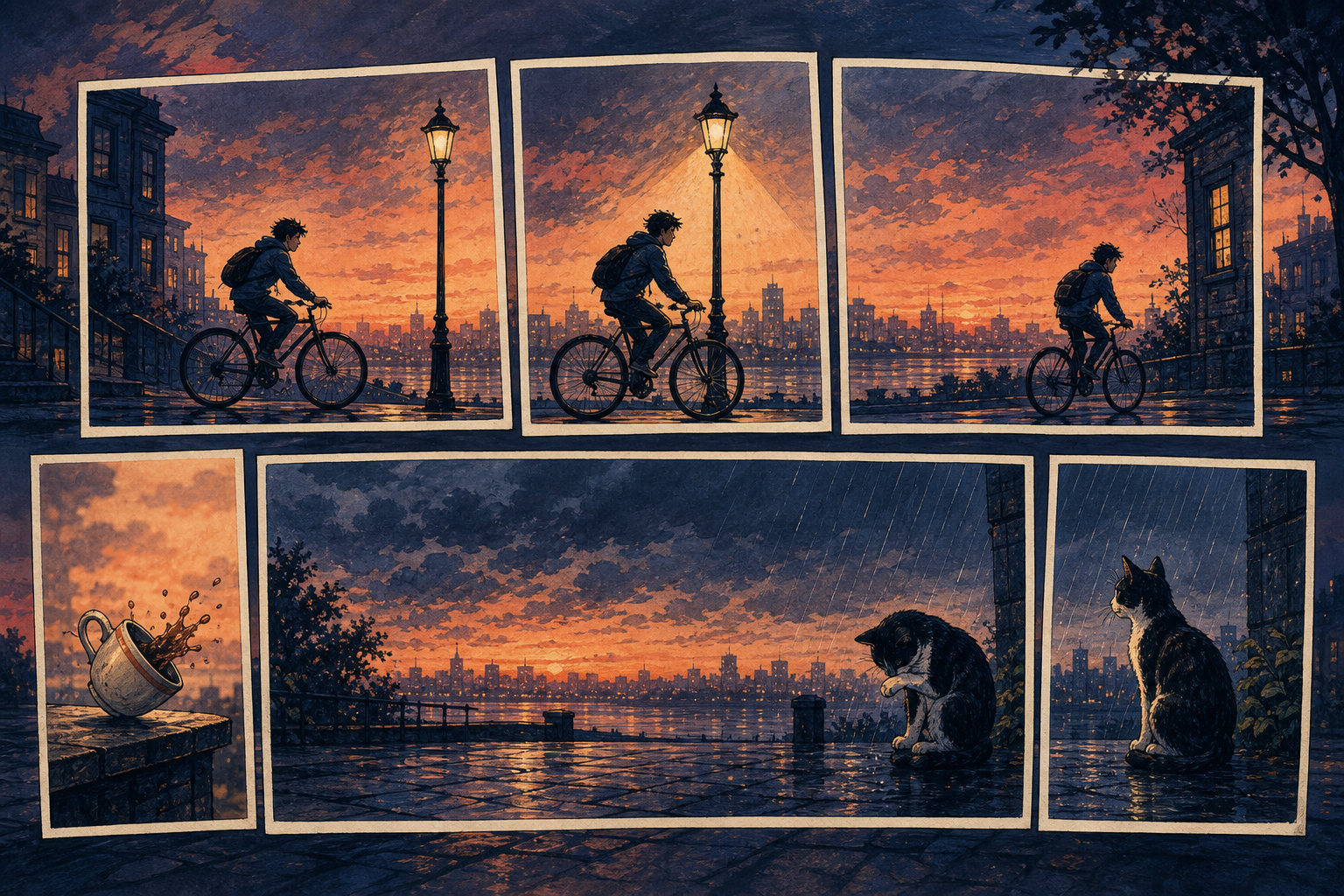
A comic can stop a door halfway closed and hold it there for as long as a reader chooses to look. It can cross an entire city between two neighboring images. It can repeat one nearly unchanged face until a hesitation feels unbearable, then leap past a year with a turn of the page. Nothing on the paper physically moves, yet time seems to accelerate, drag, fracture, and settle.
This apparent contradiction is central to comics. Film and audio normally arrive at a rate chosen by their makers. A comics page presents several moments at once while allowing the reader to decide how quickly to travel through them. The artist cannot assign every panel an exact duration, but can strongly influence the experience by shaping attention, expectation, and the amount of imaginative work between images.
The silent panel makes that influence easier to see. Remove dialogue, narration, and sound effects, and a panel does not become empty. Pose, distance, composition, repeated imagery, surrounding panels, and the space between them continue to suggest time. Silence can represent a fraction of a second, a long wait, an aftermath, or a moment that seems to exist outside ordinary sequence.
A panel is not a fixed unit of time
Readers often describe a panel as a moment, but moments vary. An image of a finger about to touch a switch may feel instantaneous. A wide landscape filled with small discoveries may invite a long pause. A crowded action panel may represent several overlapping movements even though the drawing is still. The border marks a unit of attention, not a universal second.
Duration is therefore relational. A panel feels long or short partly because of what surrounds it. One silent close-up after a page of rapid conversation can feel expansive. The same close-up inside a sequence of nearly identical faces may become one measured beat in a longer hesitation. Artists control time less like operators of a stopwatch and more like composers arranging contrast.
The reader completes the mechanism. They infer what changed, imagine motion through the gutter, decide when to inspect detail, and choose when to advance. Good timing gives that participation direction without eliminating freedom.
The gutter is an invisible event
The gutter is the interval between panels. Visually it may be a narrow strip of blank page, but narratively it can contain almost anything. A cup moves from table to lips. A suspect leaves the room. Rain stops. A child becomes an adult. Readers connect the images by proposing an event that makes both true.
The size of the printed gap does not determine the size of the imagined interval. Two adjacent close-ups can be separated by minutes if the context supports waiting. A dramatic location change can feel instantaneous when action carries across the cut. What matters is the relationship between the before-image and after-image.
This makes omission an active tool. Showing every step often slows a sequence mechanically while weakening its rhythm. Omitting the right step lets the reader supply motion. Omitting too much creates confusion. The artist’s task is to leave a gap large enough for participation but bounded enough for a confident inference.
Six controls shape the reader’s clock
No single technique owns comic timing. Artists combine several controls, and each can either reinforce or complicate the others.
- Panel count: The reader encounters more visual stops along an action. This commonly supports inspection, hesitation, procedure, or suspense.
- Panel size: The reader experiences a change in visual emphasis and available detail. This can create a held vista, decisive impact, or intimate pause.
- Repetition: The reader becomes aware of small change against stability. This commonly expresses waiting, discomfort, concentration, or ritual.
- Information density: The reader has more or fewer elements to inspect. This can separate a quick signal from a lingering environment.
- Viewing distance: The reader shifts among action, relationship, and context. Close fragments may accelerate perception, while broader space may decelerate it.
- Eye path: The reader follows a smoother or more interrupted route across the page. This can produce momentum, delay, surprise, or return.
These controls are tendencies, not mechanical equations. A larger panel may slow a reader because it contains detail, or speed them toward a bold focal point. Many small panels can prolong one action, yet a clean sequence of them can also produce rapid rhythm. Meaning emerges from the complete page.
Panel count can stretch one gesture
Imagine a character finding an unopened letter. One panel could show the discovery and the opened contents together, making the event feel efficient. Three panels could show the letter, the character’s hand hovering, and the untouched seal. The story has advanced less, but the reader has experienced more hesitation.
Additional panels create intermediate decisions. A glance shifts. Fingers tighten. Another person notices. The envelope remains closed. Each boundary asks the reader to stop and confirm what has changed. When changes are small, attention moves from event to anticipation.
Too many divisions can drain force. If every movement receives equal treatment, nothing feels selected. Stretch the part where perception, emotion, or consequence changes—not every physical step required to complete the action.
Repetition lets tiny differences become events
Repeated framing creates a stable baseline. When the chair, window, and character remain in the same position across several panels, a lowered gaze or newly empty cup becomes significant. The reader compares rather than merely observes. That comparison consumes time and can make silence feel inhabited.
Repetition works especially well for waiting because external action may be minimal while internal pressure grows. A departure board need not be readable. Changing light, thinning crowds, accumulated cups, or altered posture can show duration through visible consequence.
Exact duplication may communicate numbness, stillness, or a deliberate freeze. Slight variation often feels more organic because it rewards inspection. The artist decides whether the reader should notice time passing, struggle to notice it, or feel that time has stopped changing anything.
Detail can invite a linger without issuing an order
A panel rich in spatial clues, objects, gestures, and background activity offers several routes for the eye. Readers may pause to understand relationships before moving on. A sparse panel with one strong shape can register almost instantly. This difference influences pacing even when the depicted events occupy similar fictional time.
Detail must serve the beat. Filling a grieving character’s room with random decoration may distract from the emotional center. Carefully selected details—a second untouched mug, a coat still hanging, dust around a moved frame—can extend the pause because each one deepens the same realization.
Silence makes hierarchy particularly important. Without a speech balloon to anchor attention, value contrast, gesture, gaze, and spatial arrangement must tell the reader where to begin. A panel that is merely vague does not necessarily feel slow; it may simply feel unreadable.
Composition determines whether time flows or catches
Diagonal movement, repeated direction, and aligned figures can carry the eye smoothly from one panel to the next. A strong visual barrier, backward gaze, or focal point near the previous panel can make the eye hesitate. Page design turns reading into a physical route.
A character looking toward the next panel can pull the reader forward. A character staring back into the space already read can create resistance or memory. A shape repeated across the gutter can connect two moments; a sharp change in scale can make the transition feel like an interruption.
Reading direction varies with format and tradition, so directional assumptions should be designed for the intended edition. The broader principle remains: placement creates invitations. Timing changes when the reader accepts, resists, or has to reconsider those invitations.
Four different silences
The withheld response
One character asks a consequential question. The next panel shows the listener but no answer. Time expands around uncertainty. The panel works because the missing speech is expected; silence becomes an event with social weight.
The observational pause
The story temporarily stops pursuing a goal and attends to a place: insects around a lamp, condensation on a glass, people leaving a station, or light crossing a floor. This silence can restore scale, establish mood, or let consequences settle without explaining them.
The aftermath
An action occurs, then the page shows what remains: a swinging gate, scattered objects, an empty chair, or characters holding their positions. The event is over, but its meaning is still arriving. Aftermath panels often feel longer because readers mentally return to the cause.
The suspended instant
A panel isolates the fraction before contact, recognition, or decision. It may occupy almost no story time while receiving enormous reading time. This is not ordinary slowness. It is magnification: a narrow instant widened by attention.
Page turns can hide time until revelation
A page presents simultaneous peripheral information. Even when readers follow the intended sequence, later panels may remain partly visible. A page turn removes that preview. It can conceal an elapsed interval, a changed location, a consequence, or an image whose scale needs surprise.
The panel before the turn should create a useful question rather than merely stop. A hand reaches toward a latch. A character waits for an answer. A vehicle disappears into weather. The next page can answer immediately, refuse the expected answer, or reveal that much more time passed than the reader assumed.
Digital scrolling changes this tool because screens reveal information differently. The artist can still use spacing, panel height, and sequence, but should test the work in its actual reading format. Timing designed only on a large overview may feel entirely different when panels arrive through a narrow viewport.
Read a silent page with a timing pencil
Readers can study timing without measuring seconds. Choose a page and mark where the eye pauses, jumps, backtracks, or scans. For every gutter, describe the smallest event needed to connect the panels. Then describe the largest plausible interval. The distance between those answers shows how much time the sequence leaves open.
- Cover the words: Determine what timing survives through image and layout alone.
- Name each change: Identify what became different from one panel to the next.
- Find the longest look: Ask which panel invites inspection and what earns it.
- Trace the eye: Notice pulls, barriers, loops, and accidental distractions.
- Restore the words: See whether language supports, competes with, or overrides the visual rhythm.
This exercise does not produce one correct duration. It reveals the page’s timing arguments. Different readers may linger in different places, yet strong construction usually creates shared points of acceleration and emphasis.
Build the beat silently before adding language
A creator can thumbnail a scene without dialogue and label only its intended beats: arrival, recognition, resistance, choice, consequence. Give each beat the fewest panels that make the change legible. Then test where one extra silent panel would deepen anticipation or aftermath.
Next, vary one control at a time. Combine two panels and observe whether the action becomes abrupt. Repeat a frame and see whether tension grows or stalls. Widen the environmental panel. Remove background detail from the decisive close-up. This isolates the reason a sequence feels different.
Add words only after the silent route works. Dialogue can introduce its own rhythm through balloon size, placement, interruption, and response. It should not be forced to repair unclear staging. If the reader cannot tell who acts, where attention belongs, or what changed, more text may conceal the problem without solving it.
Silence still needs clarity and access
A silent sequence is not automatically universal. Gestures carry cultural context, facial expressions can be ambiguous, and small visual differences may be difficult to perceive. Essential story information should not depend on a tiny color shift or subtle background detail alone.
Use redundancy with restraint. Pose, composition, object state, and panel sequence can point toward the same change without explaining it twice. Strong value separation and readable silhouettes help the main action survive different print sizes and viewing conditions.
Silence should also have a narrative purpose. A beautiful panel that delays the reader without adding perception, mood, tension, or consequence is decoration acting as a brake. Ask what becomes possible because the panel is wordless. If the answer is nothing, the beat may need redesign rather than reverence.
The reader supplies the motion—and the clock
Comics do not overcome stillness. They use it. A panel preserves one arrangement while the gutter invites change, and the reader animates the relationship between them. Time is neither entirely printed nor entirely imagined; it is negotiated.
The silent panel makes that negotiation visible. Panel count creates stops. Repetition makes small changes matter. Detail invites inspection. Composition guides the eye. Gutters open intervals, and page turns conceal what comes next. None assigns a fixed duration, but together they shape a powerful sense of pace.
That is how comics control time without moving images: they arrange the conditions under which a reader chooses to move. A held look, an empty room, or a hand that has not yet opened a letter can last far beyond the event it depicts—and end at exactly the moment the reader decides to cross the border.