
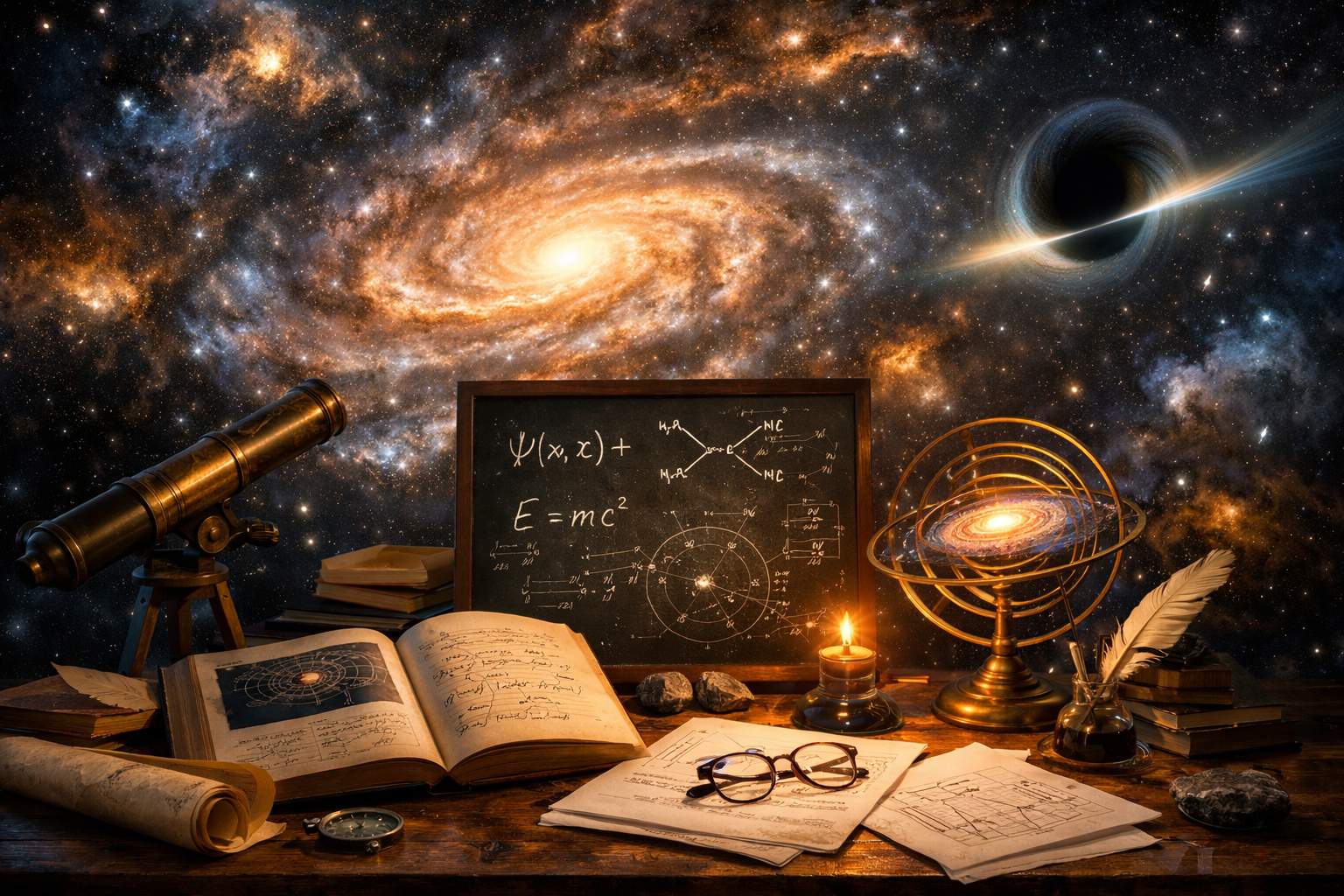
What Is Physics?
Physics is the branch of science devoted to understanding how the universe behaves. It studies matter, energy, space, time, and the interactions that connect them. At its core, physics asks some of the biggest questions humans can pose: Why do objects fall? How does light travel? What is the nature of time? What are stars made of? By seeking patterns in nature and expressing them through mathematics, physics turns observation into explanation.
Unlike many sciences that focus on specific systems such as living organisms or chemical reactions, physics often aims to uncover the most fundamental rules. These rules apply across scales, from subatomic particles to galaxies. Because of this broad reach, physics serves as a foundation for many other scientific fields, including chemistry, astronomy, engineering, and materials science.
The Main Branches of Physics
Classical Mechanics
Classical mechanics examines motion and the forces that cause it. Developed through the work of Galileo and Isaac Newton, this branch explains everyday phenomena such as a car accelerating, a ball being thrown, or a planet orbiting a star. Newton’s laws of motion and the law of gravitation remain some of the most influential ideas in science.
Although classical mechanics does not fully describe objects moving near the speed of light or on very tiny scales, it is still extremely useful. Engineers rely on it to design bridges, vehicles, machines, and countless other systems.
Thermodynamics
Thermodynamics explores heat, temperature, energy transfer, and the behavior of large collections of particles. It explains why heat flows from hot objects to cold ones and why no machine can be perfectly efficient. Concepts such as entropy, internal energy, and equilibrium are central to this field.
This branch of physics shaped the industrial world by improving engines, power generation, and refrigeration. It also plays a major role in chemistry, climate science, and even information theory.
Electromagnetism
Electromagnetism studies electric charges, magnetic fields, and light. James Clerk Maxwell unified electricity and magnetism into a single theory, showing that light is an electromagnetic wave. This insight transformed science and technology.
Modern electronics, telecommunications, radio, MRI machines, and power grids all depend on electromagnetic principles. The devices used in daily life, from smartphones to Wi-Fi routers, are practical expressions of physics in action.
Relativity
Albert Einstein’s theories of relativity changed how scientists understand space, time, and gravity. Special relativity showed that time and space are linked and that the speed of light is constant for all observers. General relativity went further by describing gravity not as a simple force, but as the curvature of spacetime caused by mass and energy.
Relativity is essential for understanding black holes, gravitational waves, and the evolution of the universe. It even has practical applications in GPS technology, which must account for relativistic effects to maintain accuracy.
Quantum Physics
Quantum physics investigates nature at the smallest scales, where particles behave in ways that can seem strange and counterintuitive. In the quantum world, energy comes in discrete amounts, particles can behave like waves, and probabilities replace absolute certainty. Electrons do not orbit atoms like tiny planets; instead, they exist in quantum states described by wave functions.
Quantum theory has enabled major technological advances, including semiconductors, lasers, and quantum computing research. It is one of the most successful scientific frameworks ever developed, even though it challenges common-sense ideas about reality.
Why Physics Matters
Physics matters because it reveals the hidden order of the universe and turns knowledge into practical power. It helps scientists predict natural events, design new technologies, and test the limits of human understanding. Nearly every major technological revolution has been influenced by physics, from electricity and aviation to nuclear energy and digital electronics.
Physics also trains the mind to think clearly. It encourages problem-solving, measurement, modeling, and logical reasoning. These skills are valuable not only in research but also in medicine, data science, finance, manufacturing, and computing.
Physics in Everyday Life
Although physics can seem abstract, it is present in ordinary experiences. When you hear music through headphones, cook food on a stove, use a touchscreen, or watch sunlight scatter through clouds, you are witnessing physical laws at work. Even the act of walking depends on forces, balance, friction, and energy transfer.
-
Gravity keeps people, oceans, and the atmosphere bound to Earth.
-
Electricity powers homes, transport systems, and digital devices.
-
Optics allows cameras, glasses, telescopes, and fiber-optic communication to function.
-
Quantum mechanics makes modern computer chips and LEDs possible.
-
Thermodynamics governs engines, heating systems, and biological energy use.
How Physicists Work
Physicists build knowledge through a combination of observation, experimentation, mathematics, and theory. A typical process begins with a question about how something behaves. Researchers then gather data, propose a model, test predictions, and refine their ideas based on evidence. Precision is crucial, because even small discrepancies can lead to new discoveries.
Some physicists work with giant instruments such as particle accelerators, radio telescopes, or gravitational wave detectors. Others focus on theoretical models, using mathematics and computation to explore phenomena that may be difficult to test directly. Both approaches are essential, and the strongest advances often emerge when theory and experiment support each other.
Big Questions Still Unanswered
Despite its success, physics is far from complete. Scientists still do not fully understand dark matter, dark energy, or how gravity fits with quantum theory. They are investigating whether there are undiscovered particles, hidden dimensions, or deeper laws beneath current models. The early universe, the interiors of black holes, and the true structure of spacetime remain active frontiers of research.
These open questions make physics one of the most exciting fields in science. Every answer tends to reveal new mysteries, pushing inquiry further rather than closing it down.
The Enduring Power of Physics
Physics is more than a collection of equations. It is a way of interpreting reality through evidence, patterns, and disciplined curiosity. It explains both the falling of an apple and the birth of stars, connecting the familiar with the cosmic. As tools improve and knowledge deepens, physics continues to reshape humanity’s view of the universe and our place within it.
In that sense, physics is not only a science of motion, matter, and energy. It is also a story of discovery, one that continues to unfold with every experiment, observation, and idea.