
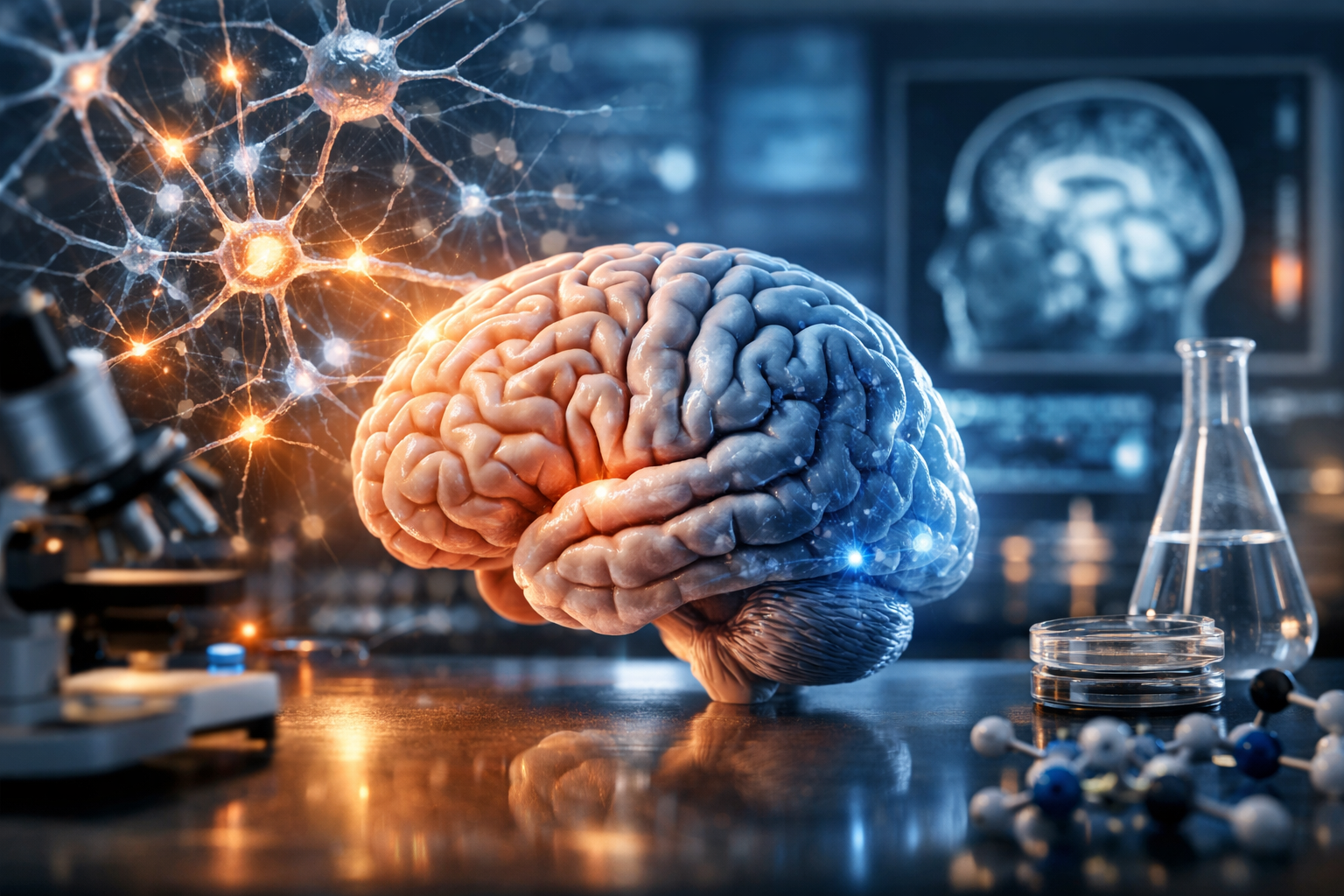
Understanding Neuroscience
Neuroscience is the scientific study of the nervous system, including the brain, spinal cord, and vast networks of nerves that connect the body. It sits at the crossroads of biology, psychology, chemistry, physics, and computer science because explaining the brain requires many perspectives at once. Researchers in this field seek to understand how electrical signals, chemical messengers, and physical structures work together to produce sensation, movement, language, decision-making, and consciousness itself.
The human brain contains roughly 86 billion neurons, along with a far greater number of supporting glial cells. Neurons communicate through specialized junctions called synapses, where chemical neurotransmitters or electrical signals pass information from one cell to another. From these interactions emerge every mental function, from recognizing a face to solving a mathematical problem. Neuroscience asks one of science’s most profound questions: how does biological tissue create the mind?
The Building Blocks of the Brain
Neurons and Synapses
Neurons are the fundamental signaling cells of the nervous system. A typical neuron receives input through branching dendrites, integrates those signals in the cell body, and sends an output along an axon. When a neuron reaches a threshold of activation, it fires an action potential, a rapid electrical impulse that travels to synapses. There, neurotransmitters such as glutamate, GABA, dopamine, and serotonin influence neighboring cells.
Synaptic communication is central to learning and adaptation. Connections between neurons are not fixed; they can strengthen or weaken over time in a process known as synaptic plasticity. This flexibility allows the brain to store experiences, adjust to changing environments, and recover partially from injury.
Glial Cells
For many years, glial cells were treated mainly as support tissue, but modern neuroscience has shown they play active and essential roles. Astrocytes help regulate the chemical environment around neurons, oligodendrocytes form myelin to speed electrical conduction, and microglia serve as immune defenders in the brain. Glia contribute to development, repair, and even the fine-tuning of neural communication.
Major Brain Regions and Their Roles
The brain is not a single uniform organ. Different regions specialize in particular functions while remaining deeply interconnected.
- Cerebral cortex: The outer layer of the brain involved in perception, language, planning, reasoning, and voluntary action.
- Frontal lobe: Important for decision-making, impulse control, problem-solving, and aspects of personality.
- Parietal lobe: Processes touch, spatial awareness, and sensory integration.
- Temporal lobe: Supports hearing, language comprehension, and memory formation.
- Occipital lobe: Primarily dedicated to visual processing.
- Hippocampus: Essential for forming new memories and navigating space.
- Amygdala: Plays a major role in emotional learning, especially fear and threat detection.
- Cerebellum: Coordinates movement, balance, timing, and may also contribute to cognition.
- Brainstem: Controls vital automatic functions such as breathing, heart rate, and arousal.
Although these divisions are useful, behavior rarely depends on one isolated area. Even simple tasks rely on distributed neural circuits that coordinate information across multiple brain systems.
How Neuroscientists Study the Brain
Because the brain is extraordinarily complex, neuroscientists use a wide range of methods to study it. Brain imaging techniques such as functional magnetic resonance imaging (fMRI) help identify regions active during specific tasks by measuring changes in blood flow. Electroencephalography (EEG) records electrical activity from the scalp and is especially useful for tracking brain activity over milliseconds. Positron emission tomography (PET) can reveal metabolic activity or the distribution of specific molecules in the brain.
At smaller scales, researchers use microscopy, electrophysiology, and molecular biology to study single cells and synapses. In animal models, techniques such as optogenetics allow scientists to activate or silence specific neurons with light, offering powerful insights into how circuits guide behavior. Computational neuroscience adds another layer by using mathematical models and artificial intelligence tools to simulate brain function and analyze massive datasets.
Memory, Learning, and Plasticity
One of the most exciting findings in neuroscience is that the brain remains adaptable throughout life. Neuroplasticity refers to the brain’s capacity to change its structure and function in response to experience, practice, stress, or injury. When people learn a new language, practice an instrument, or recover after a stroke, neural networks are being reorganized.
Memory involves multiple systems rather than a single storage location. Short-term and working memory allow temporary information holding, while long-term memory includes facts, personal experiences, and skills. The hippocampus is especially important for converting experiences into lasting memories, while other cortical areas help store and retrieve those memories over time. Repetition, sleep, and emotional relevance all influence how strongly memories are encoded.
Neuroscience and Mental Health
Neuroscience has transformed the understanding of mental and neurological disorders. Conditions such as Alzheimer’s disease, Parkinson’s disease, epilepsy, depression, schizophrenia, autism spectrum disorder, and anxiety disorders all involve changes in brain function or structure, though often in highly complex ways. Rather than viewing these disorders only through behavior, neuroscience investigates the underlying circuits, neurotransmitters, genes, and developmental processes involved.
This work has led to better diagnostics and treatments, from deep brain stimulation for movement disorders to targeted medications that influence neural signaling. It has also highlighted the importance of prevention and brain health across the lifespan. Sleep, exercise, nutrition, social connection, and stress management all affect neural resilience.
The Future of Brain Science
Neuroscience is advancing rapidly, especially through collaboration with genetics, engineering, and artificial intelligence. Scientists are mapping brain connectivity in increasing detail, developing brain-computer interfaces that may help restore movement or communication, and exploring how neural activity gives rise to subjective experience. Researchers are also confronting ethical questions about cognitive enhancement, mental privacy, and the responsible use of neurotechnology.
Despite remarkable progress, the brain remains one of nature’s greatest mysteries. Each discovery reveals not only how much has been learned, but also how much remains unknown. Neuroscience matters because it helps explain who we are: how we remember the past, respond to the present, and imagine the future. By studying the brain, science gains insight into the biological foundations of thought, emotion, identity, and human potential.