
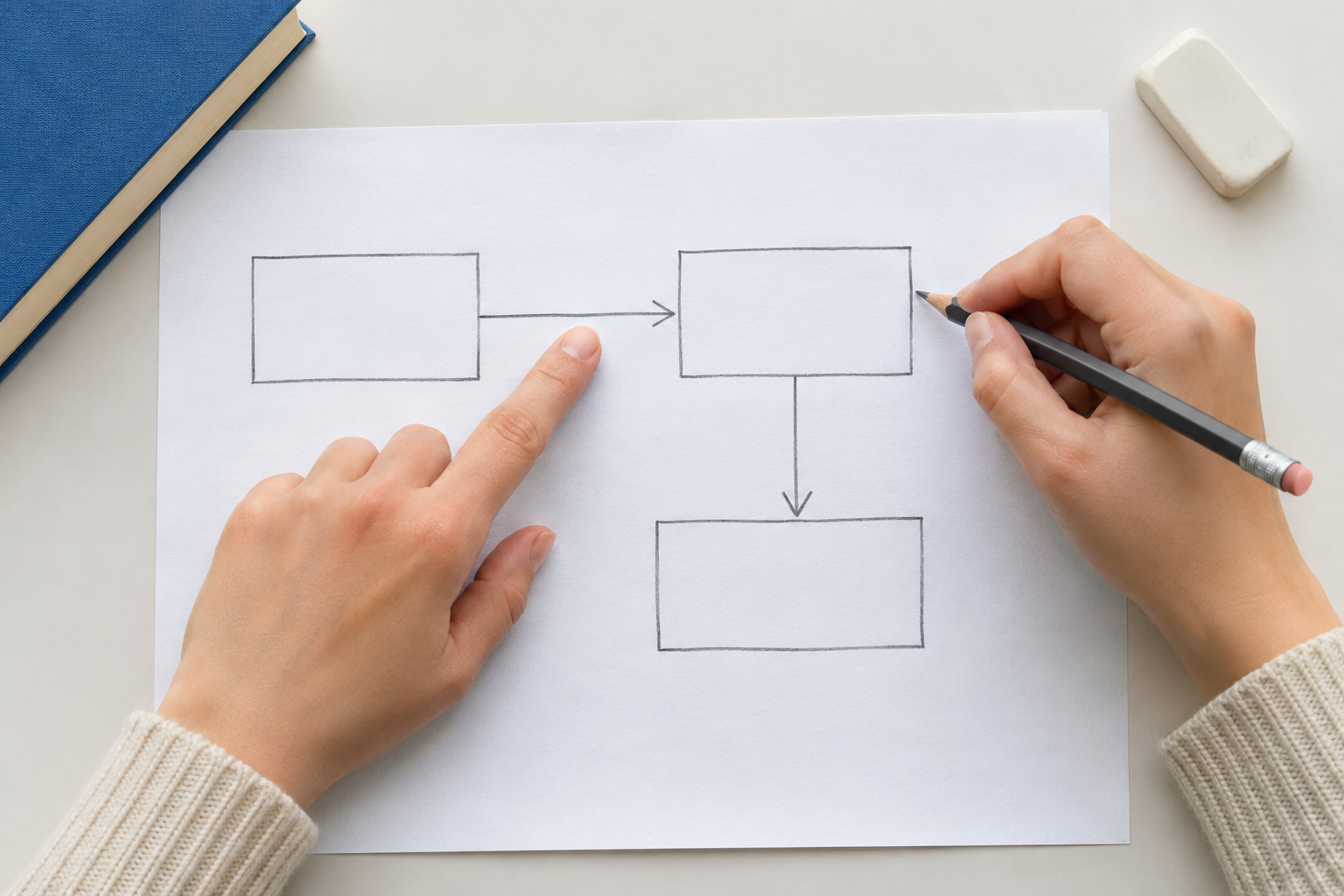
You recognise every label in a diagram, but cannot explain why one arrow points toward a box and another points away. That is a useful sign that the connections need study time of their own.
A diagram’s labels name things. Its lines, arrows, shapes, and layout describe relationships between them. A useful study guide records those relationships in words so you can explain what the picture is claiming, rather than only identify what appears in it.
Read the visual instructions first
Look for a title, caption, key, and accompanying explanation. These establish what kind of picture you are reading. A flowchart can show a sequence of actions; another diagram may show movement, influence, classification, or the parts of a structure.
Do not assume that an arrow always means causes. It may mean moves to, is followed by, sends information to, or something else defined by the source. Similarly, a dashed line is not automatically optional or uncertain. Its meaning belongs to that diagram’s conventions.
Add a small note explaining the conventions that matter. If the material does not define an important symbol, mark it as a question to resolve with the text or teacher. Guessing a meaning can make every later explanation consistently wrong.
Where arrows go both ways, write separate statements for each direction. A double-headed line may encode exchange or another relationship; its meaning still needs the legend.
Turn each connection into a sentence
Choose one arrow. Name its starting point, its endpoint, and what moves or happens between them. Write a sentence that is more informative than saying that one box connects to another.
In a water-cycle diagram, an arrow may represent a movement of water between stores. Its label helps identify the process. The lake and atmosphere are not simply adjacent terms to memorise; the connecting process is part of what the diagram explains.
Check the direction deliberately. Cover the arrowhead and ask which way the relationship should run, then uncover it. If the reason is unclear, return to the source explanation. Reversing a relationship can change the account even when both endpoint labels are correct.
Use a small set of prompts
- What does this connection represent?
- Why does it point in this direction?
- What condition makes this branch relevant?
- What information does the diagram leave unspecified?
These prompts are for investigating the picture, not replacing subject knowledge. A sentence should agree with the course material and use its technical terms where those terms are required.
Read branches without inventing a story
Consider a hypothetical order-processing diagram. A box for checking stock leads to two branches: available and unavailable. The branches represent different possible outcomes of a check, rather than two steps every order must complete in sequence.
Now imagine another arrow returning an order for correction. That loop needs an explanation of what triggers the return and what happens after correction. Merely copying its curved shape into your notes does not answer either question.
Numbers and line thickness require the same care. Unless the diagram says that width represents a quantity, a thick arrow may be only a design choice. A picture without a time scale does not establish that two steps take equally long.
Write down these limits when they could affect an answer. Distinguishing what is shown from what you inferred prevents a tidy diagram from becoming evidence for a claim it never made.
Notice the boundary around the picture
A diagram simplifies its subject. Ask what period, location, system, or level of detail it covers. A picture of a natural process may omit human influences; a more detailed version may include them. Neither should be read as a complete account without checking its stated scope.
Use your study notes to identify one important omission or assumption, where the course expects that understanding. Avoid filling the margins with every complication you can imagine. Select what changes how the diagram should be interpreted.
Finally, hide your written explanation of one connection and explain it aloud. Check the direction, mechanism, and condition against the source, then repair the note if needed. This is a small test of understanding, not an art exercise.
When you return to the topic, the useful question is whether you can explain the relationships the picture encodes. A few accurate sentences beside the arrows can make the diagram a more usable part of your guide.