
Imagine arriving at a familiar meeting place with a flat phone battery. Your partner has gone elsewhere, your child’s school has changed its pickup arrangements, and the only number you remember belongs to someone nearby who is also unreachable. A charged power bank helps with one problem. A shared contact plan helps with the others.
A useful paper plan is short enough to carry and clear enough to follow under stress. It records the information normally hidden inside contact lists and makes a few decisions before an emergency forces everyone to improvise separately.
Choose the person who connects the information
Ask a trusted person outside your immediate area to be a common contact. Local disruption may affect nearby household members at the same time, so someone farther away can provide another route for sharing updates. This improves your options; it does not guarantee that any particular call or message will connect.
Get that person’s agreement and explain the role. They should record who has checked in, where each person says they are, and any intended next contact. They should avoid guessing a missing person’s location or passing along an assumption as confirmed information.
Write down the contact’s name and complete phone number. Include any country or area code needed. Add a backup contact if the first person is unavailable, and agree on the order in which to try them.
Make location instructions precise and conditional
“Meet near home” leaves too much room for interpretation. Choose a specific nearby meeting point and another outside the neighborhood, with an address or an unmistakable description. Discuss the circumstances in which each would make sense.
Meeting points are options when they are safe and consistent with official instructions. They are not orders to cross a closed road, leave a safe shelter, or return to an evacuated area. Everyone should understand that emergency directions and immediate safety take priority over the household’s preferred location.
Check arrangements for places that control their own release procedures. Schools, care facilities, and workplaces may require authorized collection or direct people to designated sites. Record the relevant contact and process instead of assuming that a family plan overrides those arrangements.
Decide what a check-in should say
A brief, factual message is easier to use than a stream of incomplete updates. Agree on a simple pattern: who you are, whether you are safe, where you are, and when you expect to check in again if possible.
An invented practice message might read: “Maya: safe at the community library with Arun. Remaining here while we follow local instructions. Will try another update this afternoon.” In a real message, include the date or time when useful, especially if delivery may be delayed.
Text messages may get through when calls cannot. Keep them concise and avoid repeatedly calling everyone if the network is congested. A failed message is not evidence that someone has ignored you, and an old message may no longer describe their current situation.
Put the essential details on one card
- Household names and key phone numbers.
- The agreed out-of-area contact and backup.
- The two meeting locations and when they may be used.
- School, care, or workplace contact details that matter to your household.
- The local emergency number and the date the card was updated.
Keep each card readable. Large print, plain language, or translated versions may be more useful than squeezing everything into tiny type. For a child, include age-appropriate instructions about seeking help from trusted adults rather than expecting independent travel.
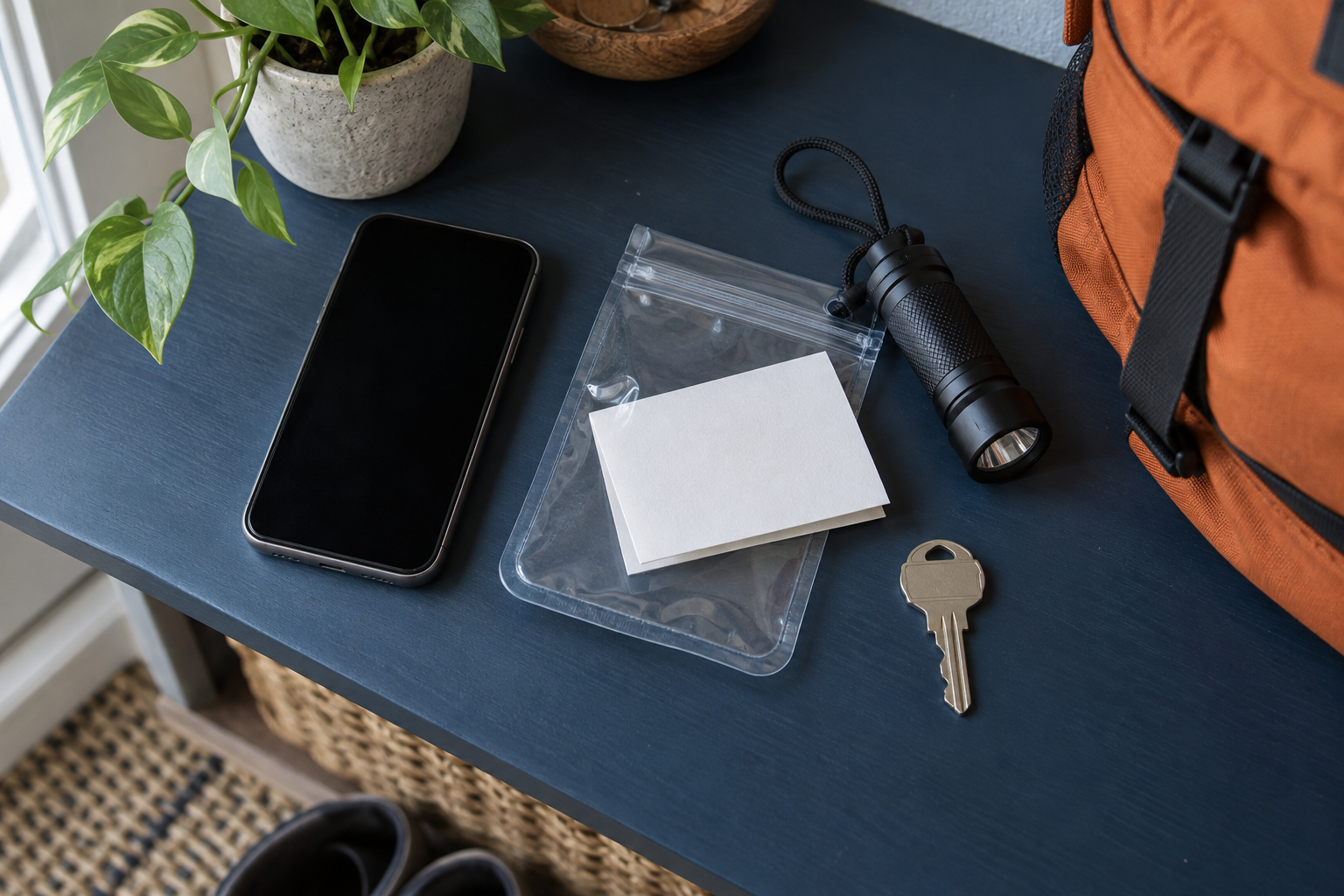
Carry a copy and place others in agreed locations, such as an emergency kit. Protect paper from water if practical. Keep detailed medical records and sensitive identity information separately and securely; the contact card should contain what is necessary for its purpose.
Run a calm, ten-minute rehearsal
Choose an ordinary evening and describe a fictional situation: the household is separated, one phone is unavailable, and the usual route home is closed. Ask each person to find their card and explain the next step. Do not actually contact emergency services during the exercise.
Notice where answers differ. Perhaps two people remember different entrances to the meeting place, or the backup contact has an outdated number. Correct the card and confirm that every copy contains the same information.
Repeat the review after a move, a new school, a changed number, or a change in care needs. A paper plan earns its value through accuracy and shared understanding. The goal is for everyone to know the same small set of actions, even when the device that normally remembers everything cannot help.