
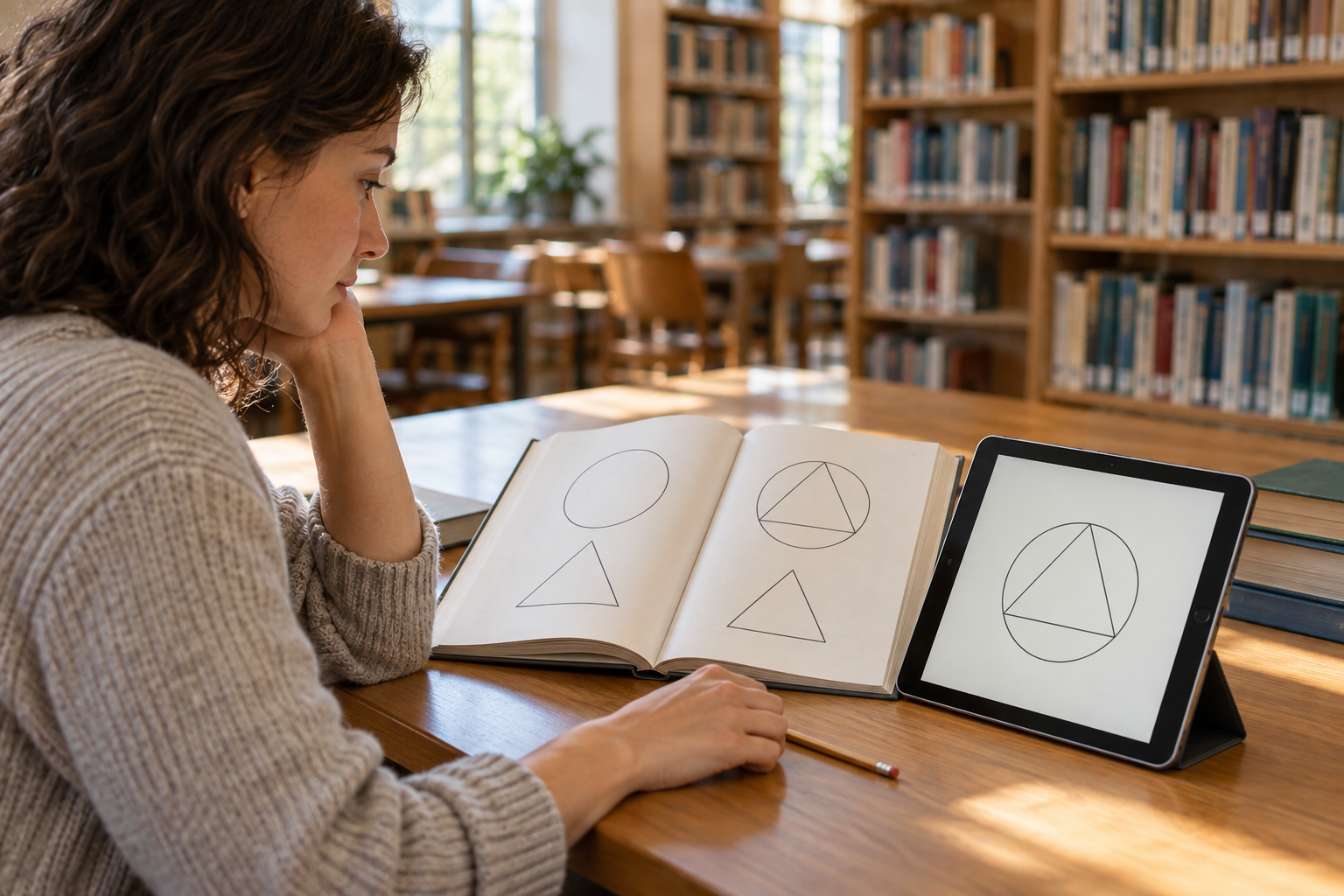
You find a free textbook with the right subject in its title. Before downloading it and rebuilding your study plan, open one chapter. Can you follow the explanation, attempt a problem, check your work, and return to the same section easily? That small trial often reveals more than an attractive cover or a long contents page.
An open textbook combines learning material with permissions that allow specified kinds of reuse. The exact license matters. So do ordinary textbook qualities: suitable depth, clear organization, accurate content, and enough support for the way you intend to learn.
Match the book to a specific learning task
Write down what the book needs to help you do. Preparing for a course examination, refreshing an old skill, and teaching a new class are different tasks. A broad introduction may be excellent while failing to cover a required method or topic in sufficient detail.
Compare the contents with your syllabus or a short list of target skills. Check prerequisites inside the chapters, not just on the description page. A book that introduces unfamiliar notation without explanation may assume background knowledge you still need to build.
Read the publication information and any revision notes. Currency matters differently by subject: a historical proof and an account of current regulation do not age in the same way. Look for corrections, named contributors, and a clear account of the book’s scope rather than assuming that a recent upload means recently reviewed content.
Record the exact edition
If an instructor has assigned a book, confirm its title, authors, and edition before substituting another version. Chapters may move, examples may change, and exercise numbers may no longer refer to the same questions.
For independent study, keep the edition details with your notes. A note that says “question 18 was difficult” becomes hard to interpret when the web edition changes or you later open a different PDF. Adding the chapter title and a few words describing the problem makes the note more durable.
If several formats are available, check that they represent the same version. The convenience of switching between browser and download disappears if their content or numbering differs in ways you have not noticed.
Inspect the practice and the available answers
Do not judge an exercise section by its length alone. Try a few questions from a topic you partly understand. Are they simple recall, worked calculations, extended applications, or a mixture? Look for enough progression to help you move from following an example to solving something independently.
Then find the answers you are actually allowed to access. Some open textbooks provide selected student solutions while reserving fuller instructor material. OpenStax, for example, explains that many exercise sets provide only selected answers and that instructor solutions are restricted.
A final number may help you detect a mistake without showing where it happened. For self-study, worked reasoning can be particularly useful. If that support is absent, decide how you will get feedback before relying on the book for a difficult new subject.
Try the format on your own device
Read several pages using the device and conditions you expect to use regularly. Increase the text size, follow the navigation, search for a term, and open a diagram. Check whether equations and tables remain understandable when enlarged.
If you use a screen reader or another assistive tool, test the actual file with it. A download button or a general accessibility statement cannot establish that every element works for your needs. Ask about alternative formats or known limitations where necessary.
Offline use deserves a separate check. Download the permitted file, disconnect from the internet, and open it again. Embedded videos, external activities, and linked answer material may still require a connection even when the main text is available locally.
Read the permissions before adapting or sharing
Free access and permission to reuse are different questions. Find the license attached to the specific edition and check whether individual images or extracts have separate notices. Keep that information with your copy.
Creative Commons licenses use conditions such as attribution, noncommercial use, and ShareAlike. Attribution requires appropriate credit. A noncommercial condition limits covered uses; ShareAlike generally requires shared adaptations to use the same or a compatible license. Read the full applicable terms for your intended use rather than relying on the letters alone.
Finally, make a short selection note: the edition, the topics it covers, the formats that work, the available feedback, and any reuse limits. Then study one complete section before gathering more books. A resource earns its place by helping you make progress through the material, not by adding another file to a crowded downloads folder.