
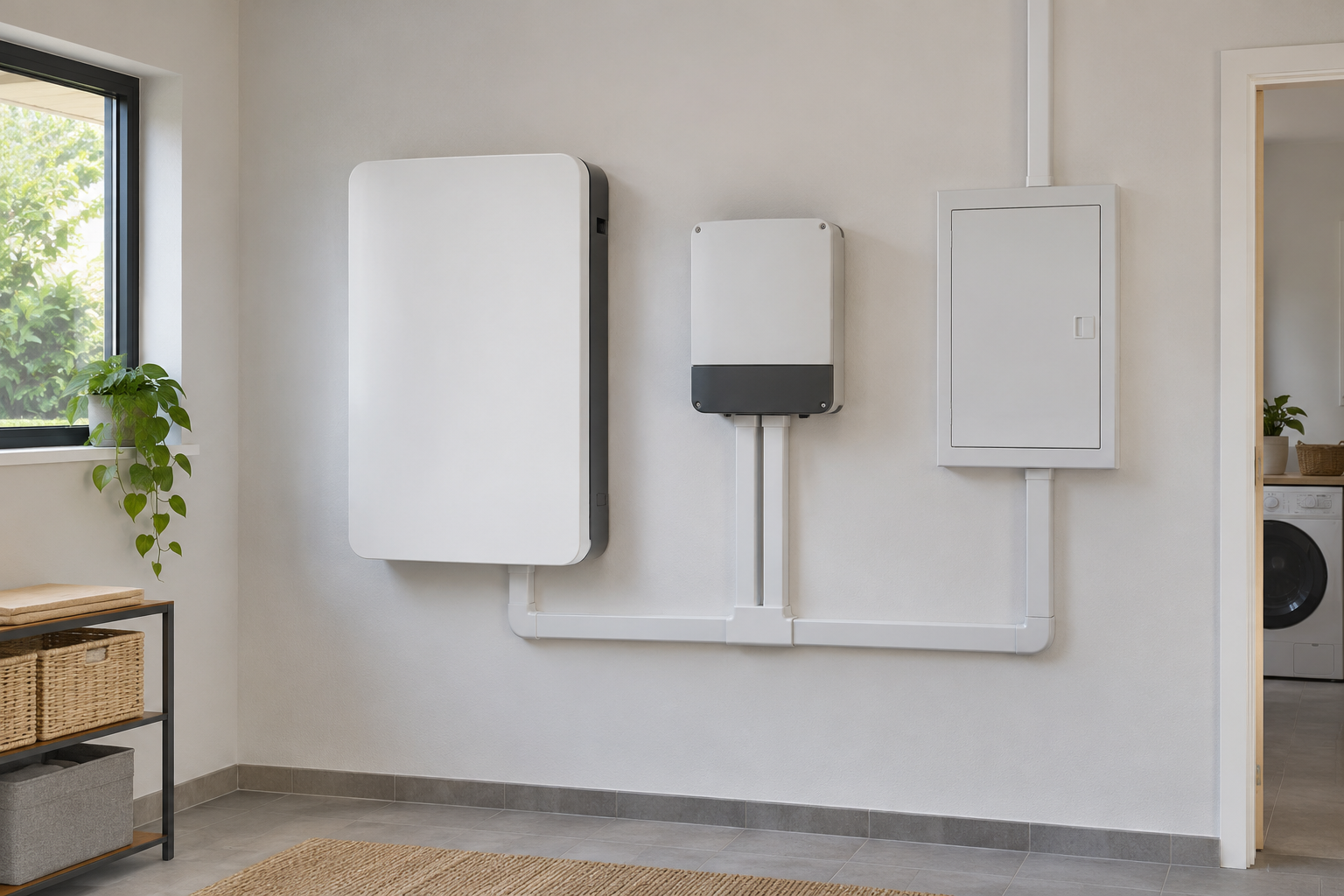
A battery is installed beside the house, and its storage capacity sounds substantial. During a power cut, however, the kitchen socket you expected to use may be outside the backup arrangement. The presence of a battery does not answer which circuits it can supply.
Before relying on a system, ask the qualified installer to explain its backup scope in ordinary household terms. You need to know what works, under which conditions, and what the limits mean for daily decisions.
Begin with the jobs you need electricity to do
Write down the activities you want to maintain during an outage. You might prioritise refrigeration, a small amount of lighting, and charging a phone. Another household may have different essential needs.
Describe the actual appliances and their locations. “Kitchen power” is imprecise if you mean the refrigerator in one corner and a kettle at another socket. Those appliances may also place very different demands on the system.
Give this list to the installer before accepting a design. Ask which requirements the proposal covers and which remain outside it. The conversation should connect your intended use with the equipment and circuit arrangement being offered.
Get a list of the backed-up circuits
Government consumer guidance explains that a configured battery system may back up a whole property or only selected circuits. In some installations, the electricity-supply arrangement also affects what can be supported.
Ask for a written explanation identifying the relevant rooms, lights, and sockets. If a term such as “essential loads” appears in a proposal, have the installer translate it into the specific points you intend to use.
Keep that information where other household members can find it. A clear note saying which socket is included can be more useful during an outage than a product brochure describing the battery’s headline capabilities.
Do not open an electrical panel or alter circuits to investigate. Have the arrangement identified and documented by the appropriate professional.
Keep energy capacity separate from power output
Kilowatt-hours describe an amount of stored energy. Kilowatts describe a rate of supplying power. These measures answer different questions: roughly how much energy is available, and how much demand the system can support at a particular moment.
A system can therefore have stored energy while being unable to run a chosen combination of appliances together. Ask the installer about continuous output, any relevant starting demands, and the combination you expect to use.
A runtime estimate also needs stated assumptions. Ask which appliances are included, what usable energy is assumed, and whether the estimate depends on solar generation. Treat an unexplained number of hours as a question to clarify.
Check what happens to the solar supply
Many grid-connected solar systems shut down during a grid outage for safety. A suitable backup design must handle isolation from the grid; it is not enough simply to have panels and a battery on the property.
Appropriately designed solar-and-storage systems can operate separately from the failed grid. Whether your installation can continue charging its battery from solar during an outage depends on its design and operating conditions.
Ask that question explicitly. A battery supplying stored energy while solar is unavailable behaves differently from a system able to replenish the battery in suitable sunlight. Do not assume the second arrangement from the presence of rooftop panels.
Request an explanation of normal operation
Before handover, ask what the household should expect when grid power fails and returns. Does transfer occur automatically? Are any normal user actions required? Where are the relevant instructions kept?
Also ask how the system indicates a limit or fault and which support contact to use. The answer should match the exact installed model and configuration, rather than a general description of what similar equipment can do.
Any demonstration or test should follow the manufacturer’s procedures and be arranged by the installer. Avoid creating an improvised household outage or changing protective settings merely to see what happens.
Keep the plan accurate as the home changes
A new appliance, altered circuit, or changed operating setting can affect the assumptions behind the backup plan. Review the arrangement with the installer when those changes matter.
Keep the documentation with the system records, including the backed-up points, operating limits, normal instructions, and support details. Explain the important parts to anyone who may be at home during an outage.
The useful result is a specific, understandable plan for the electricity you intend to keep using. A storage rating becomes meaningful when it is connected to those actual household tasks.