
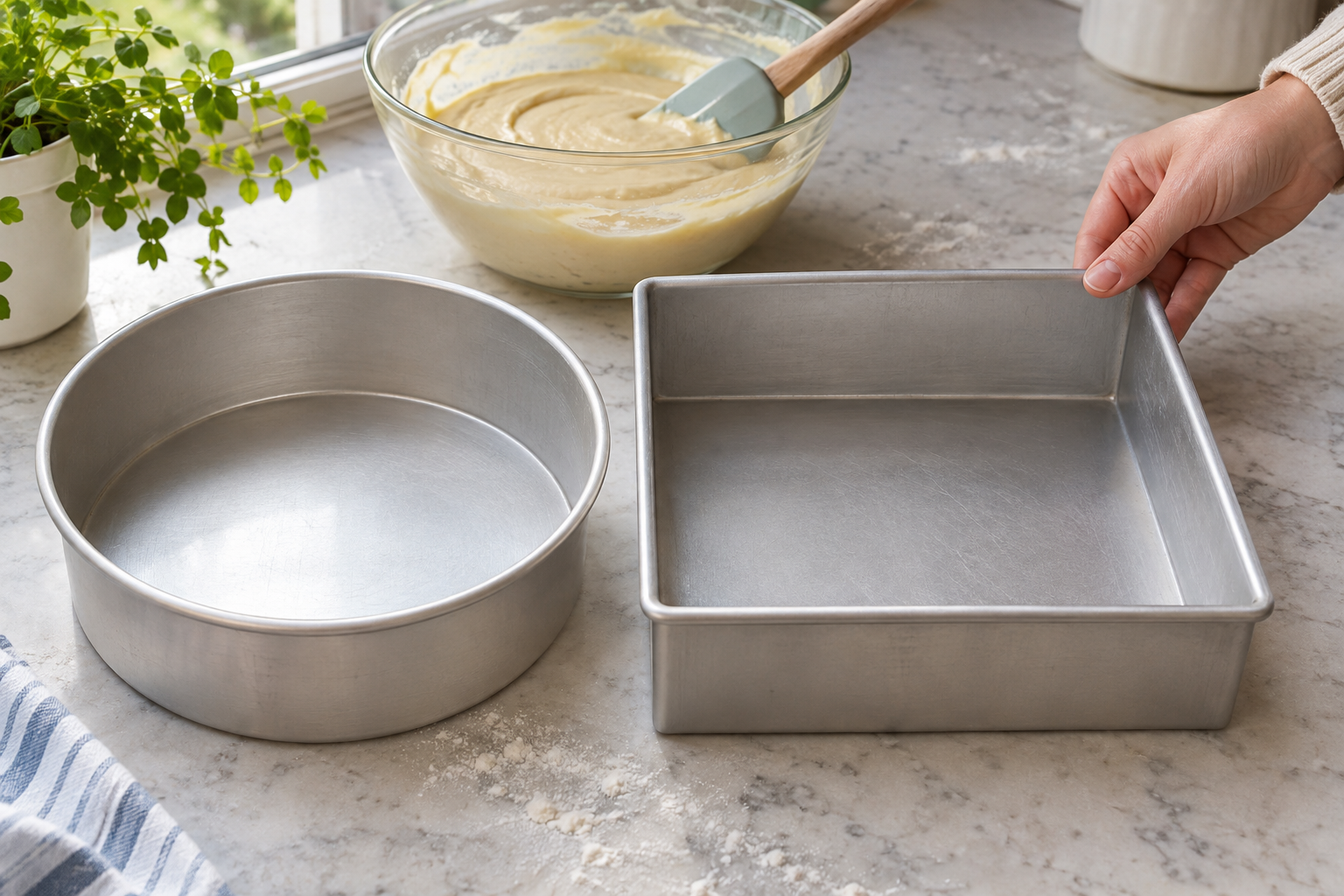
A recipe calls for a round cake pan, but the square one in your cupboard appears to be the same size. Both might be described as 20 centimetres across. That does not make them equivalent: their base areas differ, so the same quantity of batter will sit at different depths.
For a cake-pan substitution, the useful question is how the proposed pan changes the layer of batter. Shape, internal measurements, depth, and material all belong in that decision.
Compare the space inside the pans
Measure the inside rather than relying only on the outer rim or a product name. For a round pan, note its internal diameter. For a square or rectangular pan, note the internal length and width. Check the vertical depth separately.
A straight-sided 20-centimetre square has a base area of 400 square centimetres. An ideal round pan with a 20-centimetre diameter has a radius of 10 centimetres, giving an area of about 314 square centimetres.
The square therefore has roughly 27% more base area. If both contain the same volume of batter, the square holds a shallower layer. Those calculations describe simple shapes; tapered sides, rounded corners, and unusual bases make real pans less exact.
Similar capacity is not always similar baking
Brimful capacity tells you how much a container can hold, not how much rising cake batter a particular recipe should receive. Two pans can have similar total capacity while spreading batter across very different areas.
A deep narrow pan and a broad shallow pan illustrate the problem. Pouring the same mixture into both does not preserve the distance between the centre of the batter and the surrounding heated surfaces.
For an ordinary layer-cake comparison, preserving a similar batter depth is a useful starting aim. It is not a guarantee of an identical result. A tube pan, a shaped mould, or a recipe that relies on climbing the sides may have requirements that a simple area calculation cannot address.
Decide before mixing
Read the recipe’s pan instructions, including how many pans it uses. A quantity intended for two layers should not be treated as the quantity for one pan merely because the diameter looks familiar.
Check whether the recipe author offers an alternative. That is more useful than applying a general conversion to a bake with special structural needs. If the proposed pan differs substantially, choosing a recipe written for the available pan may be the more predictable option.
If you do scale a recipe, apply the factor consistently to the ingredients. Weighing can make awkward fractions more manageable. A geometry calculation alone does not establish that every cake formula will behave well at every scale, especially when equipment and mixing methods also change.
Leave the headroom the recipe requires
Do not fill a smaller pan to its rim to accommodate the original batch. Rising batter needs space, and the required allowance depends on the recipe. There is no single fill fraction that makes every cake safe from overflowing.
Plan any excess before starting. If the recipe supports dividing it between suitable pans, prepare those pans and the oven arrangement in advance. Do not assume that spare batter can wait indefinitely while the first cake bakes.
The depth of the pan wall is only part of this check. What matters is the batter level within that wall and the room the particular mixture needs as it expands.
Use the recipe’s doneness cues
A pan swap can change baking time. It does not give you a reliable rule such as subtracting the same number of minutes for every wider pan. Pan material and finish also affect heat transfer and browning.
Use any substitution guidance supplied with the recipe, and monitor the bake against its stated doneness cues. Do not rely only on surface colour or assume that a deeper centre is finished because the edges look ready. Avoid improvising an unsupported temperature change to compensate for a major mismatch.
Write down the actual pan dimensions and material alongside the result. If you repeat the recipe, that note is more informative than remembering that you used the small square tin. A successful substitution begins with the space the batter occupies, then remains attentive to the cake as it bakes.