
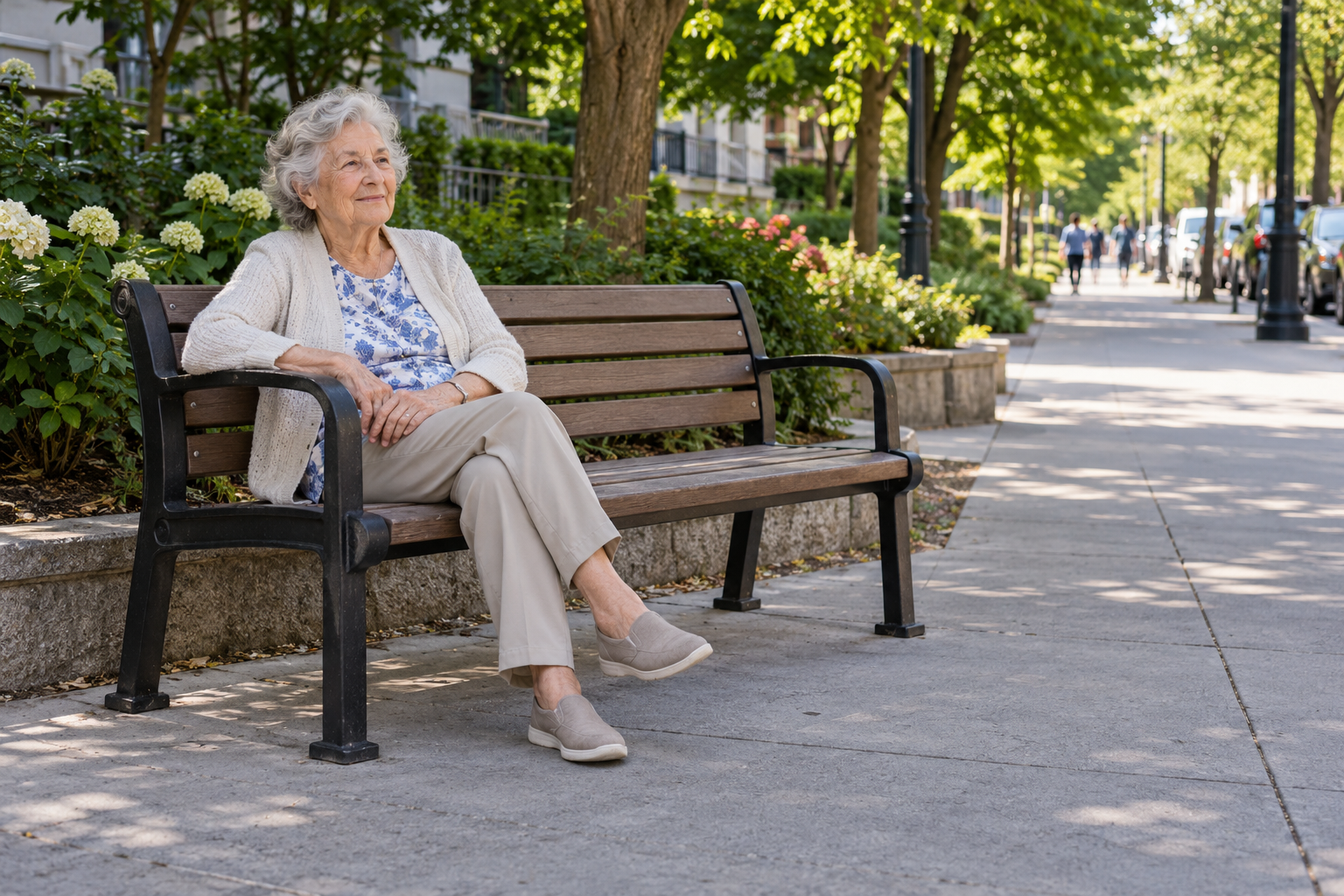
A bench can photograph beautifully and still be awkward to use. The seat may be reached only across soft grass, leave nowhere for a wheelchair user to sit beside a friend, or place resting people in the middle of a busy walking route.
Looking at public seating as part of an ordinary journey changes the questions we ask. Instead of judging only the object, consider the approach, the pause it offers, and how someone resumes their trip.
Can you reach it without solving another problem?
Begin a short distance away and follow the actual approach. Notice uneven surfaces, narrow gaps, planting that has spread into the route, or a step between the path and the bench. The seating area begins before anyone sits down.
UK Inclusive Mobility guidance recommends placing seats beside pedestrian routes without obstructing them. This is a useful design principle: a person seeking a rest should be able to leave the moving flow without becoming isolated from the route.
A hypothetical bench beside a busy shopping street might have plenty of room when installed. Later, a planter or advertising board may occupy the approach. The bench itself has not changed, but its practical usefulness has. Assess the arrangement people encounter, not just the original drawing.
Does it offer the support different people need?
Some people need more support than a low ledge provides. Back support and armrests can make a difference, including when sitting down or standing up. Others may find a different seat height or form more suitable.
Inclusive design guidance recognises variation in people’s needs. That should make us cautious about declaring one fashionable bench shape universally comfortable. A neighbourhood can offer a range of seating rather than expecting one design to serve every body and every length of stay.
Observe respectfully. You do not need to ask a stranger to demonstrate a difficulty for you. If residents are contributing to a consultation, invite descriptions of what makes existing seating easier or harder to use, and offer accessible ways to respond.
Where does a companion sit?
An empty patch beside a bench can be an essential part of the seating arrangement. A wheelchair user may want to remain beside someone on the seat rather than face them from the path or wait behind the backrest.
US accessibility standards for benches, where those provisions apply, address adjacent clear ground space along with features such as back support. The broader observation is straightforward: the area next to the seat deserves as much attention as the seat itself.
Keep that area available. A bin, a parked bicycle, or decorative planting can quietly consume it. Do not assume a usable companion space exists merely because there is open ground somewhere nearby.
Is it a comfortable place to pause?
Consider what surrounds the bench during the hours people use it. Sun, shade, exposure, nearby traffic, and the direction the seat faces can all affect the experience. A position that is pleasant on a mild morning may offer little shelter during a hot afternoon.
These observations need local context. A shaded place may be welcome in one season and less appealing in another. Avoid turning one visit into a claim about conditions throughout the year.
Think about the purpose of the pause too. A brief rest between errands, waiting for a bus, and sitting with a friend are different activities. Public seating can accommodate several of them across a route without every bench being arranged identically.
Does it remain usable after ordinary wear?
A seat that collects rainwater, has damaged boards, or is surrounded by litter can lose the function its design promised. Maintenance is part of usability rather than a separate finishing detail.
If you report a problem, describe the location and the observable condition. “Loose board at the left end” or “approach blocked by overgrown planting” is more actionable than “the seating is poor.” Share a photograph only where it can be taken safely and without intruding on people using the space.
Distinguish a temporary obstruction from a recurring layout problem. Both may deserve attention, but they call for different responses. Clearing a bin does not fix an inherently narrow approach, while replacing a sound bench may do nothing about a blocked path.
Count useful pauses along the whole route
One excellent bench cannot answer every need if the rest of a long everyday route offers nowhere to stop. Look at the sequence between homes, shops, crossings, and transport connections, including where people may need a pause.
A useful conversation about public seating brings together those routes and the details of individual places. It treats the bench as everyday neighbourhood infrastructure: somewhere a person can reach, use, and leave with dignity.