
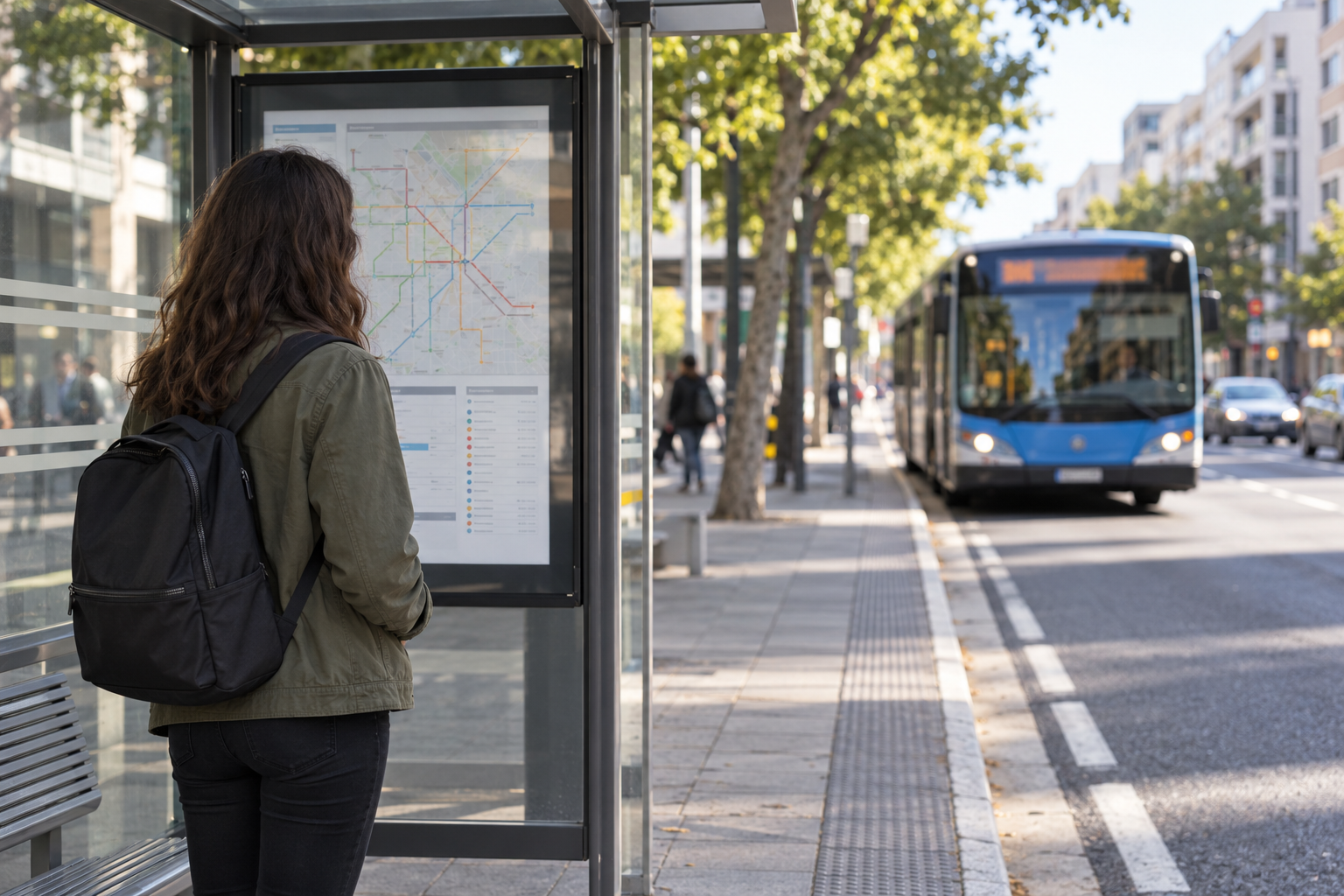
You find the stop name shown in your journey plan and see the correct route number on a bus. It feels as though the difficult part is over. Yet a stop with the same name across the road may serve the opposite direction, and the route number alone may not resolve the difference.
A reliable check uses three pieces of information together: the particular place to wait, the direction the service takes from there, and the destination or branch of the arriving bus.
A stop name describes an area
Stops are often named for a nearby street, station, landmark, or junction. More than one physical boarding location may use that name. The name helps you recognise the area; it does not necessarily identify one pavement, shelter, or pole.
Read the full instruction in the operator’s journey planner. It may include a stop letter, a specific stop identifier, a platform-style designation, or a marked location on a map. Different networks use different systems, so check what the local operator means rather than assuming a familiar convention applies.
In London’s signage system, for example, a stop letter helps distinguish boarding points at interchanges and town centres. Route numbers and “towards” information serve other purposes. Those details belong together, but they are not interchangeable.
Match the map to the street
At the location, compare the planner’s marked boarding point with the actual stop. Look for a nearby junction or building you can recognise. Confirm which side of the street you are on and whether the stop’s identification matches the instructions.
Do this from a safe place on the pavement. If you need to cross, use a suitable crossing and take time to check traffic. A bus arriving on the other side is not a reason to rush across the road while looking at your phone.
Consider a hypothetical journey to a museum. The map places your stop just beyond a junction, but the first shelter you see is before it. The shared stop name may be correct while the boarding point is wrong. Checking the small location details prevents the name from doing more work than it can.
Check which way the route continues
Look at the route information displayed for that physical stop. Find the destination you need, or a later stop you recognise along the planned journey. If the map includes directional arrows, follow the direction from your boarding point rather than reading the line as if it were a two-way path everywhere.
The word “towards” can be useful, but the named destination may be the end of the route rather than your own stop. Establish that your destination lies along that direction. Do not reject the right bus merely because its final destination is somewhere beyond your intended exit.
If the available information remains unclear, use the operator’s current planner or ask staff. A remembered route from an earlier visit may no longer reflect the service or a temporary diversion.
Confirm the arriving service
Read the bus’s route number and destination display together. Some routes have branches or services that finish before the usual endpoint. The shared number should be one check, not the entire boarding decision.
When it is appropriate and safe, ask the driver or staff whether the bus serves your intended stop before committing to the journey. Keep the question specific: name the destination or stop you need. Avoid distracting a driver who is moving or dealing with traffic.
After boarding, pay attention to the first announced or displayed stops if the service provides that information. Comparing them with your plan can reveal a mistake early. If something does not match, seek help calmly rather than assuming the information must be wrong.
Plan the return as a separate journey
The return stop is not guaranteed to be directly opposite the place where you arrived. One-way streets, route loops, road layouts, and temporary changes can put it elsewhere.
Check the return boarding point while you have time, especially if you expect to leave after dark or with tired children. Save the useful local detail: the marked stop, its identifier if applicable, and the destination direction. Check current departures when you are ready to travel.
Finding the stop name is a helpful first step. Matching the location, direction, and arriving service turns that first step into a boarding decision you can trust.