
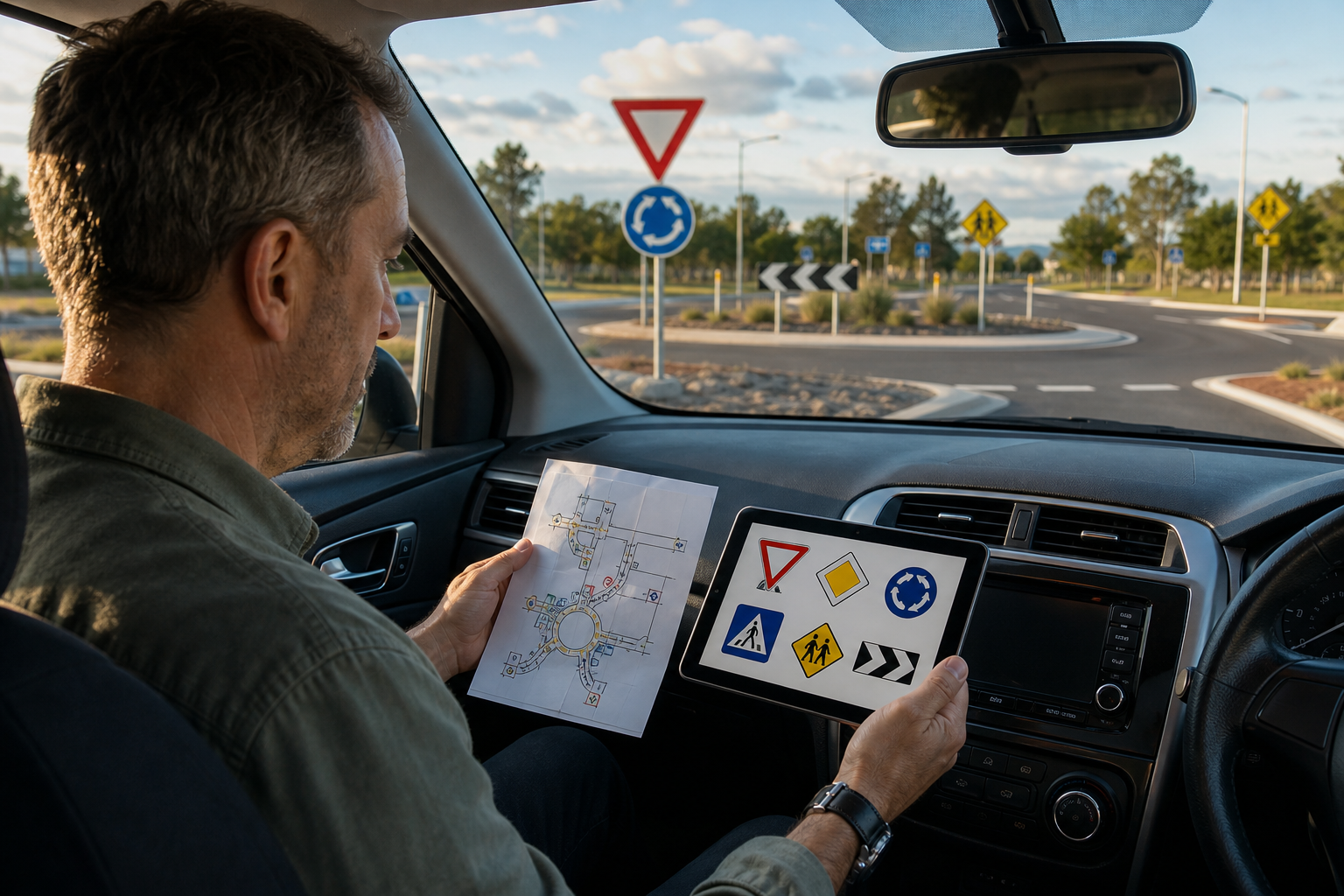
A border can change the grammar of driving before the scenery changes. The steering wheel still turns, the pedals still respond and a red light still demands attention—but the rules connecting those familiar objects may be different. Traffic may keep to the opposite side. An unsigned junction may use a priority rule you have never practiced. A flashing school-zone signal, a stopped emergency vehicle or a red turn arrow may require a response that would be wrong at home.
The safest response is not nervousness. It is a deliberate reset.
This field guide provides a method for adapting when driving across a state, province, country or other jurisdiction. It does not state the law for any particular destination. Rules, signs, penalties and required documents vary, and they change. Before driving, check the current highway code, transport authority or police guidance for every jurisdiction on the route. Rental-company instructions can clarify the vehicle, but they do not replace official rules.
Think in systems, not isolated differences
Travel advice often reduces a destination to one novelty: “They drive on the left,” or “You may turn on red.” A road-rule system has interacting parts. Road side affects turn geometry, roundabout direction, overtaking and where a driver looks first. Priority rules affect junction speed. Sign conventions affect how early a hazard is recognized. Enforcement influences where drivers expect a limit to change.
Build a destination model in three layers:
- Operating layer: road side, controls, lane position, speed units and basic signals;
- Conflict layer: priority at junctions, crossings, roundabouts, merges and turns;
- Exception layer: schools, emergency vehicles, trams, tunnels, weather equipment, tolls and local restricted zones.
If one layer is unknown, the model is incomplete. A ten-minute review of all three is more valuable than memorizing a long list of fines.
Make a one-page local rule card
Before departure, create a short card for the specific places you will drive. Do this while connected to reliable information, not while approaching the first complicated junction. Keep it available offline, but never read it while the vehicle is moving.
| Topic | Question to verify | Why it matters |
|---|---|---|
| Road side | Which side is normal, and which side is used to overtake? | It changes positioning, turns and scanning. |
| Priority | What happens at unsigned or equal-status junctions? | Your home-country instinct may be legally wrong. |
| Speed | Are limits shown in miles or kilometers, and what defaults apply? | An absent sign does not necessarily mean an absent limit. |
| Signals | Are turns permitted on red? What do flashing lights mean? | Permission and prohibition vary by place and intersection. |
| Special zones | How do school, work, emergency and residential zones operate? | Hours, triggers and required actions can be highly specific. |
| Documents | What must the driver and vehicle carry? | A valid license at home may not be the complete requirement abroad. |
Add rules for child restraints, seat belts, phone use, alcohol, lighting, winter equipment, tolls and low-emission zones when relevant. If the journey crosses several jurisdictions, use separate columns. Do not merge rules into an imaginary regional average.
Reset road-side habits before moving
Changing from right-side to left-side traffic, or the reverse, is more than choosing a lane. Deep habits surface during turns, after fuel stops, on empty roads and when fatigue narrows attention. Those are the moments when a driver can return automatically to the familiar side.
Begin in daylight if possible. While parked, locate the indicators, wipers, lights, gear selector, parking brake, mirrors, navigation mount and hazard control. Rental vehicles may place controls differently, and activating the wipers instead of signaling is a small distraction at exactly the wrong moment.
Before the first movement, say the road side aloud. Repeat it before each of the first several turns. At a junction, identify the near lane you must enter before looking for a gap. Use lane arrows and traffic flow as confirmation, not as a substitute for the rule.
Turns deserve special care because they combine positioning, priority and pedestrian scanning. A turn that crosses opposing traffic in one system may be the simpler turn in another. Look for cyclists or motorcycles traveling beside the vehicle, then scan the road being entered for pedestrians and other vulnerable users. Complete the turn into the lawful lane; do not drift across several lanes because the destination is unfamiliar.
After any break, restart the ritual. Service stations, scenic stops and quiet side roads are common habit-reset points. If you feel disoriented, stop in a lawful, safe place. Confusion is a reason to pause, not to improvise at speed.
Learn priority before learning shortcuts
Priority is the hidden architecture of a road network. Signs and signals resolve many conflicts, but not all. Different jurisdictions may give default priority to traffic from a particular side, vehicles already on a main road, pedestrians at specified crossings, or traffic continuing in a defined direction. A driver who assumes “first arrival goes first” can create a conflict even while trying to be polite.
For the destination, verify these situations individually:
- unsigned intersections and T-junctions;
- left and right turns across another traffic stream;
- vehicles leaving driveways, parking areas or unpaved roads;
- pedestrian and cycle crossings;
- merging lanes and lanes that end;
- trams, buses or other vehicles with special priority;
- instructions from police, crossing guards or road workers.
Do not wave another road user through when doing so conflicts with the local rule or hides a hazard. A pedestrian may see your gesture but not the motorcycle passing beside you. Predictability is usually safer than improvised courtesy.
If another driver yields unexpectedly, do not assume the way is clear. Recheck every traffic path. Their gesture cannot guarantee that another lane, cyclist or pedestrian has stopped.
Read signs as a local language
International agreements have encouraged common sign systems, but they have not made the world uniform. Colors, shapes, symbols, text, road markings and sign placement can differ. The same-looking sign may carry a different scope, and a familiar rule may be displayed in an unfamiliar form.
Before driving, learn the destination’s signs for stop, give way, no entry, speed limits, end of restriction, prohibited turns, pedestrian crossings, schools, road works, railways and parking restrictions. Add any local sign likely to appear on the planned route, such as a tram warning, wildlife symbol, mountain-pass control or congestion zone.
Study road markings too. Center lines, edge lines, bus lanes, cycle lanes, turn boxes, clearways and curb colors may carry enforceable meaning. Temporary signs, cones and electronic lane signals can alter the normal arrangement. When a temporary instruction appears to conflict with a permanent marking, slow down and follow the hierarchy stated in the local code; do not invent your own priority between them.
Navigation software is useful for route planning, but its speed display or turn instruction can be stale. The current roadside control and authorized direction take precedence. If the device and road disagree, continue safely and let the route recalculate.
Treat every roundabout as a fresh decision
Roundabouts look standardized from above but operate through local rules. Traffic direction normally follows the road side, yet entry priority, lane selection, signaling and pedestrian treatment may vary. Some circular junctions are controlled by stop signs or traffic signals. Some older traffic circles do not follow the assumptions a visitor associates with a modern roundabout.
Approach slowly enough to read the diagram, select a lane and observe the traffic already circulating. Confirm which movement has priority. Watch beyond cars for cyclists, motorcycles and pedestrians. Follow local lane-use and exit rules, and never change lanes suddenly.
If you miss the exit, continue around when lawful and safe. A second circuit costs little. A sudden lane cut creates a side-impact risk and surprises everyone who interpreted your position normally.
Large vehicles may need extra space or more than one lane. Stay where the driver can see you, and do not squeeze along the inside of a truck or bus at an exit.
Signals: understand permission, not just color
A green signal may permit movement without granting an uncontested path. Turning traffic may still need to yield to pedestrians, cyclists or opposing vehicles. A red light may prohibit every movement, or a jurisdiction may permit a specified turn after a complete stop unless a sign forbids it. Arrow signals can be protected, permissive or prohibitory depending on their color and local meaning.
Verify the destination’s rules for red turns, flashing red, flashing amber, dark signals and stop-line position. Check where signal heads are placed; in some systems they appear mainly beyond the junction, while in others a driver relies on near-side units. Stop at the legal line, not where the light is easiest to see.
Never copy the vehicle ahead as your legal interpretation. The other driver may be making a permitted move, responding to a sign you missed—or simply breaking the law.
Speed limits require three translations
First translate the unit: miles per hour and kilometers per hour are not interchangeable. Second translate the road type: built-up streets, rural roads and controlled-access highways may have default limits even when signs are sparse. Third translate the conditions: the posted maximum may still be too fast for rain, snow, dust, darkness, congestion or limited sight distance.
Learn how the destination marks the beginning and end of a limit. Ask whether limits change for novice drivers, trailers, heavy vehicles, poor weather or particular lanes. Average-speed enforcement and automated cameras can measure behavior differently from a single roadside checkpoint, but the safe plan is the same: follow the lawful limit continuously rather than braking only near a device.
Use the vehicle’s primary speed display and know its unit. If the car shows an unfamiliar unit, locate the alternate display before departure or use a conversion chart while parked.
School, work and emergency rules deserve their own review
Special zones are dangerous places to rely on analogy. A school limit may apply at fixed times, when children are present, when lights flash or according to a posted calendar. Rules around a stopped school bus vary sharply. Passing restrictions can depend on the road layout and direction of travel. Check the exact local instruction before encountering the situation.
In work zones, temporary lanes may be narrower, markings may be shifted and workers may control traffic manually. Increase the following gap and prioritize the authorized person’s instruction. Do not follow an old lane line through a newly coned path.
Emergency-vehicle rules also differ. A moving ambulance, fire engine or police vehicle may require drivers to pull over, stop, clear a particular lane or avoid entering a junction. A stationary response or maintenance vehicle may trigger a move-over or slow-down rule. The safe response must still avoid creating another collision: check mirrors, signal, and move progressively rather than swerving or stopping blindly.
Carry the right authority to drive
A driving license is only one part of cross-border readiness. Depending on the destination, vehicle and length of stay, a driver may need an international driving permit together with the original license, proof of insurance, registration, rental agreement, border authorization, road-tax vignette, emissions permit or mandatory safety equipment.
Confirm that insurance applies in every jurisdiction and to every intended driver. Read exclusions for unpaved roads, ferries, border crossings or particular regions. If renting, obtain written authorization before taking the vehicle across a border. A verbal assurance at a counter may not satisfy police, customs or the insurer.
Store originals and copies according to local requirements, with emergency and insurer contact details available offline. Never leave identity documents exposed in a parked vehicle. Also confirm what to do after a collision: whom to call, whether vehicles may be moved, which report form is required and what information must be exchanged.
Use a five-question routine on the road
When workload rises, use Pause, Position, Priority, People, Proceed:
- Pause: Reduce speed early enough to observe without forcing a last-second choice.
- Position: Confirm the correct road side and lane for the intended movement.
- Priority: Identify signs, signals, markings and the applicable default rule.
- People: Scan separately for pedestrians, cyclists, motorcyclists, road workers and emergency responders.
- Proceed: Move predictably only when the route and obligation are clear.
This routine is not a replacement for law. It is a way to retrieve the law you already researched while controlling the vehicle calmly.
Plan the first hour, not just the destination
The highest workload often occurs immediately after collecting a rental car or crossing a border. Choose an easy first segment. Avoid a dense city center at night, a complex motorway interchange or severe weather if a lower-stress alternative exists. Let a passenger navigate, but agree that instructions will arrive early and that the driver may ignore a turn to preserve safety.
Fatigue makes old habits stronger. Schedule breaks, especially after flights or long border waits. If another licensed driver takes over, brief them on the rule card rather than assuming they absorbed the same research.
When uncertain, continue in the current lawful lane, reduce speed smoothly and seek a safe place to stop. Missing a turn is a navigation problem. A sudden maneuver turns it into a safety problem.
Cross the border mentally before crossing it physically
Competent driving at home can create overconfidence abroad because vehicle-control skill transfers more easily than legal instinct. The disciplined traveler treats every jurisdiction as a separate operating system. They verify current rules, rehearse the unfamiliar conflicts, prepare documents and create enough time to make conservative decisions.
The goal is not to become a local in an afternoon. It is to become predictable: correctly positioned, attentive to priority, alert to vulnerable road users and willing to pause when the system is unclear. A border should reset assumptions before it changes behavior. Done well, that reset turns unfamiliar roads from a guessing exercise into a manageable sequence of informed decisions.