
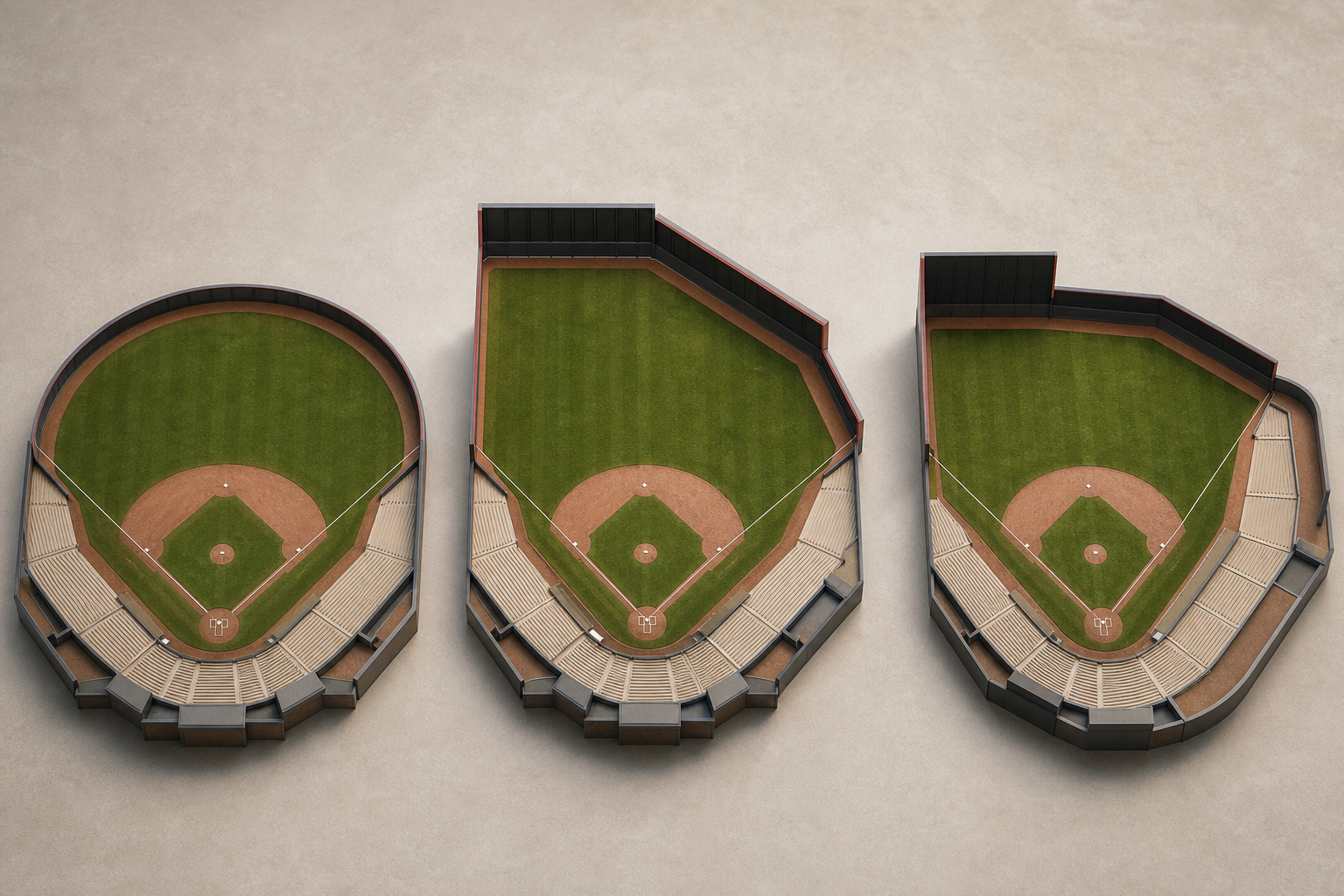
A high fly ball can be an easy out in one stadium, a home run in another and a complicated rebound off a wall somewhere else. The batter has not changed the swing. The official at-bat still belongs to the same sport. What changed is the landscape allowed to surround the contest.
That is the most interesting answer to why baseball fields differ. Baseball standardizes a precise operating core, then permits meaningful variation beyond it. The bases, pitching distance, foul lines and home plate create a shared grammar. Outfield depth, wall shape, foul territory, orientation, surface and local atmosphere give each park an accent.
The exact requirements depend on league, competition level, age group and the date a facility was constructed. A major-league park is not the template for every school or community field. Yet the design principles travel well: geometry, site, safety, visibility, drainage and climate all help determine how a field plays.
The diamond creates the common game
Under current Major League Baseball rules, the infield is based on a ninety-foot square and the pitcher’s plate sits sixty feet, six inches from the rear point of home plate. Those measurements organize the contest between pitch, hit, catch, throw and run. They keep a ground ball and a stolen-base attempt recognizable from one park to the next.
Other forms of baseball can use different dimensions, especially for younger players. Even within a professional park, the grass and dirt can be shaped within applicable rules and standards. The important design idea is that the central relationships are controlled more tightly than the distant boundary.
Foul lines extend two sides of the square beyond first and third base. From there, the amount of fair and foul ground can widen, narrow and bend around a real parcel of land. Baseball does not place its entire game inside a standardized rectangle.
The outfield is where place enters the rules
Professional rules include minimum outfield distances for fields built after a specified historical date, along with provisions that acknowledge existing parks and permitted exceptions. That creates a regulatory floor without making every wall identical.
A designer can vary the distance down each line, the depth of the power alleys, the center-field reach and the curves or corners connecting them. A wall may remain low and catchable in one area, rise dramatically in another or change height along its route. The boundary can include angles that send a ball back toward the infield or carry it away from a fielder.
Distance and height must be read together. A closer wall is not automatically easier for every hitter if it is unusually tall. A deeper section can still produce extra-base hits when a long rebound stays in play. The field is a package of interacting dimensions, not one number printed beside each foul pole.
Many shapes began with the site
Older ballparks were often fitted into streets, rail corridors, existing neighborhoods and irregular property lines. The available land shaped the outfield. Instead of clearing a perfect geometric footprint, builders negotiated with the city around them. That history could become part of the park’s identity.
Modern facilities have more engineering freedom, but they still respond to boundaries, transport, adjacent buildings, environmental conditions, public space and development plans. A symmetrical park is a choice, not the natural absence of design. An asymmetrical park can likewise be deliberate rather than accidental.
Renovations add another layer. Moving a wall, changing seating, relocating a bullpen or altering field level can solve one problem while changing sightlines, playable territory or rebound behavior. Historic character, accessibility, safety and current competition standards have to coexist.
Wall height changes the meaning of distance
An outfield wall decides whether a long ball leaves play, remains catchable or rebounds. Its surface also decides how predictable that rebound will be. Padding, material, seams, railings and transitions require careful design because fielders may approach at speed while tracking a ball overhead.
A high wall can remove the possibility of an over-the-wall catch while keeping more batted balls in play. A low wall may bring spectator proximity and dramatic catches but demands a safe interface beyond the boundary. Angled walls reward fielders who learn the carom and punish assumptions based on a flat surface.
Teams practice these interactions. Familiarity helps an outfielder choose an approach, but it does not make every bounce controllable. Ball speed, spin, impact point, weather and human reaction still matter.
Architecture sometimes needs a local ruling
A distinctive boundary can create situations that a plain fence never would. A ball may lodge beneath padding, enter an opening, strike a rail, pass near a spectator area or rebound from a feature beside the playable wall. Competition organizers use approved park-specific ground rules to clarify how those interactions are handled.
Those rules do not give a home team permission to improvise during play. They establish shared expectations for both clubs and the umpires before an unusual bounce occurs. Players still have to continue responsibly until the play is ruled dead; assuming an automatic outcome can give a runner or fielder an avoidable advantage.
Good architecture tries to remove needless ambiguity through continuous boundaries, secure gates, appropriate padding and careful transitions. Ground rules then address the distinctive features that remain. The result is a useful partnership: design shapes the challenge, while rules keep the challenge legible.
Foul territory quietly changes at-bats
The space between the foul lines and the stands or barriers can be broad or narrow. More playable foul ground gives fielders additional room to catch popups that would reach seats elsewhere. That can turn a strike into an out and end an at-bat before the hitter sees another pitch.
Narrow foul territory brings spectators close and can intensify the visual experience. It also compresses the space available to the catcher, corner infielders and on-deck areas, increasing the importance of padding, barriers and clear operational zones.
Foul territory is not uniform all the way around. A park can offer broad space near one base and narrow quickly toward an outfield corner. Dugouts, camera positions, tarp storage and access routes all meet the playing surface at this edge.
Orientation manages sun, shadow and arrival
A field is not placed on a site by drawing a north arrow and stopping. Designers consider sun angles during likely game times, prevailing weather, nearby structures and the experience of batters, fielders and spectators. The same orientation can create different conditions across seasons and start times.
Low sun can challenge a fielder looking in one direction while a shadow line changes the visual background between pitcher and hitter. Artificial lighting must support ball tracking without creating disabling glare. Roofs and upper seating decks add shade patterns of their own.
No orientation eliminates every difficult moment. Scheduling, lighting, shading and operational decisions work with the geometry. The goal is not to remove nature from an outdoor sport but to manage foreseeable visibility and safety problems.
The batter’s eye creates visual calm
Beyond center field, a visually controlled background helps a batter see a pitched ball. Movement, high contrast, reflective surfaces or spectators in ball-like colors can make tracking more difficult. The batter’s eye provides a more uniform field behind the pitcher’s release area.
Its exact shape and integration vary. It may be a wall, screen, planted area or architectural surface. It has to work from the batter’s viewpoint while coexisting with seating, cameras, circulation and the park’s larger design.
This feature shows how a spectator building remains part of the playing system. What sits outside the foul lines can affect the ability to perform a central baseball task.
Air changes how the same contact travels
A batted ball moves through air, so air density and movement matter. Elevation, temperature and humidity contribute to density, while wind can assist, resist or redirect flight. The effects interact with launch angle, speed and spin; weather does not predetermine the result of a particular swing.
A park at higher elevation can present a different flight environment from one near sea level. A waterfront setting may experience recurring wind patterns, while an enclosed or roofed stadium manages air differently. Openings between stands can channel wind in ways that are not obvious from a weather report outside.
Players and coaches observe current conditions rather than relying only on a park’s reputation. Flags, warm-up throws, batting practice and the movement of earlier fly balls all provide clues, but the atmosphere continues to change.
Surface design controls bounce and footing
Natural grass, engineered turf, infield mixes and transition zones create different ball and body interactions. Moisture, compaction, grass height, maintenance and temperature can change speed and bounce. A hard, dry infield may produce a different ground ball from a softer surface, even within the same park on another day.
Drainage is fundamental. The field must move water away while preserving safe, consistent footing and a playable surface. Slopes can be subtle yet important. Irrigation, subsurface systems, covers and maintenance practices support the design after construction.
The warning track is both a material transition and a spatial cue for an outfielder approaching the wall. It should be understood as part of a larger safety system, not as permission to run without awareness. Wall padding, gate details, bullpen boundaries and communication remain essential.
Geometry changes defensive questions
Outfielders adjust depth and lateral position according to the hitter, pitcher, count, game situation and park. A deep alley may require a center fielder to protect more space. A difficult corner can increase the value of clean communication and practiced relay positioning.
Infielders also respond to foul ground, surface and the path of likely throws. The catcher needs to know how much room exists behind and beside the plate. Bullpen locations and low barriers can affect whether a ball remains playable and how fielders approach it.
These adjustments do not mean a park determines roster decisions by itself. Player skill, health, broader strategy and league context matter far more than one architectural feature. Geometry adds a recurring question that teams must answer.
Hitting changes without becoming simple
A hitter may recognize that one part of the outfield is closer or that a wall produces extra-base opportunities. Yet attempting to force every ball toward that feature can distort an otherwise sound approach. Pitch location and quality still lead the interaction.
Analysts can compare outcomes across parks, but raw totals do not isolate architecture. Team quality, opponents, weather, schedule and player mix all contribute. Responsible comparison adjusts for context rather than declaring one wall the explanation for an entire season.
The most interesting park effects are often probabilistic. A shape can make one outcome more likely without making it inevitable.
Fans experience the geometry too
Seating follows the field while trying to preserve sightlines to the ball, bases and boundaries. A seat near an outfield corner sees the game differently from one behind home plate. Overhangs, rails, aisles and accessible viewing positions require coordination so that architecture does not casually block important action.
Proximity can create atmosphere, but safety barriers and netting respond to real ball speeds and spectator attention. Concessions, circulation and social spaces have to coexist with the ability to follow play. A beautiful view beyond the park matters less if the field itself disappears behind a poorly placed element.
Acoustics also emerge from form. Enclosed seating bowls, roofs and open ends handle crowd sound differently. That changes the feeling of a moment without changing the formal score.
Community fields solve a different brief
A local field may serve multiple age groups, sports, schools and public uses. Its priorities include safe dimensions for intended players, durable surfaces, maintenance capacity, drainage, lighting, accessibility, neighborhood impact and a realistic budget. Copying a professional park’s eccentric wall would rarely be the first objective.
Portable fences or flexible markings can allow one site to support different competitions, but every configuration needs appropriate supervision and compliance with the governing organization. Familiar major-league measurements should not be imposed on younger players or another code without verification.
Learn a park by watching its edges
During a first visit, watch how the foul ground widens, where the wall changes direction, which areas hold shade, how flags and grass move, where fielders position and how bounces return from the boundary. Notice the playing surface transitions and the space behind home plate.
Then return attention to the shared diamond. The park is distinctive precisely because a familiar game operates inside it. Standardization makes comparison possible; variation makes place visible.
Baseball fields are not incomplete versions of one perfect template. They are negotiated environments where rules meet land, architecture, weather, safety and history. The infield establishes the promise that this is baseball. Everything beyond it asks how baseball will inhabit this particular place.