
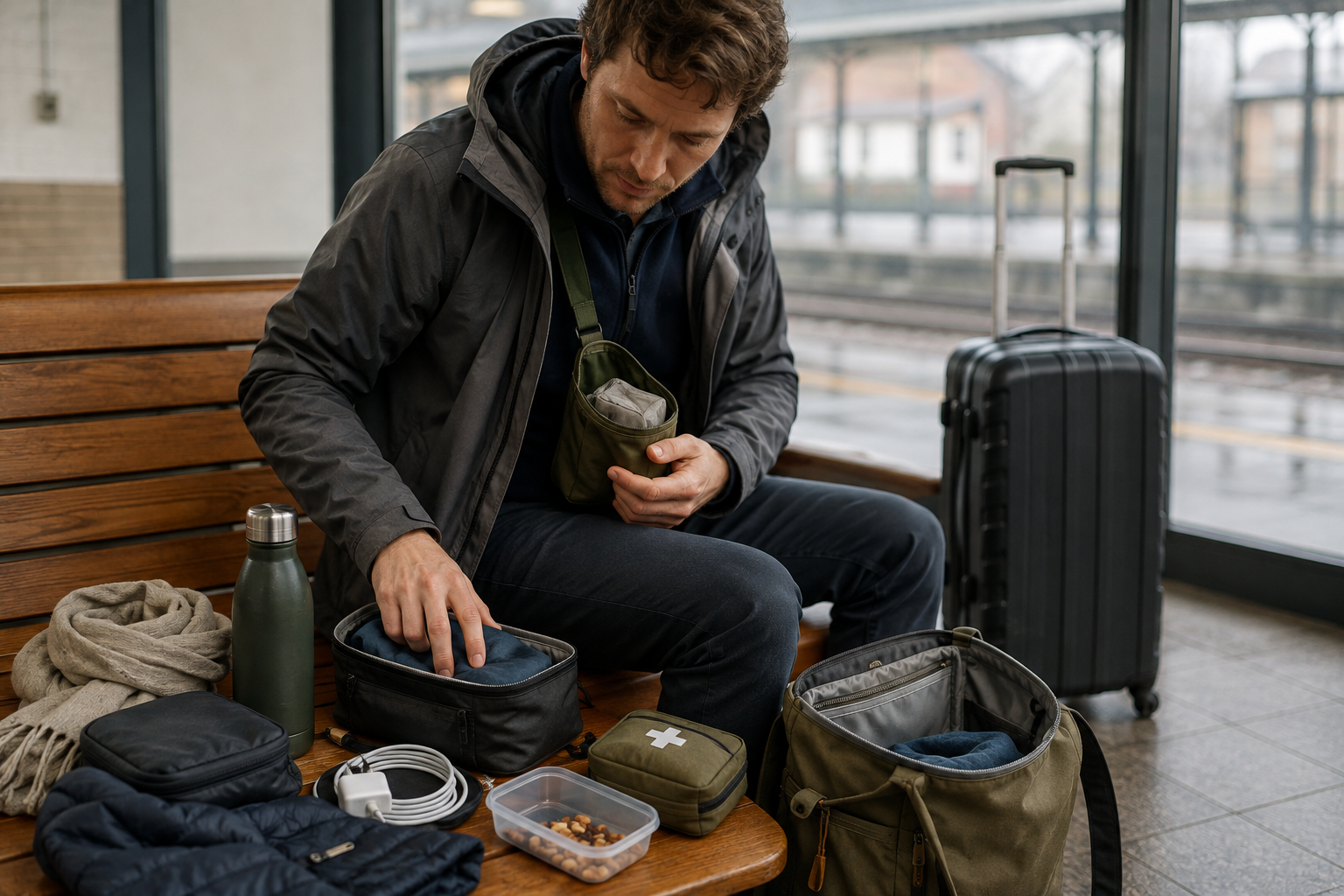
Packing becomes difficult when every item argues for itself. A jacket may be useful if the weather changes. An extra cable might rescue a dead device. A second pair of shoes could suit a particular evening. Each case sounds reasonable in isolation, yet the bag becomes heavy, cluttered, and strangely hard to use.
The solution is to stop treating packing as a contest between favorite objects. Treat it as a small operating system. Every item must earn a place through three questions: how quickly must it be reached, what happens if it fails or disappears, and how many situations can it serve before it needs cleaning, charging, or replacement?
The three-zone packing system turns those questions into physical locations. Zone One stays on the traveler or within a single movement. Zone Two holds active-day equipment that can be reached during a normal stop. Zone Three contains reserve items and destination-only gear. The zones are simple, but the reasoning behind them prevents most of the friction that makes travel feel disorganized.
Why Access Matters More Than Bag Capacity
A bag can technically hold an item and still be the wrong place for it. A rain shell buried beneath folded clothing is useless during a sudden platform downpour. A passport loose in an outside pocket is easy to reach but too exposed. Good packing balances speed with security.
Access should be measured by the situation in which the item is needed. Imagine the traveler standing in a narrow aisle, holding a cup, watching luggage, and trying not to block other people. An object that requires opening the main case, moving packing cubes, and searching a pouch has a high access cost. If that object is needed repeatedly, the cost compounds into delay and stress.
Do not solve every access problem by adding external pockets. Too many quick-access locations create a memory problem. The traveler must remember not only what was packed but where it migrated. Three stable zones provide enough distinction without creating a scavenger hunt.
Zone One: Immediate and Identity-Critical
Zone One contains items needed without setting luggage down. It usually includes identification, payment, essential medication, one communication device, and the smallest comfort items required during movement. Depending on clothing and local conditions, these may sit in a secure inner pocket, a compact cross-body pouch, or a consistent compartment of a personal bag.
An item belongs here when delay creates a meaningful problem. Identification requested at a checkpoint qualifies. A lip balm probably does not unless a medical need changes its importance. The zone should remain sparse because every added object makes the critical ones harder to distinguish by touch.
Use a fixed internal order. One secure location holds identity documents. Another holds the primary payment method. Medication remains in an appropriate container rather than mixed with loose objects. The exact arrangement matters less than keeping it unchanged throughout the trip.
Zone One also carries the smallest failure buffer. Separate one backup payment method from the primary wallet. Keep a written emergency contact card without sensitive account information. If a device is the only place holding directions or booking details, store the essential information in another accessible form. The principle is separation, not duplication in the same vulnerable pocket.
Zone Two: The Active-Day Toolkit
Zone Two holds items used during ordinary transitions: a light layer, water, a snack, a basic hygiene pouch, a charging lead, ear protection, and anything needed for the day’s planned activity. This zone belongs in a day bag or the accessible portion of a carry-on.
Items here should be reachable after a deliberate stop. The traveler can step aside, place the bag safely, open one section, and retrieve the object without unpacking. Group items by action rather than by product type. A weather pouch might contain a compact shell and a simple cover. A transit pouch might contain ear protection, a cable, and a small power source. This reduces the number of decisions made in public spaces.
Zone Two changes from day to day, but its structure stays stable. Before leaving accommodation, move only what the current plan requires. A museum day, long walk, business meeting, and beach visit need different active kits. The rest remains in Zone Three instead of following the traveler everywhere.
Weight matters most here because it is carried for the longest continuous period. An object that seems light during packing can become irritating after hours. The active-day toolkit should support likely needs, not every imaginable event.
Zone Three: Reserve, Recovery, and Destination Use
Zone Three lives in the main bag. It holds clothing rotations, sleep items, destination-specific equipment, refills, and backups that can wait until accommodation or a safe unpacking point. It is not a junk zone. Its purpose is controlled recovery.
Organize it so that one disruption does not spread. Keep liquids contained. Separate worn clothing. Protect items whose failure would contaminate or damage others. Place the next needed layer near the opening while lower-priority equipment sits deeper.
Reserve items should answer a defined scenario. A spare charging cable is useful if the primary cable is heavily used and difficult to replace at the destination. A third cable kept merely because it was available is clutter. A compact repair item is justified when it can address several common failures. A specialized tool that requires expert skill may not be.
Zone Three also supports reset rituals. At the end of each day, return identity-critical items to Zone One, replenish the active kit from Zone Three, charge what needs charging, isolate wet or dirty gear, and preview the next day’s conditions. Ten calm minutes prevent rushed decisions in the morning.
Judge Every Item by Its Failure Cost
Failure cost is the consequence of an item becoming unavailable. The object might break, leak, run out, be delayed, or simply be buried when needed. Evaluate the consequence before deciding on redundancy.
Use three practical levels:
- Critical failure threatens health, identity, safe movement, or the ability to enter accommodation. Protect or separate these items and carry appropriate backups.
- Disruptive failure consumes significant time, money, or comfort but has a manageable workaround. Carry a backup when local replacement is difficult or timing is tight.
- Minor failure causes inconvenience but can be tolerated, borrowed, replaced, or skipped. Avoid packing duplicates for these cases.
Redundancy should not mean two identical objects stored together. If the bag is lost, both vanish. A better backup may be smaller, simpler, or located in another zone. A phone charger in the day bag and a compact alternate in the main case protects against different failures. Two chargers tangled in one pouch do not.
Failure analysis also reveals when knowledge can replace gear. Understanding how to wash and dry a garment reduces the need for extra clothing. Knowing the address and arrival procedure reduces dependence on a single device. A simple repair skill can be lighter than carrying multiple replacements.
Measure Reuse in Real Conditions
Multi-use gear is often praised, but theoretical versatility is not enough. An item earns reuse value only if the traveler will actually use it in several situations without creating another problem.
A light overshirt may serve as a warm layer, sun cover, and smart-casual piece. That is real reuse if it dries overnight and works with the rest of the wardrobe. Shoes advertised for every setting may still be uncomfortable for long walks or unsuitable in rain. Judge the object against the itinerary, not its marketing promise.
Consider the full reuse cycle:
- Use. Does the item perform its main job comfortably?
- Recover. Can it be cleaned, dried, charged, or reset with available time and facilities?
- Combine. Does it work with other packed items without requiring a special companion?
- Repeat. Will the traveler willingly use it again under slightly different conditions?
An item that performs four roles poorly may be less valuable than one reliable object used repeatedly for a single important task. Reuse is about dependable cycles, not cleverness.
Create a Gear Decision Card
Before packing, make a short decision card for each uncertain item. It can be a mental check or a few notes on blank paper. Record the item’s main job, likely frequency of use, required access zone, failure cost, recovery needs, and best alternative.
Suppose a compact umbrella is under consideration. Its main job is rain protection. It may be needed suddenly, which suggests Zone Two. Failure causes discomfort rather than danger in a city with shelter. A light shell already packed may be a workable alternative. If strong wind is likely, the umbrella may add little. The decision becomes contextual instead of emotional.
Now consider prescription glasses. They are used continuously, belong in Zone One, and have a high failure cost. A protected backup in Zone Three may be justified. The card makes the difference obvious without relying on a generic packing list.
Pack for Transitions, Not Destinations
Travel plans are written as destinations, but gear is used during transitions. The demanding moments may be moving from airport to train, waiting before check-in, crossing a wet street with luggage, or changing clothes between an outdoor activity and dinner.
Walk through the itinerary as a chain of actions. What will be worn and carried during each transfer? When can the main bag be opened safely? Where might temperature, surface, security, or social expectations change? This rehearsal identifies access needs more accurately than imagining the destination as a single scene.
Transitions also determine whether luggage can be managed independently. The traveler should be able to lift, carry, close, and supervise every bag without relying on ideal conditions. Empty space is useful gear capacity. It allows a wet layer to be stowed, food to be carried briefly, or packing to be completed without perfect folding.
Run the One-Room Packing Test
A useful test requires no travel. Pack everything, then simulate a sequence in one room. Put on the travel outfit and carry all bags. Retrieve identification without looking. Take out the weather layer while keeping the main case closed. Find the charging kit. Remove the first-night items without disturbing the rest. Repack everything under a modest time limit.
Notice friction rather than speed. Did one object fall out when another was removed? Did the same zipper need to be opened repeatedly? Could liquids reach clothing? Was a critical item visible to someone nearby? Adjust zones and containers based on those observations.
Then carry the packed setup for a sustained walk around the room or building. Check shoulder pressure, wheel behavior, loose straps, and balance. The goal is not athletic endurance. It is to reveal whether the system remains usable when the traveler is tired and attention is divided.
Adapt the System to Different Trips
The zones remain useful even when the equipment changes. On a cold-weather trip, Zone Two may hold gloves and an adjustable layer, while Zone Three stores the heavier reserve. On a work trip, Zone One protects identity and access credentials, Zone Two contains the meeting kit, and Zone Three holds presentation backups and clothing.
For family travel, assign zones to roles rather than scattering every person’s belongings across every bag. An adult may carry shared critical items in Zone One, while each capable traveler manages a simple Zone Two kit. Shared reserves stay organized by function in Zone Three. Clear ownership prevents repeated searching.
For journeys with checked luggage, assume Zone Three may arrive late. Move a compact recovery set into the carry-on: essential medication, one basic clothing change, and the minimum needed to sleep and begin the next day. This is not permission to recreate the entire suitcase. It is a bridge.
Use the Return Trip as Evidence
Do not trust memory alone after travel. During unpacking, sort gear into four groups: used repeatedly, used once with high value, unused but justified as critical protection, and unused without a convincing reason. The final group is the starting point for the next packing reduction.
Also record what was borrowed, bought, or missed. An item purchased because access was poor may already have existed in the wrong zone. A garment left untouched may have duplicated another. A frequently used object that was annoying to retrieve deserves a new location, not necessarily a replacement.
This review turns each trip into evidence. Over time, the travel system becomes personal without becoming excessive. The bag reflects actual habits, tolerances, destinations, and recovery routines.
A Smaller Bag With Better Decisions
Efficient packing is not about owning the lightest version of every product. It is about reducing the distance between a need and a reliable response. The three zones make that distance visible.
Zone One protects immediate and identity-critical needs. Zone Two supports the active day. Zone Three provides reserves and recovery. Access determines placement, failure cost determines protection, and reuse determines whether an item earns its weight. When those decisions are made before departure, the traveler carries fewer objects yet has a clearer answer when conditions change.