
Small home upgrades often begin with inspiration and end with a collection of half-related purchases. A new basket hides one problem, a fashionable lamp introduces another, and a Saturday disappears into a project that looked effortless in a photograph. The room may look different afterward, yet the daily annoyances that prompted the work remain.
The one-weekend upgrade map begins somewhere less glamorous and more useful: friction. Friction is any small feature of a room that repeatedly interrupts an ordinary action. It may be a dark entry where keys disappear, a kitchen drawer that forces tools into a pile, a bedroom chair that collects clothing because there is no easier landing place, or a bathroom counter that must be cleared before it can be wiped.
When you plan by friction, style still matters, but it follows function. The goal is to choose a modest project that makes one repeated action easier, complete it within a defined weekend, and leave the room fully usable. That approach protects the budget, reduces unfinished work, and creates improvements you notice through convenience rather than novelty.
Observe the room before trying to improve it
Spend several ordinary days noticing where movement slows or objects gather. Do not reorganize yet. Watch what happens when someone enters with full hands, prepares a meal, changes clothes, cleans up, or looks for a charging cable. The most useful clues are repeated workarounds: a door used as a hook, a stack that migrates between surfaces, or an item stored far from where it is used.
Record each friction point as an action and consequence. Instead of writing hallway clutter, write shoes block the door because there is no easy place to remove and store them. Instead of writing bad lighting, write the work surface becomes difficult to use after sunset. This wording keeps the project connected to a behavior that can later be tested.
Take a few plain photographs from normal eye level. They are not for display. They preserve the starting state and reveal patterns that familiarity hides. Look for empty vertical space, crowded surfaces, awkward reach, weak light, and furniture that interrupts a natural walking path.
Score friction by frequency and effort
Not every annoyance deserves a project. A corner that looks dated may bother you occasionally, while a drawer that jams is handled ten times during one meal. Rank problems with three simple questions:
- Frequency: how often does this interruption occur during a normal week?
- Effort: how many extra movements, decisions, or minutes does it create?
- Reach: how many people or household routines does it affect?
Give priority to frequent, low-risk problems with a compact solution. A hook installed where a bag is naturally removed may outperform a decorative overhaul. A shelf that moves everyday supplies into reach can improve several routines at once. The best first project is not necessarily the ugliest area; it is the one where a small change removes a reliable irritation.
Separate a symptom from its cause
A crowded surface is a symptom. Its cause may be missing storage, storage in the wrong location, too many objects, or an unclear decision about what belongs there. Buying containers before identifying the cause can make clutter more elaborate rather than less common.
Trace each object backward. Where was it last used? Why was it placed here instead of returned? If the proper location is inconvenient, moving the storage may solve the problem. If the object has no home, create one. If it is rarely used, remove it from the high-demand area instead of building new storage around it.
Define a weekend-sized finish line
A project fits a weekend only when the completed state is specific. Refresh the entryway is too broad. Install a narrow shoe shelf, add three bag hooks, and create a tray for keys is measurable. The finish line should include cleanup and return to normal use, not just the last installation step.
Write a project card with five boundaries:
- The single friction point being reduced.
- The physical area included in the project.
- The maximum amount available for materials and replacements.
- The latest time work must stop so cleanup can happen.
- The test that will show whether the change helped.
Also write what is outside the project. Paint may be included while replacing flooring is not. Cabinet organizers may be included while moving plumbing is not. Clear exclusions prevent a useful refresh from quietly expanding into renovation.
Choose reversible improvements first
Reversible changes are valuable because they allow learning. You can move a freestanding shelf, adjust a lamp, replace a removable organizer, or relocate a rug after living with the result. These changes test whether the idea is correct before you commit to larger work.
Begin with placement, containment, light, and surface renewal. Rearranging furniture can improve movement without buying anything. A correctly sized tray can give loose daily objects a boundary. A task light can make a desk more usable. Fresh paint on one worn surface can change the room without requiring a full redesign.
Any project involving structural changes, hard-wired electrical work, gas, major plumbing, or uncertain hidden conditions falls outside a casual weekend refresh. Treat those as separate projects and use appropriately qualified help. A clear boundary is part of good planning, not a failure of ambition.
Design around the point of use
Useful storage reduces the distance between an action and the objects that support it. Cleaning cloths belong near the area where they are used. Charging cables need a stable location beside the device’s resting place. A landing zone belongs where pockets and bags are naturally emptied, not where a floor plan says an entry should look symmetrical.
Observe reach and sequence. If making tea requires crossing the kitchen several times, gather the everyday items into a compact zone. If a work bag is packed near the dining table, give its contents a nearby home. The room should support the routine that actually occurs, even if that routine differs from the room’s conventional label.
Open storage favors items used frequently and kept reasonably consistent. Closed storage suits visual noise and occasional supplies. Do not force everything into identical containers. Choose the degree of visibility that makes returning an item easier.
Make a material plan before shopping
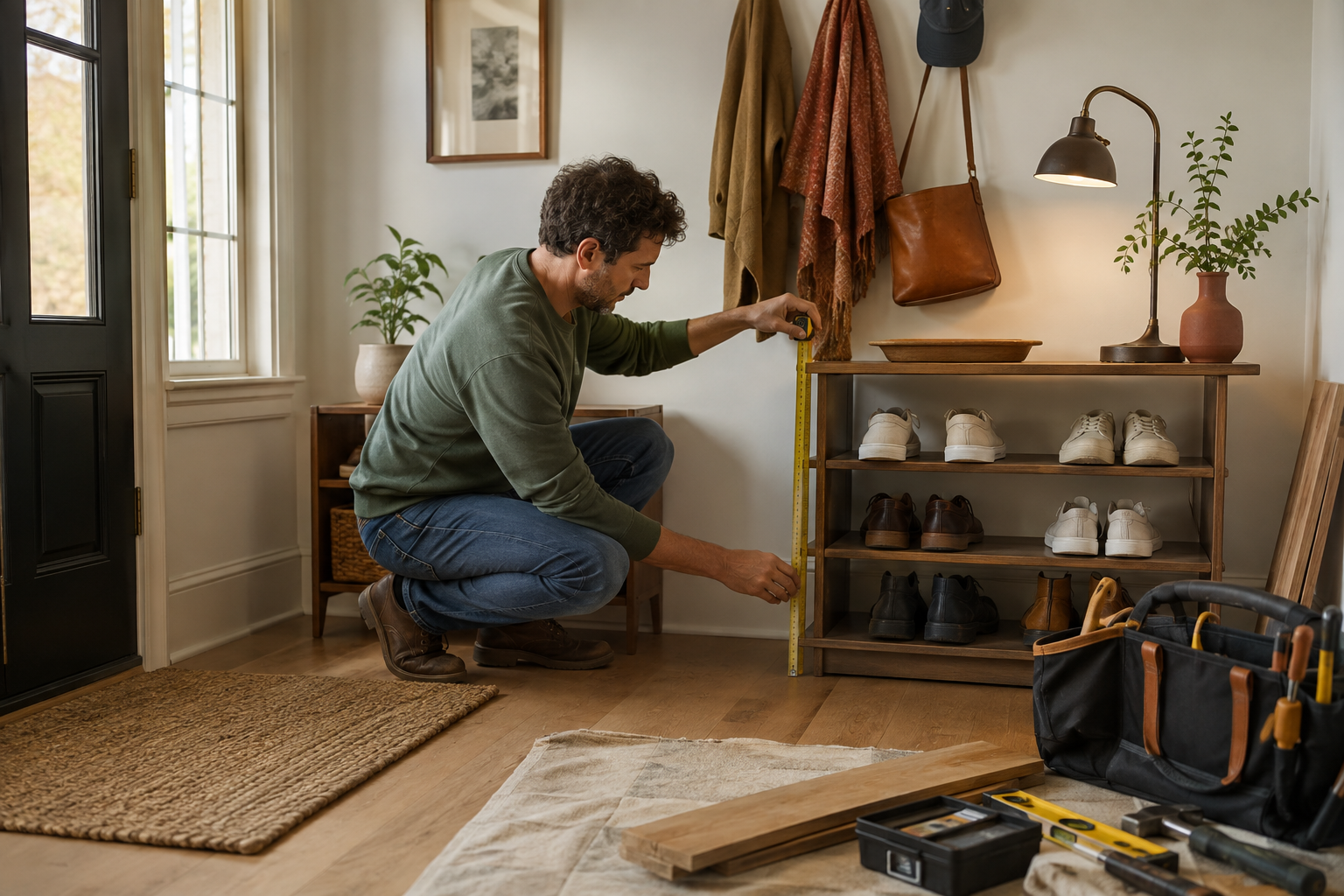
Measure the available area at more than one point because walls, floors, and alcoves may not be perfectly uniform. Note nearby doors, drawers, switches, vents, and walking clearance. Record the dimensions of the objects the upgrade must hold, not only the space it will occupy.
Build the shopping list around the installation sequence. Include fasteners or supports appropriate to the surface, simple preparation supplies, and the small finishing items that are easy to forget. Check what you already own before buying tools for a single use. If a product must be assembled, review its parts and dimensions before the weekend begins.
Choose finishes by the demands of the location. An entry surface needs to tolerate abrasion. A kitchen organizer must be easy to clean. A fabric near strong daylight should not be selected only for a delicate color. Practical durability protects the budget because the improvement remains useful after its newness fades.
Use a visual rule to keep purchases coherent
Set one simple rule for color, material, or shape. You might repeat the room’s existing wood tone, choose matte black only for small hardware, or use rounded containers where the room already has many hard lines. The rule limits impulse decisions without requiring every item to match.
Bring a photograph and measurements when choosing materials. Compare each potential purchase with the actual room, not the display around it. If an item does not solve the named friction point or support the visual rule, leave it out.
Sequence the weekend backward
Plan from the moment the room must return to service. Reserve the final block for vacuuming, wiping surfaces, returning essential objects, and testing the routine. Before that comes installation and adjustment. Preparation, emptying, and measuring happen earlier.
A practical sequence is:
- Friday preparation: confirm measurements, gather tools, inspect materials, and clear only the immediate work zone.
- Saturday setup: photograph the starting state, protect nearby surfaces, remove items, and complete messy preparation.
- Saturday build: assemble, paint, mount, or rearrange while enough time remains to correct surprises.
- Sunday adjustment: place stored items, test movement and reach, then make small changes.
- Sunday reset: clean fully, remove packaging, and restore the room to normal use.
Do not empty an entire room for a small project. That creates a second task and obscures the original problem. Work in a contained zone, keeping essential pathways and routines available whenever possible.
Use low-cost upgrades that change repeated actions
In an entry, a slim landing surface, hooks at useful heights, and a washable mat can shorten the arrival routine. In a kitchen, drawer dividers, an underused vertical rail, or a relocated everyday shelf can reduce searching. In a bedroom, a deliberate clothing landing zone can replace the accidental chair pile.
A bathroom may benefit from lifting small items off the counter and assigning each routine a shallow container. A work area may improve with a task lamp, a cable path, and a small tray for current materials. A living room can feel calmer after adjusting furniture to preserve a clear route and moving frequently used objects within comfortable reach.
These ideas are prompts, not a universal checklist. A storage addition is useful only when it serves a named action. A new light belongs where it changes visibility. A decorative finish should support the room after function has been restored.
Test the upgrade with the original routine
When work is complete, reenact the moment that revealed the friction. Enter with a bag and keys. Prepare the drink. Charge the device. Put away the cleaning supplies. The test should happen under normal conditions, not while you are carefully performing for the new arrangement.
Ask whether the number of movements decreased, whether the next action became obvious, and whether returning items is easier than abandoning them on a surface. Watch for a transferred problem. A shelf may clear the counter but block a door. A basket may contain cables but make the correct one harder to identify.
Adjust before declaring the project finished. Shift a hook, change which drawer holds an item, remove one container, or rotate a lamp. Small corrections are the reason to prefer reversible choices early.
Use a stopping rule to protect the result
Weekend projects become exhausting when completion keeps moving. Establish a stopping rule before work begins: when the named friction is reduced, the room is clean, and the test can be completed, the project is done. New ideas go onto a later list.
A stopping rule prevents decorative extras from consuming the time needed for cleanup. It also gives the household a chance to live with the change. What looks incomplete immediately after rearranging may feel balanced once routines resume. What seems perfect may reveal a small inconvenience after several days.
Review after one ordinary week
Take another photograph from the original angle after the room has been used normally. Compare behavior rather than appearance. Are objects returning to their new homes? Is a surface staying clear without constant effort? Has the walking path remained open? The room itself will show whether the design fits the household.
If clutter reappears, do not assume the household lacks discipline. The new location may require too many steps, hold too little, or ignore where the action happens. Move, simplify, or remove the feature. A useful system should cooperate with ordinary behavior.
Keep a short note about what worked, including measurements and finish names for future continuity. Then choose the next project from the friction list rather than extending the current one by habit.
Build a home through accumulated ease
A home refresh does not have to chase a trend or produce a dramatic reveal. It can make shoes easier to store, a counter easier to wipe, a chair available for sitting, or a desk ready when work begins. Those changes are modest in photographs and substantial in daily life.
The one-weekend upgrade map turns irritation into a controlled project: observe the routine, name the cause, score its impact, define a finish line, choose a reversible response, and test the result. Style enters as a coherent layer over a functional decision rather than as the decision itself.
Over time, these projects create a home that feels considered because it removes unnecessary effort. Each weekend ends with one complete improvement, not several open loops. The reward is not simply a refreshed room. It is an ordinary action that becomes easier every time you repeat it.