
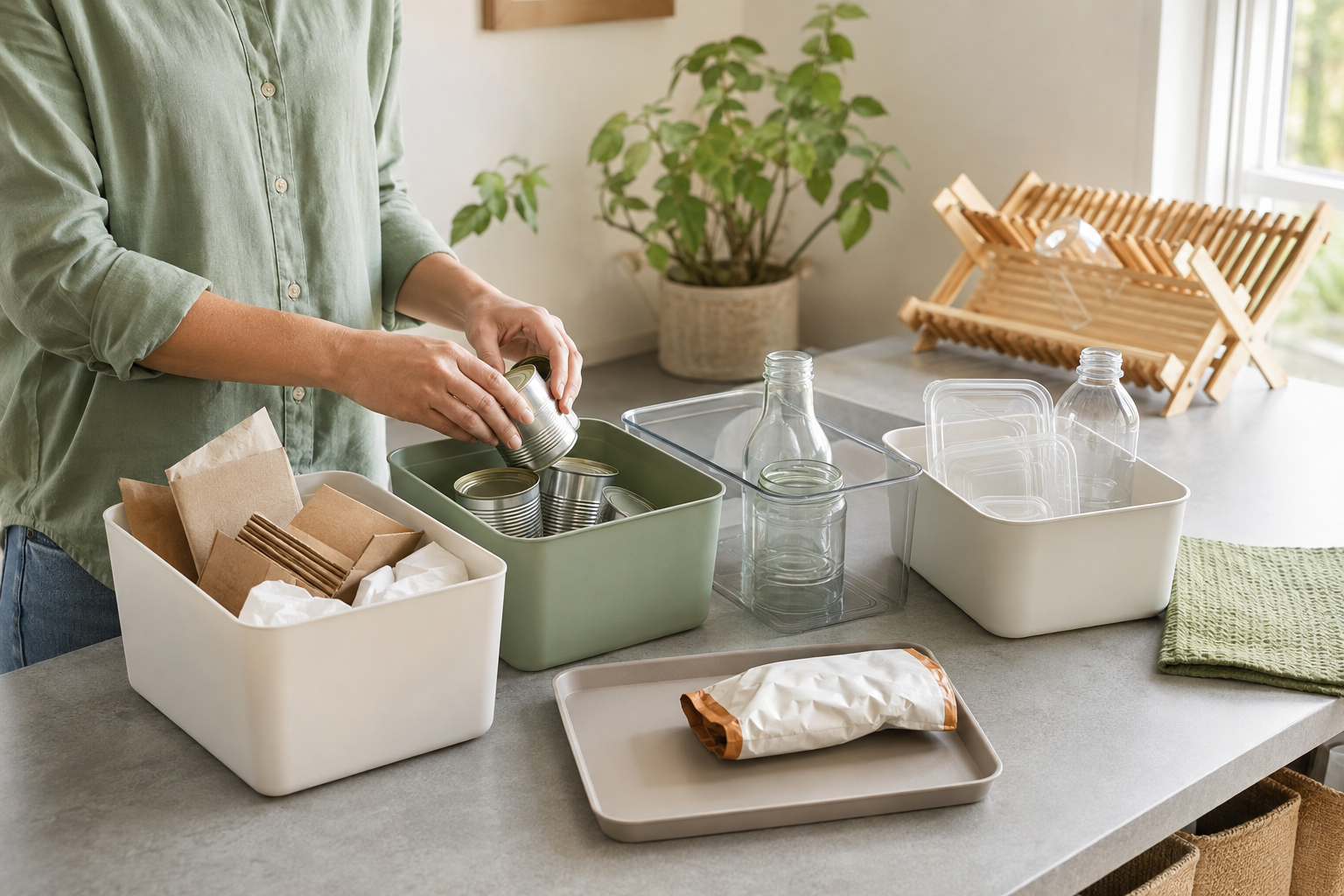
Recycling becomes confusing at the exact moment it asks for a decision. You finish a container, notice a symbol or familiar material, and have only a few seconds before choosing a bin. When the rules are unclear, optimism takes over: perhaps the sorting facility can use it. That hopeful guess is often called wish-cycling.
Wish-cycling feels environmentally responsible because an item enters the recycling bin instead of the rubbish. Yet a collection system is not defined by everything that could theoretically be recycled. It is defined by what the local program accepts, what its equipment can sort, what processors can use, and how materials must be presented. An uncertain addition can contaminate otherwise useful material or create extra handling.
The clean stream method turns recycling from a series of guesses into a small household workflow. It creates one verified rule set, separates preparation from disposal, gives uncertain items a temporary home, and makes correct action easier than hopeful action. The objective is not a perfectly empty rubbish bin. It is a recycling stream with fewer mistakes and more usable material.
Begin with the actual collection program
Rules vary by place, building, collector, and processing contract. A container accepted in one city may be rejected in another. A symbol molded into packaging usually identifies a material; it does not guarantee that a nearby program wants that shape, size, color, or combination.
Create a household rule card using the current instructions from the service that collects your material. Record accepted categories in concrete terms, including any preparation requirement. Do not expand the list through assumption. If the instructions say bottles and jars, that does not automatically mean every object made from the same plastic or glass belongs in the bin.
Keep the rule card near the sorting area. Use simple object descriptions and, if helpful, photographs of ordinary accepted items. The card should answer a hurried question without requiring anyone to remember a technical code.
Mark exceptions as clearly as accepted items
Exceptions often cause more errors than broad categories. Drinking glasses may differ from glass containers. Flexible film may differ from rigid packaging. A paper cup may contain a lining that changes how it is handled. Add recurring household exceptions to the card, especially when they resemble accepted materials.
Review the card whenever collection guidance changes. Date the household version in a way that is meaningful to you, but keep readable dates out of any shared image if privacy matters. Remove old instructions so two competing versions do not remain beside the bins.
Understand the four household decisions
Most items can be handled through four questions:
- Is the material category accepted locally?
- Is this particular form or object accepted?
- Can it be prepared to the required condition?
- Does it need a separate return or special collection route?
The order matters. Washing an item does not make an unaccepted format acceptable. A recyclable material bonded to another layer may be unsuitable for the household stream. An accepted bottle may still need to be emptied and loosely replaced with its cap only if local guidance permits.
If any answer is unknown, move the item to the uncertainty station rather than the recycling bin. Pausing is not failure. It is the mechanism that protects the clean stream.
Create a small uncertainty station
An uncertainty station is a modest container for items awaiting a rule check. It prevents the kitchen counter from becoming a debate area and keeps guesses out of collection. Choose a container small enough to force regular decisions. A large box hidden in a cupboard can become permanent clutter.
Set a review rhythm, such as during the weekly household reset. Check each item against the current collector instructions or a clearly identified special return route. Once the answer is known, add that recurring example to the household rule card. The station should teach the system, not store unresolved packaging forever.
Use a stopping rule. If no practical accepted route exists after a reasonable check, dispose of the item according to local requirements and consider whether a lower-waste purchasing choice is available next time. Keeping an unusable object indefinitely does not improve its recovery.
Separate empty, clean, and dry
These words are often treated as one instruction, but they solve different problems. Empty means no usable product or free liquid remains. Clean means food and residue have been removed to the standard required by the collector. Dry means the item will not soak paper or carry liquid into the bin.
Preparation should be proportionate. Scrape containers thoroughly. Use a small amount of leftover washing water when a rinse is needed. Let items drain before collection. The goal is to prevent residue from spreading, not to make packaging suitable for a dining table.
Items heavily coated with food, grease, paint, chemicals, or other material need special attention to local guidance. Do not assume aggressive washing is worthwhile or appropriate. When the preparation cost becomes unreasonable, the better long-term intervention may be choosing different packaging.
Keep loose materials loose when required
Bagging recyclables can interfere with systems designed to receive loose items, while some building programs require a particular bag. Follow the actual collection method. Do not improvise with opaque bags merely to make the bin look tidy.
Small loose pieces can also behave differently from larger containers. Sorting equipment relies on size, shape, weight, and movement as well as material. A tiny item may fall through screens even if its material has value. This is another reason not to infer acceptance from material alone.
Nesting one type of container inside another may hide items from sorting. Flattening may be requested for cardboard but unsuitable for certain containers where shape helps identification. Put the preparation verbs on the rule card: flatten, leave whole, separate, replace, remove, or keep attached.
Design the bin around the disposal moment
A recycling system works when the correct bin appears where the item becomes empty. In a kitchen, collection may belong near food preparation and washing. A work area may need a small paper tray. A bathroom may produce accepted containers but lack a convenient route to the main bin.
Use satellite containers only if they can be emptied and checked easily. A tiny open basket can collect clean paper; a washable caddy can move bathroom containers to the main sorting point. Avoid placing identical unmarked bins together if household members confuse them. Shape, lid style, and location can communicate purpose without relying solely on color.
Place the uncertainty station near the main bin but visibly separate from it. Preparation tools, such as a scraper or drying rack area, should fit the natural movement from use to emptying to sorting.
Prevent the common contamination chain
Contamination often spreads through a sequence. A half-full container leaks onto paper. Wet paper sticks to other objects. The bin begins to smell, so someone seals everything in a bag. At collection, several otherwise acceptable materials arrive in an unsuitable condition.
Break the chain at the first step. Empty food and liquid fully. Keep paper away from the wet preparation zone until containers have drained. Rinse the bin when residue appears rather than masking it. A clean collection area reinforces careful sorting because people can see what is already inside.
When one messy item appears, remove it before adding more. Do not treat the contents of the bin as committed. A quick correction protects all the work already done.
Handle composite packaging as a separate question
Many packages combine layers, coatings, windows, closures, labels, and different materials. The components may be difficult to separate or may require a dedicated process. The fact that one visible layer is paper or plastic does not settle the decision.
Check whether the local instructions name the whole object. If they do, prepare it as directed. If they describe only one component and the parts separate easily, follow the stated rule for each part. Do not dismantle an item in a way that creates sharp fragments or tiny mixed pieces.
Use recurring composite packages as purchasing feedback. If two similar products perform the same job but one has a clear accepted route, the second may fit the household system better. Recycling begins at the shelf, not only at the bin.
Build a return-route map for items outside the bin
Some materials use drop-off, take-back, deposit, donation, repair, or specialized collection routes. These routes should remain separate from ordinary household recycling. Create a small return box only for items with a confirmed destination and a realistic next trip.
Group returns by place rather than material. If several accepted items can go to one location, store them together and attach the trip to an existing errand. Set a size limit. When the box is full, complete the return before accepting more.
Be cautious with programs that have narrow acceptance criteria. A return label does not mean every similar item qualifies. Confirm condition, brand restrictions if any, and whether the program is currently operating before collecting a large quantity.
Teach the system with examples, not lectures
Household participation improves when rules are easy to see and correct. Use a few familiar examples from the week’s waste. Explain the decision path: accepted category, accepted form, required preparation, correct bin. Avoid turning every mistake into a moral judgment.
If an item repeatedly appears in the wrong place, redesign the system. The rule may be unclear, the uncertainty station may be too far away, or two bins may look identical. A label using a clean picture can help, provided it matches current local guidance.
Children can participate through simple jobs such as identifying empty containers, placing clean paper in its tray, or helping match an item to the household card. Adults remain responsible for ambiguous or potentially hazardous items.
Audit one collection cycle
Before collection, spread a small clean sample or look through the top of the bin without handling unsafe material. Notice patterns: liquids, bagged items, unaccepted forms, nested containers, or repeated uncertainty. Choose one pattern to improve during the next cycle.
Track decisions rather than obsessing over weight. A useful audit can record:
- Which item caused the most repeated confusion.
- Which preparation step people skipped.
- Which bin location created unnecessary movement.
- Which package had no practical recovery route.
- Which rule should be added or clarified.
The audit is successful when the next week’s system becomes easier. It is not a competition to produce the largest recycling volume.
Reduce first when the stream stays difficult
A clean recycling stream cannot solve every packaging problem. If one product repeatedly creates residue, mixed materials, or uncertainty, look upstream. Buy a larger size when it suits actual use, choose a refillable option, select a simple container, reuse a durable item, or avoid an unnecessary single-use component.
Reduction should remain practical. An alternative that spoils before use or requires a long special trip may not fit the household. Compare the whole routine and choose the option that reliably produces less difficult waste.
Reuse also needs a purpose and a limit. A jar reused for storage replaces another container. Forty jars waiting for an imaginary project become clutter. Keep only the number connected to a real use.
Make careful sorting the easiest action
The clean stream method replaces hope with a repeatable pause. Verify the local rule, identify the exact form, prepare the item proportionately, and use a separate route when required. Give uncertainty a temporary station so it does not leak into the recycling bin or spread across the counter.
A good household system remains small. One current rule card, a well-placed bin, a preparation habit, a limited return box, and a weekly check are enough. Every feature should shorten a decision or prevent a recurring mistake.
Recycling is most useful when the collected material arrives in the condition the program can actually handle. That outcome may look less impressive than filling a bin with hopeful possibilities. It is more honest, more practical, and better aligned with the purpose of sorting: delivering a clean stream of accepted material rather than transferring uncertainty to someone else.