
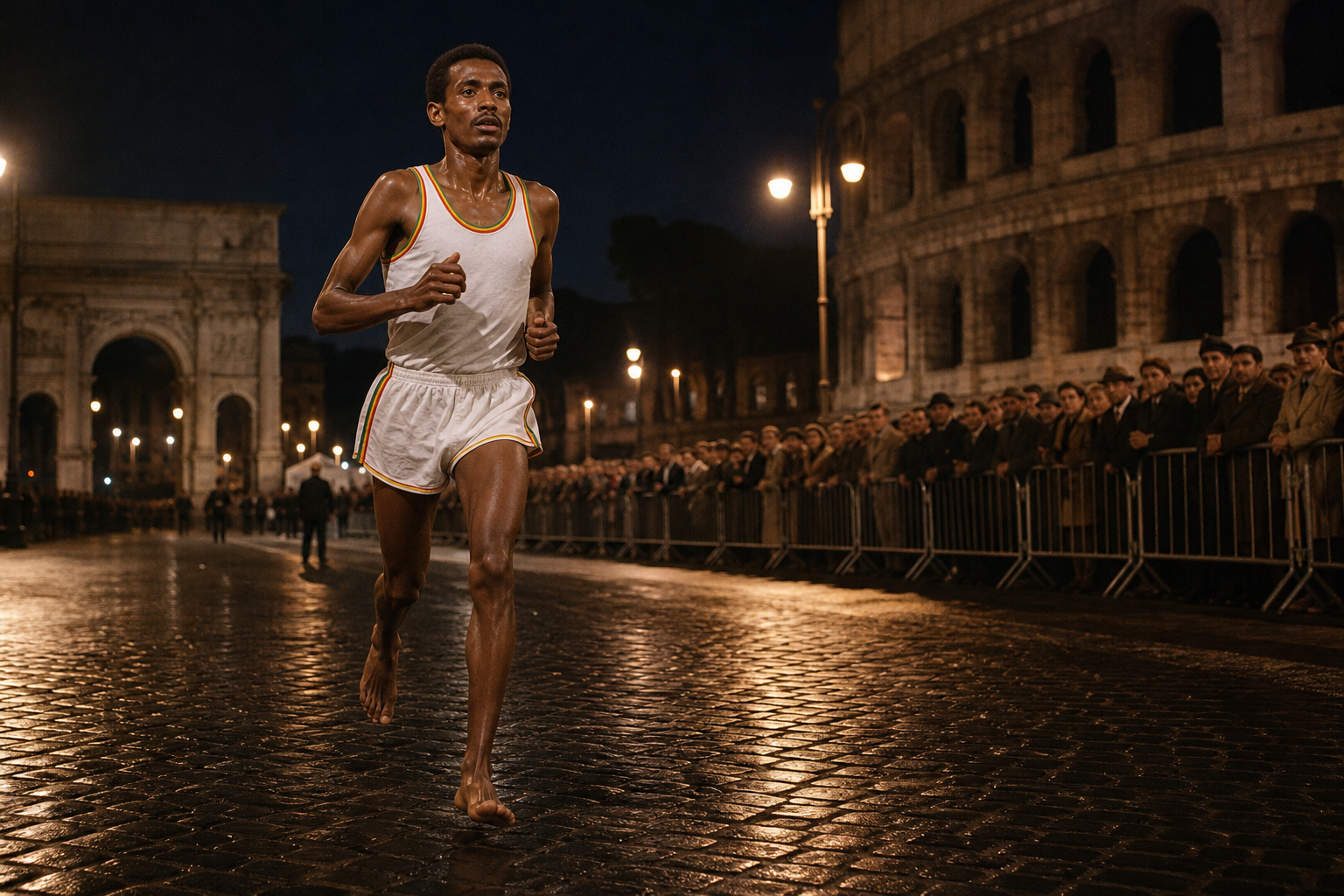
The enduring photograph is almost too powerful: Abebe Bikila moving through Rome at night, barefoot and apparently untroubled, while the stones beneath him carry the weight of an empire. It is one of sport’s perfect images. It is also an incomplete account of the athlete.
Bikila did not change distance running simply because he rejected shoes. He changed it by winning the Olympic marathon twice in radically different circumstances, by turning patience into a competitive weapon, and by forcing an international sporting establishment to reconsider where champions could come from. The barefoot victory made him visible. His second gold medal proved that the first was no accident.
To understand his influence, it helps to look past the myth and study the runner: how he arrived late to elite competition, how he prepared, how he managed two very different races, and how his example widened the imagined geography of endurance sport.
A champion who did not follow the expected path
Born in rural Ethiopia on August 7, 1932, Bikila was not developed by a large commercial athletics system. He joined the Imperial Bodyguard and emerged as a serious runner in his twenties. That matters because modern profiles often make greatness appear inevitable from childhood. Bikila’s route was narrower, less visible and dependent on an institution that happened to value physical training.
His coach, Onni Niskanen, was a Swedish military officer and physical-education specialist working with Ethiopia’s armed services. Niskanen did not discover a finished champion. He worked on Bikila’s posture, arm carriage, balance and rhythm, then paired technical refinement with long runs and demanding interval sessions. Training in the hills around Addis Ababa supplied altitude and strength, but geography alone was not a program. The program came from repeated work, observation and adjustment.
Bikila also belonged to a training community. Wami Biratu, one of Ethiopia’s early distance-running pioneers, frequently beat him before Rome and was expected to be part of the Olympic team before illness intervened. That relationship complicates the story of a solitary natural talent descending from the highlands. Bikila developed around rivals and partners who raised the standard even when the wider world did not know their names.
By the time he reached the 1960 Olympic Games, he was 28 and largely unknown outside Ethiopia. Many observers saw an anonymous entrant. Niskanen and Bikila saw a prepared marathoner.
Rome: the night the map changed
The Rome marathon began late in the day on September 10, 1960. It was the first Olympic marathon staged at night, its closing miles illuminated by torches along the Appian Way. The course finished near the Arch of Constantine rather than inside the main stadium. Heat, darkness, ancient paving and the championship field made it a test of control as much as speed.
Bikila ran barefoot. He had trained that way, and the shoes available to him did not offer a sufficiently comfortable reason to change. The decision was practical rather than theatrical. This distinction is important. Bare feet became the symbol, but the performance did not come from symbolism. It came from a runner choosing the equipment condition in which he trusted his body.
For much of the race, Bikila remained with Morocco’s Rhadi Ben Abdesselam. He did not turn the early miles into a demonstration or waste energy answering every movement. The decisive contest arrived late. As the pair approached the finish, Bikila accelerated and opened a clear gap. He crossed the line in 2 hours, 15 minutes and 16.2 seconds, then a world best for the marathon.
The result carried several kinds of significance at once. It was Ethiopia’s first Olympic gold medal. Bikila became the first Black African Olympic champion. An East African runner had defeated the established marathon powers on one of sport’s largest stages, not through a fortunate sprint after a slow race but with the fastest performance yet recorded for the distance.
History has attached political meaning to the route, particularly the presence of the Obelisk of Axum, which Fascist Italy had taken from Ethiopia. The setting inevitably resonated in a country that Italy had invaded within Bikila’s lifetime. Yet the runner’s accomplishment does not need an invented inner monologue. No one must claim to know precisely what he thought at every landmark. The verified achievement is forceful enough: an Ethiopian athlete won in Rome, under the lights, on his own terms.
The danger of remembering only the bare feet
A famous visual can simplify the skill that created it. If Bikila is remembered only as “the barefoot runner,” his win begins to resemble a charming anomaly—a tale about toughness, minimal equipment or an exotic training environment. That framing hides the elements that serious marathoners recognize: economical form, accurate judgment of effort, comfort with discomfort and a refusal to spend energy merely to look dominant.
It can also encourage a false lesson. Bikila’s victory was not proof that every runner should abandon shoes. He chose bare feet in a specific context, after training that way, while possessing an extraordinary body and preparation. Copying the most visible detail without copying the years of adaptation would confuse an outcome with a method.
The deeper lesson from Rome is compatibility. Equipment should serve the athlete rather than interrupt a proven movement pattern. Race tactics should fit fitness rather than public expectation. A championship marathon rewards the runner who can make calm decisions while fatigue steadily reduces the margin for error.
Tokyo: the victory that confirmed the revolution
Four years later, Bikila arrived at the Tokyo Olympics as a defending champion—but not an obvious favorite. Forty days before the marathon, he underwent an emergency appendectomy. The operation disrupted the final phase of his preparation and created an apparently reasonable explanation for failure. He recovered, rebuilt and started the race wearing shoes.
That change alone should end any attempt to reduce his identity to barefoot running. Bikila was not loyal to an image. He was loyal to performance.
The early pace in Tokyo was aggressive. Australian track star Ron Clarke led the opening stages, while Bikila stayed controlled. Near the middle of the race, the Ethiopian moved to the front and began separating from the field. His advantage grew without visible panic or repeated surges. He entered the National Stadium alone and finished in 2:12:11.2, another world best, more than four minutes ahead of silver medalist Basil Heatley.
Afterward, Bikila declined the blanket offered to him and performed a sequence of exercises on the infield. The calisthenics became another famous image, but their real meaning was competitive: the runner who had undergone surgery less than six weeks earlier had not merely survived. He had controlled the Olympic marathon so completely that he looked composed after the finish.
He was the first man to win two Olympic marathon titles and the first to defend the championship successfully. The two victories answered different doubts. Rome showed that an unknown Ethiopian could beat the world. Tokyo showed that a known champion, carrying expectation and a recent medical setback, could adapt and do it again faster.
How Bikila ran before the data age
Contemporary distance running is surrounded by measurements: lactate levels, power estimates, GPS splits, shoe geometry, hydration plans and altitude-response data. Bikila’s preparation did not have that information density, but it contained principles that remain recognizable.
- Specific endurance: Long runs in demanding terrain prepared him to maintain effort beyond the point where freshness disappeared.
- Structured intensity: Intervals developed speed and control rather than relying on steady mileage alone.
- Technical economy: His form was coached. Smoothness was refined, not treated as a mysterious gift.
- Competitive restraint: Both Olympic races showed the value of letting others make costly early statements.
- Adaptability: He could win barefoot or shod, as an outsider or favorite, after an uninterrupted buildup or a surgical interruption.
These traits resist romantic shortcuts. Altitude may have shaped his physiology, but many people live at altitude and do not become Olympic champions. Hardship may develop resilience, but hardship alone is not coaching. Bikila’s excellence arose from talent meeting a disciplined system, then being expressed through unusually clear race judgment.
Five ways he changed distance running
1. He shifted the sport’s center of attention
Before Rome, East Africa was not widely treated as the future center of global distance running. Bikila’s victory created a visible precedent. Later champions from Ethiopia, Kenya and neighboring countries built their own careers through different institutions and methods, but his result made it impossible to dismiss the region’s potential.
2. He expanded the image of an Olympic champion
Bikila arrived without the publicity, commercial backing or internationally familiar competition history attached to many favorites. His win exposed how easily sporting systems confuse familiarity with ability. Talent did not become real when foreign observers noticed it; their understanding simply caught up.
3. He elevated the marathon from survival to controlled speed
His two world-best performances showed a marathoner combining durability with decisive pace. Tokyo was especially influential: a defending champion separated from an elite field around halfway and sustained the advantage. The marathon could be commanded, not merely endured.
4. He made repeatability part of greatness
One championship can be framed as perfect conditions meeting a perfect day. Back-to-back Olympic victories require answers to changing courses, competitors, expectations and health. Bikila gave the marathon a new standard of championship mastery. Decades passed before another man matched two consecutive Olympic marathon wins.
5. He demonstrated that simplicity and sophistication can coexist
The bare feet looked simple. The pacing, technical preparation and adaptability were sophisticated. Bikila’s career warns against judging a training system by its visible equipment. Advanced thinking can exist without elaborate tools, while elaborate tools cannot replace sound decisions.
The difficult final chapter
Bikila returned for a third Olympics in Mexico City in 1968, but a fractured fibula forced him to withdraw before completing the race. His teammate and training companion Mamo Wolde won, extending Ethiopia’s hold on the Olympic marathon title. Even in withdrawal, Bikila’s presence linked a pioneering victory to a growing national tradition.
In 1969, a car crash caused spinal injuries that left him paralyzed from the waist down. He later competed in archery and table tennis at the Stoke Mandeville Games, an important predecessor of the modern Paralympic Games. This was not a miraculous return to his former physical life. It was a different form of participation, undertaken within permanent disability.
Bikila died in Addis Ababa on October 25, 1973, after a brain hemorrhage. He was 41. Ethiopia mourned him as a national hero, while the running world was still learning the scale of the change he had helped begin.
What modern runners can take from his story
Most runners should not imitate Bikila literally. They should not race barefoot without a long adaptation, treat an elite athlete’s surgery timeline as a recovery template, or assume mountain training automatically creates speed. His useful inheritance is a set of questions.
- Does the training match the event, or merely look impressive?
- Does equipment support a trusted movement pattern?
- Can form remain economical when the pace becomes uncomfortable?
- Is the athlete prepared to let competitors spend energy first?
- Can the plan change without damaging confidence?
Bikila’s best races were not frantic. They were patient until patience became separation. That quality is easy to admire and difficult to practice because it demands confidence without display. It asks a runner to believe in preparation while rivals occupy the lead and attention.
A legacy larger than a footprint
The barefoot stride through Rome remains a magnificent entry point into Bikila’s story. It should not be the exit. His greater achievement was to return in shoes, after surgery, under expectation, and run faster than anyone had before. Together, the two victories transformed surprise into authority.
Abebe Bikila changed distance running by making overlooked excellence impossible to ignore. He showed that a marathon could be raced with restraint and finished with command. He opened attention toward a region that would reshape the record books, and he established a championship standard that outlived the equipment choice most associated with his name.
The bare feet made history visible. The disciplined runner made it last.