
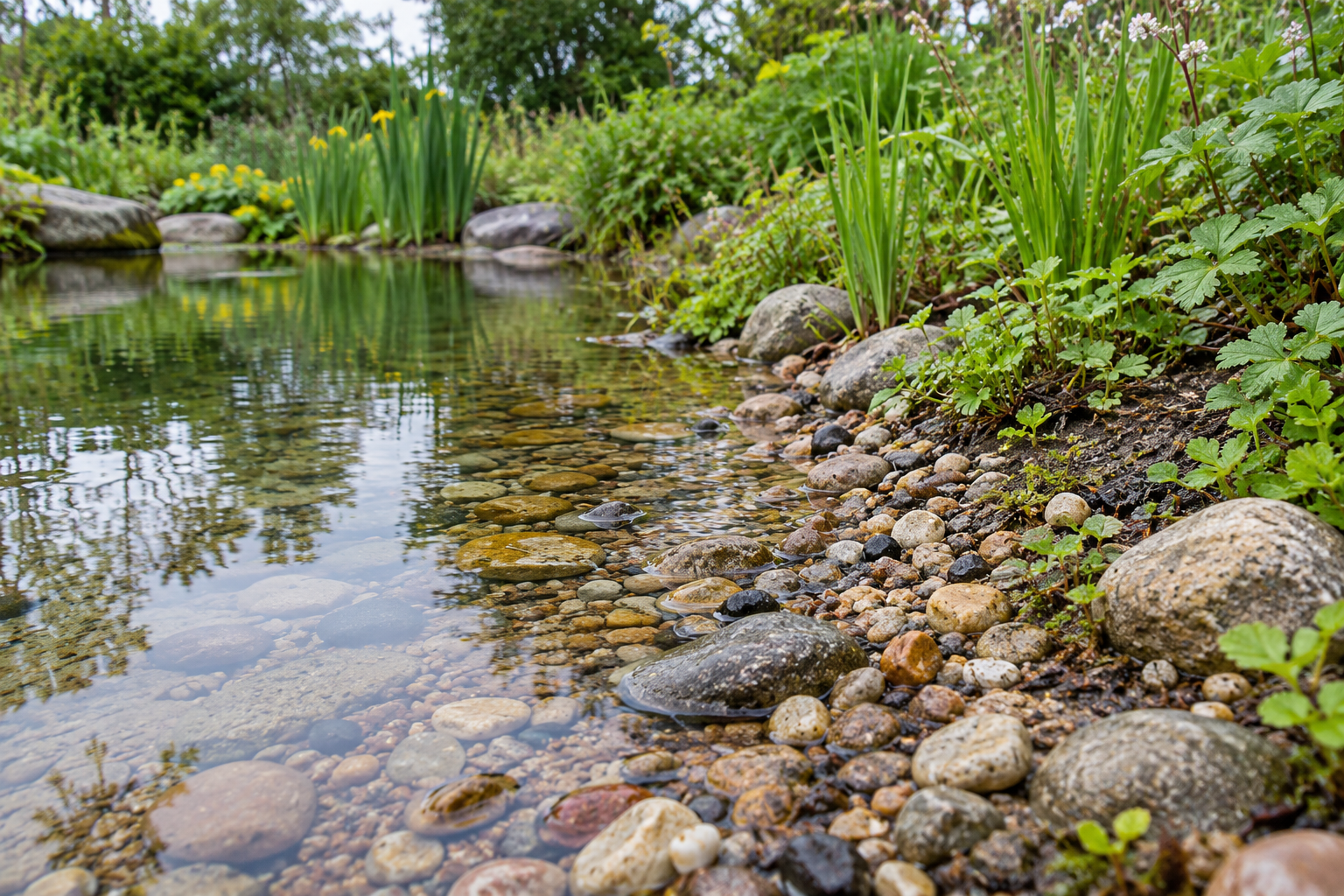
A garden pond can have attractive planting and clear water while still presenting a difficult edge. An animal that enters may face a smooth vertical wall when it tries to leave. For a pond intended to support wildlife, the route back to land deserves attention before another ornament or plant.
The key question is simple: can a small creature move from the water onto a stable, accessible bank? Look at the complete journey, including the point where the water meets the edge.
Follow the edge from water to soil
Wildlife-pond guidance recommends at least one long, shallow slope. A gently graded margin provides a transition rather than requiring an animal to climb a sudden step. It can also create a damp area as water levels fluctuate.
Look closely at your own pond from a safe, stable position. A flat stone beside the water may look like an exit without actually reaching below the surface. Likewise, a planting shelf can provide a resting place while leaving a steep final climb to the bank.
Trace the route in stages: water, shallow margin, edge, then surrounding ground. Identify any gap, overhang, or smooth-sided section that interrupts it. This observation is more useful than judging the pond only from its overall appearance.
Adapt the pond you have
A new pond offers the opportunity to design the slope into its shape. An existing straight-sided pond may need an added route. RHS guidance describes options including stable arrangements of rocks or pebbles, a partly submerged branch, or an appropriate ramp.
The important property is a usable transition, not a particular decorative style. Materials need to remain in place and provide suitable grip. A loosely balanced pile is a poor substitute for a stable margin. Avoid creating sharp edges or a structure that shifts when disturbed.
Consider access for maintenance too. If the route must be removed whenever you clear leaves, it is easy to forget to replace it. Include checking its position in the same routine as the maintenance task.
A raised container has two sides to the problem
A small container pond can provide wildlife habitat, but its rim may be high above the surrounding ground. The journey into the water and the journey out are separate parts of the design.
For a raised container, RHS advice calls for access on both the outside and the inside. An internal ramp that ends at the rim does not necessarily provide a route from that rim to the garden. Check where each end goes.
Picture a hypothetical tub with a good internal slope but a smooth outer wall. Adding more water plants would not solve that access problem. The useful next action is to review the external transition and the container’s overall suitability.
Check the route as the water level changes
An exit that reaches the water when the pond is full may leave a drop after a dry period. Revisit the meeting point between the route and the water rather than assuming the original arrangement remains effective.
Use a simple observation note if it helps: the usual water level, where the slope begins, and any point that becomes disconnected at a lower level. A photograph from the same safe position can make later comparisons easier.
Inspect again after work nearby, substantial weather changes, or a knocked container. You are checking whether the route still functions, not trying to keep every stone looking exactly as it did on installation day.
Let planting support the route
Suitable plants in and around a wildlife pond can provide cover and habitat. Choose species appropriate to your location and pond rather than transferring unfamiliar plants or animals from another water body.
Keep the intended exit identifiable while planting develops. A route can become difficult to inspect when growth covers its whole length. Plan how you will reach it for a visual check without trampling the surrounding habitat or leaning over an unstable edge.
Do not assume that wildlife will use the arrangement immediately. Allow natural colonisation and observe without repeatedly handling animals or disturbing the water to test your design.
Keep wildlife access separate from household safety
A shallow margin or animal ramp does not make a pond safe for children. Assess the water feature’s location, access, supervision needs, and appropriate protective measures separately. Seek suitable local advice where children or vulnerable people may encounter it.
For the conservation review, finish with one concrete check: a continuous, stable route should connect the water to land under the conditions the pond actually experiences. That modest detail can matter more than making the pond look elaborate.