
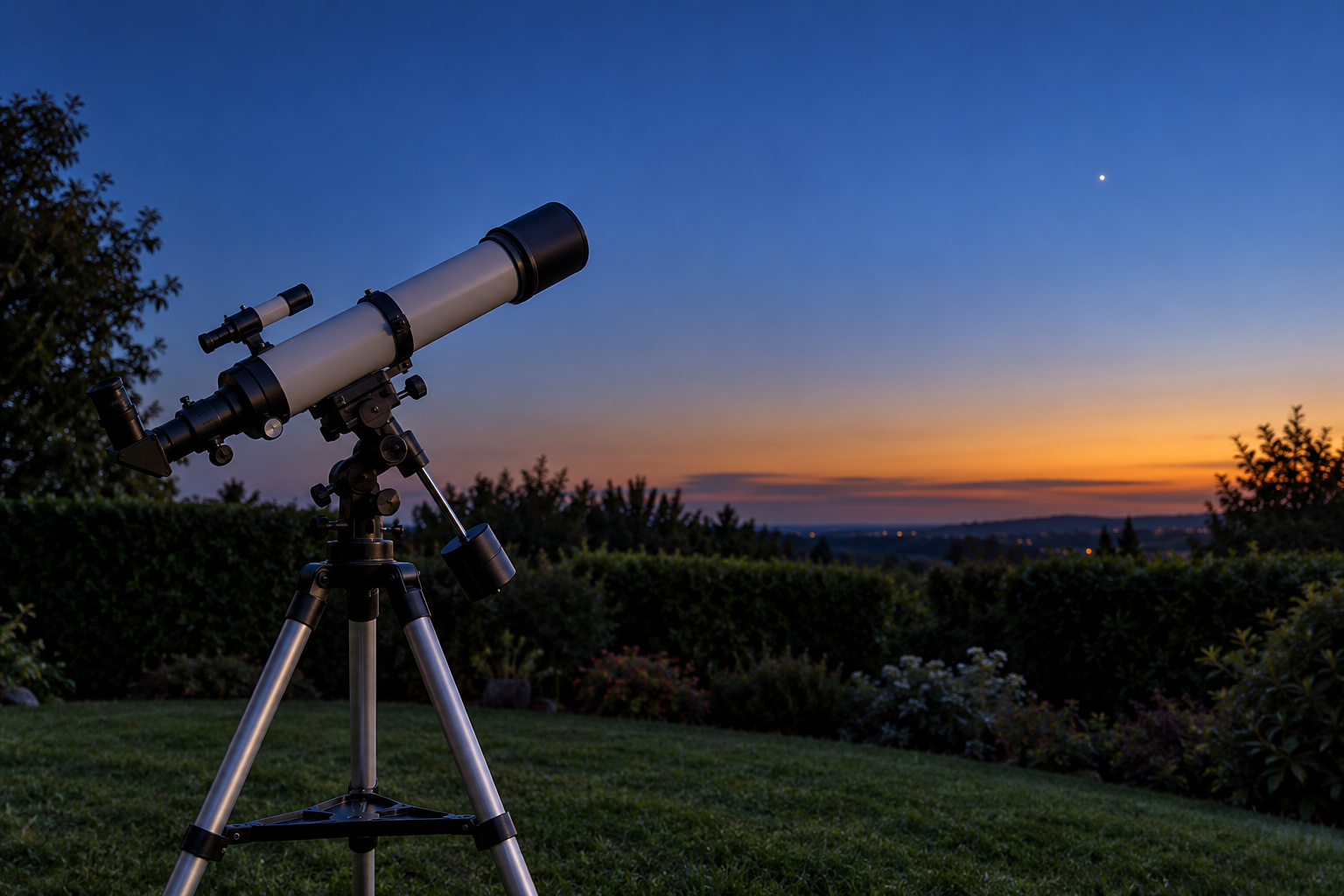
To the unaided eye, Venus usually looks like a very bright point. Through a telescope, it can reveal something unexpected: a shape resembling a tiny crescent Moon. On another occasion, the same planet can look more rounded and noticeably smaller.
Venus has not changed its physical shape. You are seeing different proportions of its sunlit side from different distances. Separating those two effects makes the changing view much easier to understand.
The sunlight comes from one direction
Venus shines by reflecting sunlight. At any moment, roughly half the planet faces the Sun and is illuminated, while the other half faces away. The boundary between those regions divides day from night.
Your view from Earth does not always face the centre of that illuminated hemisphere. Sometimes you see much of it; sometimes only a narrow part appears along the edge. The illuminated fraction visible to you is what gives the planet its phase.
This is a viewing-angle effect. The dark portion has not disappeared, and the bright portion is not a separate object. A crescent is the lit part of a whole planet viewed from a particular direction.
Venus travels inside Earth’s orbit
Venus orbits closer to the Sun than Earth does. As both planets move, our line of sight towards Venus changes relative to the direction of sunlight. That changing arrangement produces the progression between crescent, half-lit, and gibbous appearances.
A gibbous phase means more than half the visible disk is illuminated. It occurs when Venus is on the more distant part of its orbit relative to us. Near the far-side alignment with the Sun, nearly all its illuminated side faces Earth, but the planet is difficult to observe because it appears so close to the Sun.
When Venus is on the nearer part of its orbit, between our general direction and the Sun, much of the side facing us is dark. We may see only a slender illuminated crescent. That near-side arrangement is often called inferior conjunction when the planets and Sun are aligned in direction; it is not a safe telescope target for a beginner.
Distance changes the apparent size
Now consider a separate question: how wide does the planet look? Venus’s physical diameter remains effectively the same for this discussion. Its distance from Earth changes, so the angle it occupies in our sky changes too.
A nearby object appears larger than the same object farther away. You can recognise the idea by looking at a coin held near you and then at arm’s length. The coin has not grown or shrunk. Its apparent width has changed.
For Venus, the nearer crescent can therefore look larger through the same eyepiece than the farther gibbous disk. “Less illuminated” and “smaller-looking” are different measurements. A sketch should record both the fraction lit and the approximate width, rather than using one to stand in for the other.
Brightness is a third question
A thin phase does not automatically mean Venus will look faint. Its overall brightness depends on several factors, including distance and the amount of illuminated area visible. Its highly reflective cloud cover also contributes to the brilliant appearance.
Do not expect a simple rule that the fullest-looking phase must be the brightest. Nor should you expect a normal visual telescope view to show the planet’s surface. Venus’s dense clouds hide that surface; the main feature available to an observer is often the shape of the illuminated disk.
Look for a pattern over time
For a simple observing record, note the date, whether Venus appears crescent or gibbous, the apparent disk size, and the equipment used. Keep the magnification comparable when you want to compare size. Otherwise a different eyepiece can mimic a change caused by distance.
Add a note about the quality of the view. An uncertain impression should stay marked as uncertain. Several observations separated in time can be more instructive than a single ambitious drawing with details you could not confidently see.
Visibility changes through the orbital cycle and depends on your location. Check a current sky guide rather than assuming Venus is available every evening.
Keep the Sun out of the observing session
For beginner evening observations, wait until the Sun is fully below the horizon. Never sweep a telescope or binoculars towards the Sun while searching for Venus. Unfiltered optical viewing of the Sun can cause severe eye injury.
There is no need to chase the most difficult phase to understand the geometry. A safely observed half-lit or gibbous Venus already shows that this bright point is a sunlit world viewed from a moving Earth.