
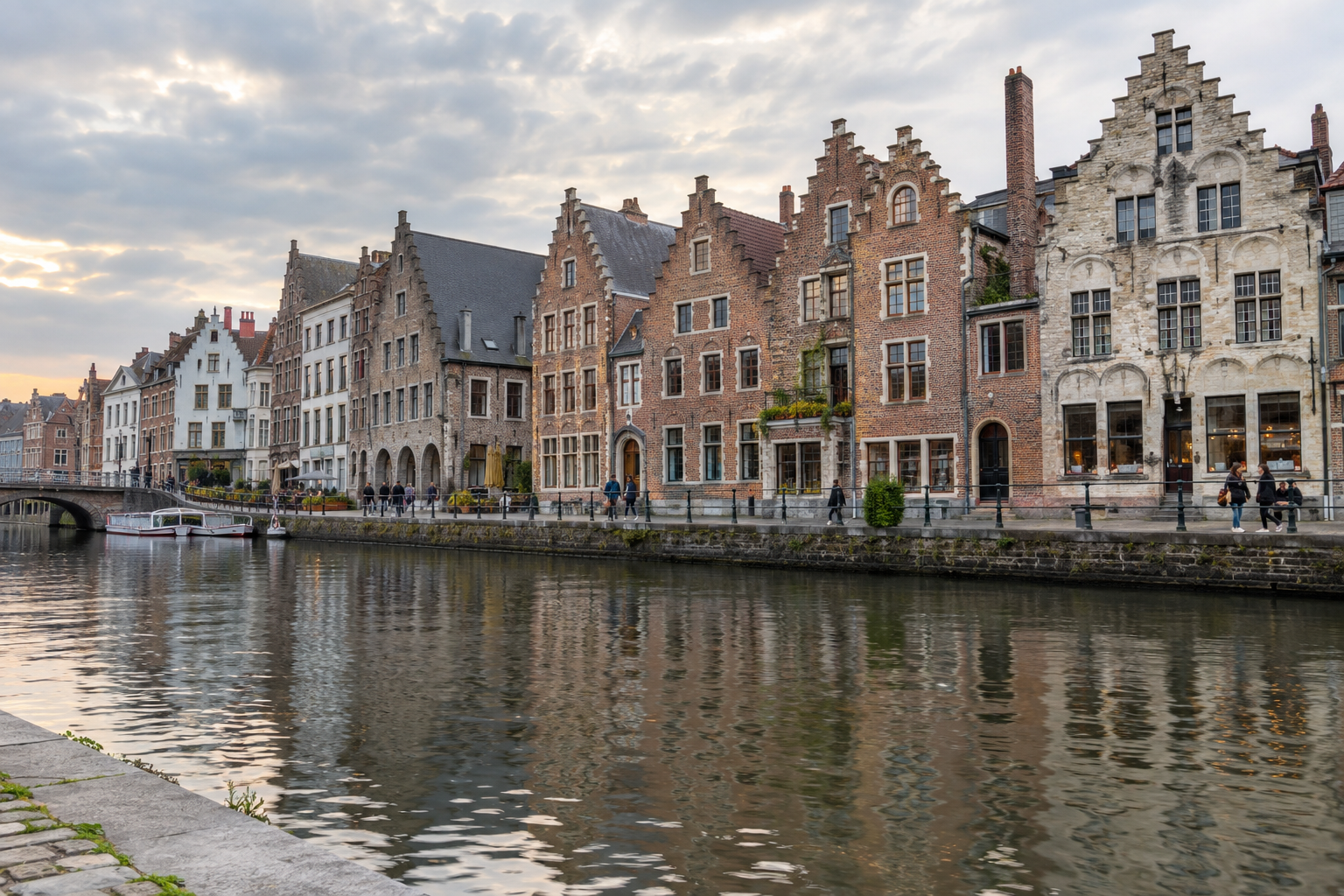
Ghent’s waterfront facades make a persuasive first impression, but they are only one way to read this Belgian city. Narrow residential streets offer a different scale, while the former docks reveal a landscape shaped by loading, storage, and redevelopment. Visiting these contrasting settings gives the trip a clearer purpose than collecting an ever-longer list of sights.
The three areas below are choices, not a route you must complete in a single day. Pick the setting that matches your interests, then add another if you have the time and energy. The reward is in noticing how the city changes around you.
For the broad view: Graslei and Korenlei
Begin with the historic quays of the Graslei and Korenlei. A quay is a built waterfront edge where boats can come alongside. Here, the relationship between buildings, river, and public space is immediately visible: the facades face an active corridor through the city.
Look across the water before standing directly in front of the buildings. From the opposite bank, rooflines and differences in height become easier to compare. Then move closer and pay attention to the details that disappear in a wide photograph, such as masonry, doorways, and the changing proportions of windows.
Give yourself a small observational task. Choose one facade and find three details you would otherwise have missed. This is a useful way to enjoy a famous setting without spending the entire stop searching for a photograph with no other people in it.
The quays also make a sensible pause between indoor visits. Sit where permitted, keep routes clear, and let the scene continue around you. Boats, pedestrians, and changing reflections can hold your attention without another ticket or a tightly timed activity.
For the close view: Patershol
Patershol offers a more enclosed experience. Its narrow streets and long-established street pattern contrast with the open views along the water. Restaurants are an important part of its appeal, but it remains a neighborhood where people live.
Approach it with the pace of a residential walk. Stay out of doorways, avoid turning private windows into photographic subjects, and lower your voice on narrow streets. The area’s character depends partly on ordinary life continuing alongside visitors.
Instead of choosing a restaurant solely because it appears on a long recommendation list, decide what you want from the meal. A quick lunch, a leisurely dinner, and a stop with children impose different needs. Check the restaurant’s own current menu, opening arrangements, and reservation requirements before committing.
If everyday history interests you, consider the House of Alijn as an indoor complement to the streets. Confirm its current visitor information before arranging the day around it. A museum stop can provide context; the lanes outside give you room to reflect without immediately moving to another large attraction.
For a wider horizon: Houtdok and the old docks
North of the city center, the Oude Dokken area presents another part of Ghent’s story. Houtdok combines traces of the former port with a promenade and the Kapitein Zeppos park. Quay walls, cranes, railway tracks, and bollards help make the earlier working landscape legible.
A bollard is a sturdy post used for securing boats. Details like this are worth noticing because they explain what a waterfront was built to do. Ask yourself where goods would have moved, where vessels could have stopped, and how much space those activities required.
This area suits a traveler who enjoys industrial heritage, open space, or observing urban change. It should not be treated as another medieval streetscape. The interest lies in the contrast between older infrastructure and newer uses.
Check a current local map before setting out. Choose a manageable section and a clear return route rather than assuming that every waterfront path joins into a convenient short loop. Redevelopment areas can change, and an appealing line on a map does not establish access on the ground.
Choose your combination by interest
- Architecture: spend longer comparing the quays, then use Patershol to examine buildings at street level.
- Everyday life: pair Patershol with a carefully chosen meal and an indoor visit that adds context.
- Urban change: give the former docks a substantial block of time, with the historic waterfront as a comparison.
Check walking surfaces, steps, and venue access against your own mobility needs. Cobblestones and waterfront edges deserve more attention than a general claim that an area is walkable. Leave enough time to take a different route if the first choice proves uncomfortable.
At the end of the visit, compare one detail from each setting you explored: perhaps a decorative facade, a modest doorway, and an old mooring point. Together, they describe a city at different scales. Ghent becomes more memorable when those scales have time to stand apart.