
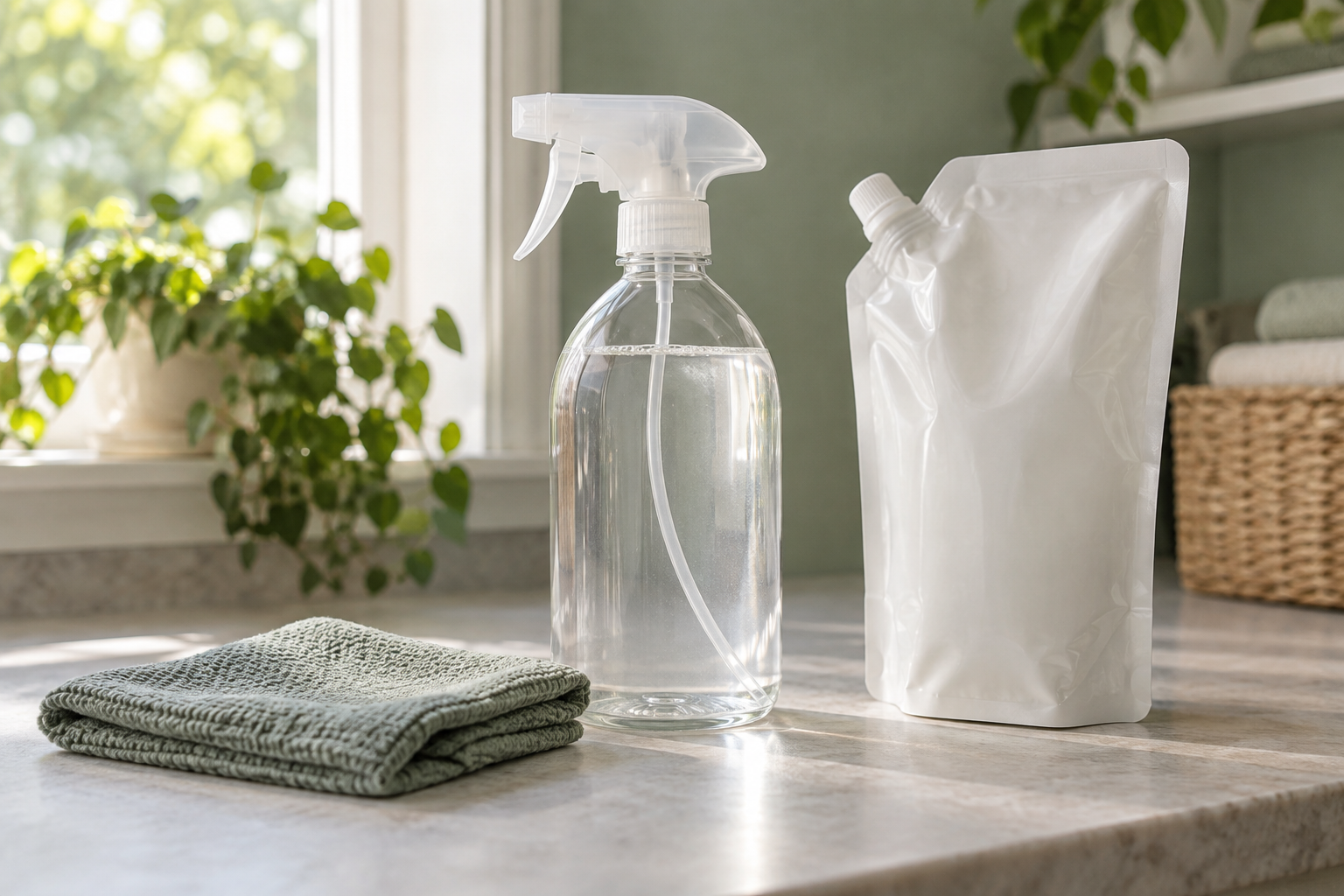
A refill pouch can look like an obvious improvement over another spray bottle. Yet two packages of similar size may provide very different amounts of usable cleaner, and a concentrate is only convenient if the bottle and instructions make it easy to prepare correctly. The useful comparison begins with the cleaning job you already do.
Choose one product you regularly finish, such as a general surface cleaner. Keep its empty packaging long enough to compare it with a possible refill. You are looking for a workable replacement for that particular product, with understandable instructions and a realistic route for disposing of the remaining packaging.
Compare the amount you can actually use
A ready-to-use refill goes into an approved bottle at its supplied strength. A concentrate requires the amount of water specified by its manufacturer. The volume printed on the front of the concentrate is therefore different from the volume of prepared cleaner it can make.
Consider a hypothetical pouch advertised as making four 500-milliliter bottles when prepared as directed. That represents two liters of usable solution. Compare its packaging and purchase cost with two liters of the alternative, rather than with one 500-milliliter spray bottle. The example is arithmetic, not a suggested mixing ratio.
Check whether the advertised yield applies to the cleaning task you intend. If the label gives different doses for different uses, select the relevant one. A calculation based on the weakest permitted dose tells you little about a job requiring a different concentration.
Make the bottle part of the decision
Refilling works best when the container is designed for repeated use with that product. Check the manufacturer’s compatibility instructions, the closure, and the trigger. A bottle that leaks or sprays badly can turn a promising purchase into another replacement.
Do not assume that any old container is suitable because the liquid fits. Avoid beverage containers, and do not combine leftovers from different cleaning products. If the manufacturer requires a particular refill bottle or preparation method, include that requirement in your comparison.
Before buying, answer three practical questions:
- Can you identify the correct fill level and dose without improvising?
- Are the product name and safety directions available after the outer package is discarded?
- Can the bottle be stored securely and used comfortably by the people who clean your home?
Keep prepared solutions clearly labeled and follow the product’s storage instructions. Store cleaning products away from children and pets. A reusable bottle should preserve the information needed to use its contents safely.
Read the environmental claim narrowly
Less packaging and safer ingredients are different claims. A compact refill may reduce the amount of packaging you buy for a given volume, but that alone does not establish the product’s overall environmental impact. Manufacturing, materials, transport, use, and disposal all contribute.
Similarly, words such as natural or plant-based do not tell you everything about a formulation. A recognized program with defined criteria gives a more specific basis for evaluation. In the United States, EPA’s Safer Choice label identifies products assessed against requirements covering ingredients and other product criteria.
Read what a certification actually covers. Do not treat an ingredient-focused label as proof that every part of the packaging is recyclable in your neighborhood, or that the product is suitable for every surface. Those are separate checks.
Follow the pouch after it is empty
Look for disposal instructions for the pouch, cap, and any inner packaging. Then compare those instructions with what your local collection service accepts. A recycling symbol or material description does not, by itself, confirm local acceptance.
If packaging weights are provided, compare the total packaging required for the same usable volume. Include a replacement trigger or bottle when the comparison period realistically requires one. Without reliable weights, describe the observation honestly: fewer complete bottles purchased is something you can count; a precise carbon saving is not something you can infer from appearance.
Try one refill before stocking up
Use the product on a permitted surface and follow its directions. Notice whether the preparation is straightforward, the cleaner performs the intended task, and the bottle remains reliable. Do not increase the concentration to compensate for disappointment unless the label explicitly allows that dose.
Record when you start and finish the refill. This simple note helps distinguish an economical product from one you use up faster. Include shipping or travel costs if obtaining refills requires a separate order or journey.
After one complete cycle, decide whether to continue. A good refill system earns its place through repeat use: you understand the dose, can obtain the replacement, trust the bottle, and know what happens to the empty pack. That is a firmer reason to switch than the size of the package on the shelf.