
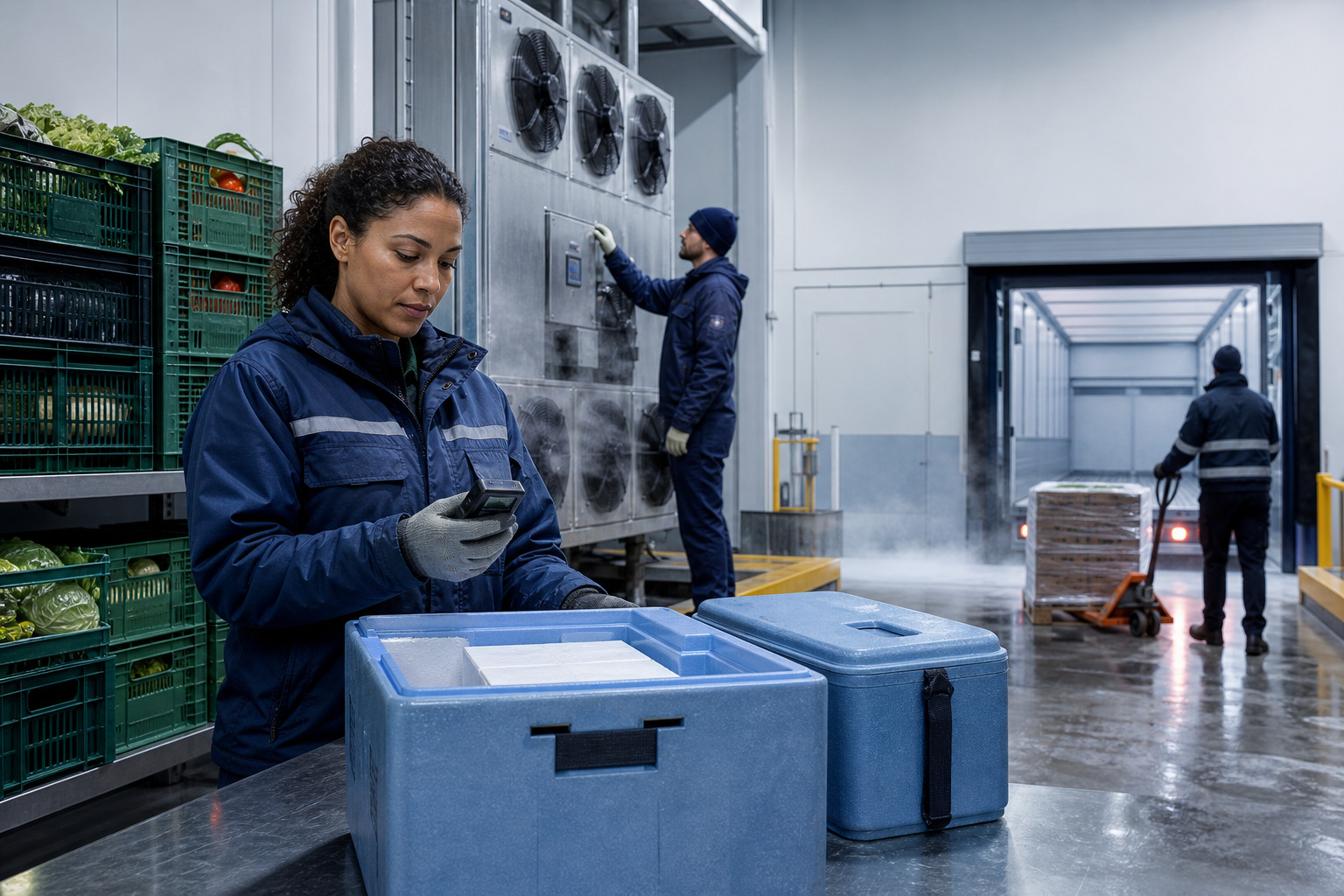
A carton of berries, a tray of biologic medicine, and a case of laboratory reagents appear to have little in common. Yet each may depend on an unbroken chain of people, equipment, records, and decisions that keeps it within approved conditions from origin to use. That chain is easy to overlook when it works. When it fails, quality can be lost without an obvious change in appearance.
The cold chain is therefore more than refrigerated transport. It is a coordinated operating system. Warehouse teams control receiving and storage, drivers protect loads between facilities, technicians keep refrigeration assets reliable, quality specialists interpret excursions, and analysts turn millions of readings into useful decisions. For job seekers, this creates a field with unusually varied entry points. A person can arrive through skilled trades, logistics, food safety, pharmacy operations, engineering, data, or customer service and still contribute to the same outcome: delivering a usable product with its history intact.
Understand the Chain Before Choosing a Job
Every cold-chain lane begins with a product requirement. The required range, allowable exposure time, packaging method, handling rules, and release process come from the product and its governing procedures. There is no universal temperature that fits every food or medicine. Some products are chilled, others frozen, and some require much colder storage. A limited controlled exposure may be acceptable for one item and disqualifying for another.
That product requirement becomes a series of handoffs. Goods move from production to staging, loading, transport, receiving, storage, picking, and final delivery. Each handoff creates questions: Was the space preconditioned? Was the probe positioned correctly? Was the door open too long? Did the receiver compare the seal and shipment record? Cold-chain careers differ mainly in which questions a person owns and how that person proves the answer.
Warehouse Operations: Where Discipline Becomes Visible
Cold-storage associates, receivers, pickers, inventory controllers, and shift leads make the written process real. They inspect incoming loads, verify quantities and identifiers, move products into the correct zone, rotate stock, assemble orders, and record exceptions. The best operators do not treat scanning as clerical work. They understand that identity, location, time, and condition must remain connected.
Entry-level candidates can stand out through careful work rather than technical vocabulary. Employers need people who follow gowning or hygiene rules, notice damaged packaging, keep doors closed, separate questionable goods, and escalate rather than improvise. Comfort with handheld scanners and warehouse systems helps, but accuracy under time pressure matters more. A strong operator leaves the next person a clear, trustworthy state instead of a mystery.
Transport Coordination: Managing Time Between Doors
Dispatchers, route planners, carrier coordinators, and transport supervisors design the journey between controlled facilities. They select equipment, confirm capacity, arrange pickup windows, check preconditioning, monitor progress, and prepare alternatives for delays. Their work balances product protection with driver hours, traffic, weather, dock availability, and customer requirements. A route that looks short on a map may be risky if it ends at a congested receiving point.
Excellent coordinators think in thresholds and decision points. They know when a late arrival is merely inconvenient and when remaining thermal protection is becoming uncertain. They document who was contacted, what evidence was available, and why a diversion or hold was chosen. Communication is a core technical skill here: the coordinator must translate a sensor alarm into a precise action for a driver, warehouse, customer, or quality team.
Drivers and Delivery Specialists: Custody on the Road
Refrigerated drivers and medical couriers hold direct custody during the most variable part of the trip. They perform vehicle checks, confirm set points against instructions, observe loading, protect airflow, manage seals, and capture delivery evidence. They also encounter real-world complications that a routing screen cannot fully represent: a closed gate, a damaged pallet, an idling restriction, or a receiver who is not ready.
This lane suits people who combine independence with procedural discipline. The job is not simply to make time. It is to preserve conditions while making safe, lawful decisions. A driver who reports an abnormal sound early, refuses an undocumented change, or photographs damage according to procedure may prevent a much larger loss. Experience with refrigerated equipment and regulated deliveries can open paths into dispatch, training, fleet safety, or regional operations.
Refrigeration and Facilities: Keeping the Environment Stable
Refrigeration technicians, controls specialists, electricians, and facilities engineers maintain the physical systems behind the chain. Their world includes compressors, evaporators, sensors, insulation, defrost cycles, backup power, alarms, and building controls. A repair must restore performance without introducing contamination, unsafe conditions, or an unrecorded change to a qualified space.
Preventive maintenance is as important as emergency repair. Technicians look for drift, ice buildup, blocked airflow, worn door seals, unusual cycling, or rising energy use before a failure stops operations. Skilled-trade training can be a direct route into this work. Over time, a technician who learns documentation, calibration boundaries, and regulated change control can progress toward controls engineering, commissioning, reliability leadership, or facility design.
Quality Assurance: Deciding What the Evidence Means
Quality specialists write and review procedures, train teams, assess deviations, approve corrective actions, and decide whether affected product can move forward. When a temperature excursion occurs, they do not judge by instinct or appearance. They preserve the material, secure the records, establish the timeline, confirm the monitor and product identity, and obtain the appropriate stability or manufacturer assessment.
This work rewards calm reasoning and precise writing. A useful investigation separates fact from assumption, explains why the event occurred, and proposes controls that address the cause rather than the symptom. Candidates often enter from laboratory, food safety, pharmacy, manufacturing, or operations backgrounds. Familiarity with audits helps, but the deeper skill is building a defensible connection between procedure, evidence, risk, and disposition.
Validation and Temperature Mapping: Proving the System Works
Validation engineers and mapping specialists test whether a room, vehicle, container, or process performs as intended. They develop protocols, place calibrated sensors, challenge likely hot and cold locations, analyze results, and document conclusions. Mapping is not decorative data collection. Sensor placement, season, loading condition, door activity, and equipment state can all affect what a study proves.
These roles sit between engineering and quality. They require attention to measurement uncertainty, calibration status, traceable records, and deviations from the test plan. A junior specialist may begin by preparing equipment, checking logger inventories, cleaning datasets, and assembling reports. With experience, that person can design studies, qualify new lanes, assess changes, and explain technical findings during an audit.
Packaging Engineering: Designing Time Into a Shipment
Not every shipment uses an actively refrigerated vehicle. Packaging engineers create insulated systems that can protect a product for a defined journey using materials, coolant, configuration, and packing instructions. They study heat transfer, payload geometry, seasonal conditions, handling patterns, and the consequences of opening a container. A successful design must perform reliably and remain practical for the people who pack and unpack it.
The work includes prototypes, chamber tests, transport trials, specification control, and continuous improvement. Sustainability adds another design problem: reduce material and waste without weakening protection or making return logistics unworkable. People enter through mechanical engineering, materials science, industrial design, laboratory testing, or packaging operations. Curiosity about both physics and human behavior is valuable because a theoretically strong design can still fail if its instructions are confusing.
Calibration and Metrology: Trusting the Measurement
A temperature reading is only useful when the organization knows which device produced it, whether the device was suitable, and how its performance was checked. Calibration and metrology technicians manage reference equipment, test sensors, document tolerances, label status, and control devices that are damaged, overdue, or outside acceptance criteria.
This lane fits detail-oriented people who enjoy instruments and repeatable methods. The work may look narrow, yet it supports every later decision. If a logger is unreliable, a perfect chart can create false confidence. Training in electronics, instrumentation, laboratory practice, or industrial maintenance can provide a foundation. Advancement may lead to metrology leadership, automation, validation, or quality systems.
Cold-Chain Data: Turning Readings Into Decisions
Modern networks can produce more temperature records than a team can manually review. Data analysts, monitoring specialists, system administrators, and product managers help make that stream actionable. They configure devices, maintain master data, define alert rules, monitor dashboards, investigate missing readings, and connect shipment events with orders, locations, and custody changes.
The strongest analysts understand operational context. A spike during an open-door event is different from a slow drift across many assets, and a missing transmission is not automatically a temperature failure. Useful analysis distinguishes product risk, equipment health, and data quality. Skills in spreadsheets, databases, visualization, and structured problem solving can open the door, while knowledge of operations keeps conclusions grounded.
Inventory and Demand Planning: Preventing Avoidable Pressure
Planners influence the cold chain before a box moves. They forecast demand, set stock policies, balance capacity, coordinate replenishment, and watch expiry. Poor planning creates rushed shipments, crowded rooms, unnecessary transfers, and emergency use of expensive transport. Good planning gives operations enough time and space to follow the intended process.
This role requires comfort with uncertainty. Demand can change, production can slip, and capacity is rarely infinite. Planners compare scenarios and make tradeoffs visible rather than hiding them in a single forecast. Experience in inventory control, procurement, production planning, or analytics transfers well. The cold-chain dimension adds shelf life, qualified capacity, lane constraints, and the cost of condition-sensitive waste.
Customer and Clinical Coordination: Protecting the Final Handoff
Cold-chain service does not end when a vehicle reaches an address. Customer coordinators, pharmacy operations staff, clinic logistics teams, and field service specialists prepare the receiving site. They confirm hours, storage capacity, trained contacts, delivery instructions, and escalation routes. For a small clinic or specialty patient, the final handoff may be the least standardized part of the journey.
People with service backgrounds can thrive here if they learn the product rules and resist vague communication. “Delivery attempted” is less useful than a timed account of who was contacted, where the shipment remained, and what condition evidence is available. Empathy matters because the receiver may be under pressure, but empathy must be paired with a process that protects the product.
Emergency Readiness: Careers Built Around the Unexpected
Power outages, equipment failures, storms, labor disruption, and road closures test whether the chain is resilient. Business continuity specialists and operations leaders prepare backup storage, alternate carriers, contact trees, generator tests, fuel plans, and product-priority rules. During an event, they coordinate decisions while preserving a reliable event log.
Emergency work is not heroic improvisation. It is rehearsed flexibility. Teams run drills, confirm that contact information is current, identify who can authorize a move, and verify that backup capacity truly exists. Candidates who remain composed, communicate concisely, and learn from exercises can grow into continuity, risk, network control, or crisis leadership roles.
Build a Skills Stack, Not a Collection of Buzzwords
A useful cold-chain skills stack has four layers. First is operational literacy: product identity, handoffs, hygiene, safety, and basic inventory control. Second is measurement literacy: sensors, calibration status, alarms, and the difference between a reading and a conclusion. Third is documentation: clear records, version control, deviation reporting, and traceable decisions. Fourth is communication across functions.
Choose training that supports the lane you want. A facilities candidate may prioritize refrigeration, electrical safety, and controls. An operations candidate may focus on warehouse systems, safe equipment use, and regulated handling. A quality candidate may study investigations, auditing, and risk assessment. Certifications can help signal preparation, but employers will still look for evidence that you can notice a problem, protect the process, and explain what you did.
Create Evidence Before You Have the Job Title
A practical portfolio can demonstrate judgment without using confidential material. Map the handoffs for a fictional chilled shipment. Write a one-page response plan for a delayed delivery. Analyze a sample temperature series and list the questions that must be answered before disposition. Design a preventive-maintenance checklist or a simple logger inventory with calibration due dates.
For each exercise, state assumptions and boundaries. Do not pretend to release a medical product or declare food safe without the required authority. Show instead how you would preserve evidence, quarantine uncertain goods, contact the responsible specialist, and document the decision. This signals maturity: cold-chain professionals know when to act and when a conclusion belongs to someone else.
Interview the Workflow, Not Just the Employer
During a job search, ask how the organization handles alarms, deviations, training, preventive maintenance, and handoffs. Learn whether monitoring is continuous or periodic, who reviews it, and what happens outside normal hours. Ask how new employees are qualified for tasks and how temporary staff receive instructions. The answers reveal whether responsibility is supported by a working system.
Also examine the daily reality. Cold facilities can involve protective clothing, shift work, noise, repetitive movement, and strict safety rules. Transport roles may include variable hours. Quality and monitoring positions may carry on-call duties. These conditions are not reasons to avoid the field, but they should be matched honestly with your preferences, health, and family obligations.
See the Career Ladder as a Network
Cold-chain careers rarely form a single vertical ladder. A receiver can become an inventory controller, trainer, dispatcher, or quality technician. A refrigeration mechanic can move into controls, commissioning, energy management, or reliability. A monitoring analyst can progress into systems implementation, lane qualification, or network design. Cross-functional credibility often creates more options than chasing a title alone.
Keep a record of improvements you helped produce: fewer unexplained alarms, faster response, better inventory accuracy, a clearer instruction, a successful mapping study, or a recurring fault eliminated. Describe the starting condition, your contribution, the evidence, and the sustained result. That record turns everyday reliability into a visible career story.
The Work Is Stewardship
Food and medicine move through a cold chain because their quality cannot be taken for granted after uncontrolled exposure. Every role therefore carries a form of stewardship. The operator protects a handoff, the technician protects the environment, the analyst protects the signal, and the quality specialist protects the decision.
For someone seeking meaningful technical work, the field offers many doors. Start with one lane, learn how it connects to the whole system, and become reliable at the boundaries where information and custody pass between people. The most valuable cold-chain professional is not merely the person who keeps something cold. It is the person who helps the organization know, with credible evidence, that the product was protected all the way through.