
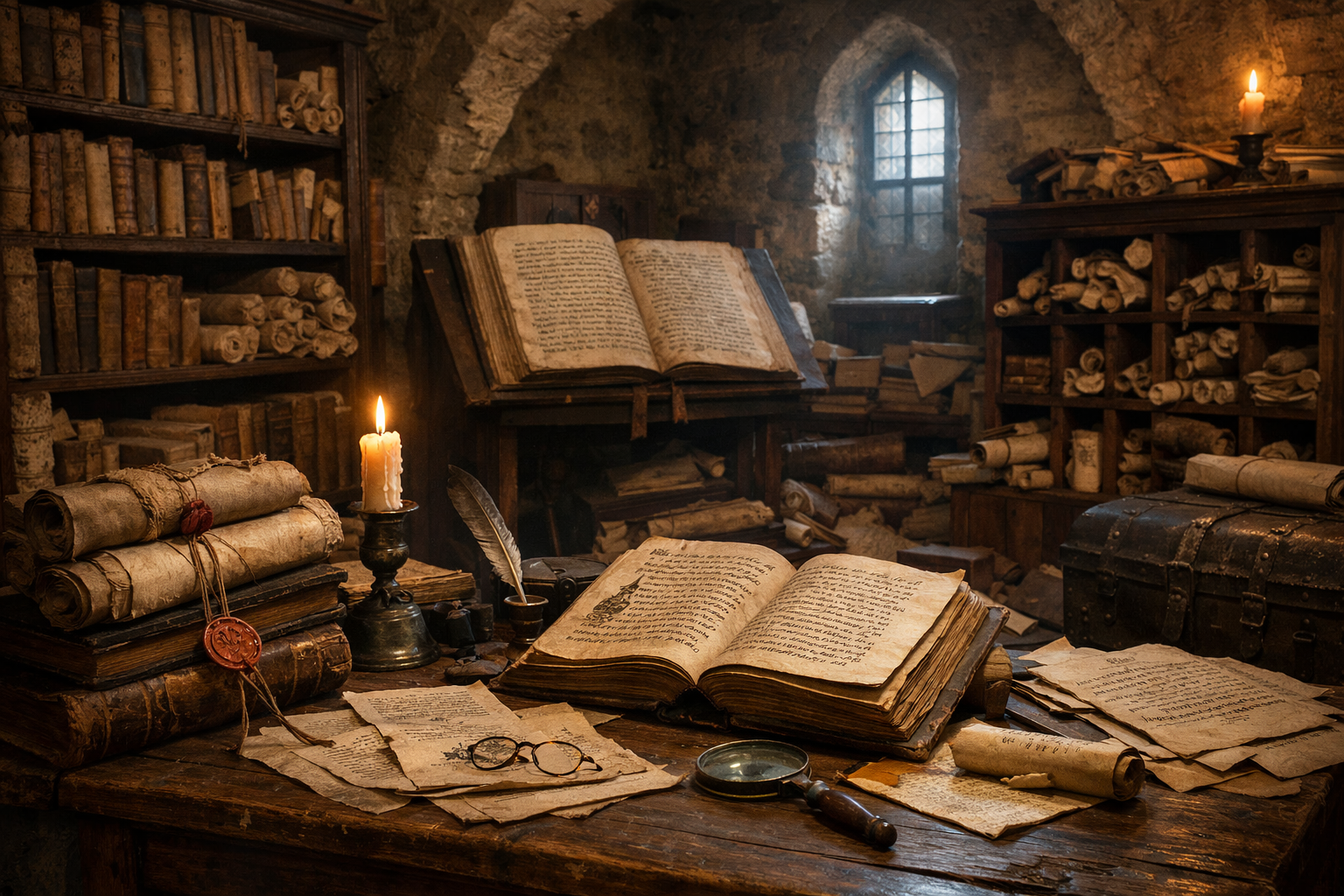
The Medieval World in Its Own Records
Medieval history is often imagined through castles, kings, crusades, and cathedrals, yet the true foundations of our knowledge lie in archives. Long before modern filing systems or national record offices, medieval societies created and preserved written evidence for practical, political, and spiritual reasons. Charters confirmed land rights, monasteries copied sacred texts, royal chanceries recorded government orders, and town clerks tracked taxes, disputes, and trade. Together, these materials form the documentary backbone of medieval history.
Archives from the Middle Ages do not survive evenly. Some regions preserved vast collections, while others lost records to war, fire, neglect, or reform. Even so, what remains allows historians to reconstruct everyday life as well as major events. Medieval archives are not simply containers of old documents; they are active witnesses to power, memory, and identity.
What Counts as a Medieval Archive?
In the medieval period, an archive was rarely a single public institution in the modern sense. Instead, records were scattered across monasteries, cathedrals, castles, town halls, guild houses, and private estates. A bishop might keep papal letters and legal rulings, while a noble household stored marriage agreements, rents, and military obligations. Urban communities developed their own documentary traditions through council minutes, merchant accounts, and judicial registers.
These records survive in many forms. Parchment charters with wax seals are among the most iconic, but they are only one category. Medieval archives also include chronicles, saints’ lives, cartularies, tax rolls, manorial court records, maps, liturgical books, and personal correspondence. Some were created as official instruments of law; others were copied to preserve memory or defend institutional rights.
- Charters: legal grants, privileges, and confirmations of property or status.
- Cartularies: manuscript compilations of copied charters, often made by monasteries or churches.
- Chronicles: narrative histories written by monks, clerics, or court historians.
- Account rolls: records of revenues, expenses, rents, and taxation.
- Court records: documentation of disputes, crimes, obligations, and local justice.
- Letters and registers: correspondence and administrative copies of outgoing documents.
Why Medieval People Kept Records
Record-keeping in the Middle Ages was driven by necessity. Land was wealth, and written proof could secure ownership across generations. Religious houses documented donations to protect endowments and to commemorate benefactors in prayer. Kings and princes issued written orders to project authority over wider territories. Towns preserved privileges granted by rulers because legal autonomy could depend on a single parchment.
Archives also served memory. Medieval institutions were deeply concerned with legitimacy, precedent, and continuity. A monastery that could produce an old charter might win a dispute over a field, a mill, or a church. A dynasty with a written genealogy could reinforce its political standing. In this sense, archives were tools of both administration and persuasion.
The Monastery as a Center of Preservation
Monasteries played a central role in the survival of medieval history. Monks and nuns not only copied biblical and theological texts, but also preserved legal and historical records. Scriptoria produced manuscripts with extraordinary care, while monastic libraries became repositories of local memory. Because many religious houses endured for centuries, they accumulated archives that linked communities to their past.
Chroniclers in monasteries often recorded famines, battles, royal successions, weather events, and unusual signs interpreted as divine messages. Their writings are invaluable, though never neutral. A monastic author might praise a patron, condemn a rival lord, or frame political turmoil in moral terms. Historians therefore read such sources critically, balancing them against legal documents and archaeological evidence.
Reading the Archive Critically
Medieval records can seem authoritative because they are old, formal, and often beautifully written. Yet every archive reflects the priorities of those who created it. Most documents were produced by literate elites: clerics, officials, landlords, and merchants. The voices of peasants, women, laborers, and marginalized groups are often indirect, appearing only when they entered legal disputes, paid taxes, or received mention in narrative texts.
This imbalance does not make the archive useless; rather, it requires careful interpretation. Historians ask who created a record, for what purpose, and under what circumstances. A charter may present a gift as voluntary piety when political pressure was involved. A royal chronicle may exaggerate victory. A copied cartulary may omit inconvenient details from an earlier original. The archive preserves truth, but rarely the whole truth.
Forgery, Loss, and Survival
One of the most fascinating aspects of medieval archives is the presence of forgery. Institutions sometimes created false or altered documents to defend claims they believed were ancient or deserved. These were not always crude deceptions; some were carefully crafted to imitate earlier styles and seals. Detecting forgery has become a specialized historical skill, involving handwriting analysis, formula comparison, and material study.
Equally important is loss. Countless records disappeared through damp, insects, warfare, dissolution of monasteries, and simple reuse of parchment. What survives is often accidental. Historians must therefore remember that the medieval archive is fragmentary. Entire communities may be known from a handful of references, while powerful institutions can dominate the record simply because they preserved paper trails more effectively.
What Archives Reveal About Medieval Life
Despite gaps and bias, archives open vivid windows onto medieval society. Manorial accounts show what crops were planted, how much grain was harvested, and what labor tenants owed. Urban registers reveal apprenticeships, market regulations, and the rhythms of commercial life. Wills illuminate family ties, devotion, and material possessions. Legal records expose violence, inheritance conflicts, debt, and negotiation.
Even the driest administrative texts can be unexpectedly human. An account roll may mention repairs after a storm, payments to a midwife, or ale bought for workers. A court case may preserve insults shouted in a village lane. A monastic chronicle may pause to describe fear during plague or wonder at a comet in the sky. Through such details, medieval archives make the past tangible.
The Medieval Archive in the Modern Age
Today, medieval archives are preserved in libraries, cathedral collections, municipal repositories, and national archives. Conservation science helps stabilize parchment, ink, and bindings, while digitization has transformed access. Scholars and the public can now view manuscripts online that once required long travel and specialist permission to consult. Digital catalogues also allow new connections across dispersed collections.
Yet technology does not replace the need for historical skill. Understanding a medieval document still demands knowledge of language, paleography, law, and institutional context. The archive remains a place of interpretation as much as preservation. Its power lies not only in what it contains, but in how carefully we learn to read it.
Conclusion
The history of the Middle Ages survives because people wrote things down for reasons that mattered deeply to them: property, prayer, governance, memory, and status. Their records were selective, political, and often fragile, but they endure as one of the richest legacies of the medieval world. To study medieval history through archives is to encounter the period in its most immediate form—not as legend, but as evidence shaped by human hands. In every charter, chronicle, and account book, the Middle Ages continue to speak.